
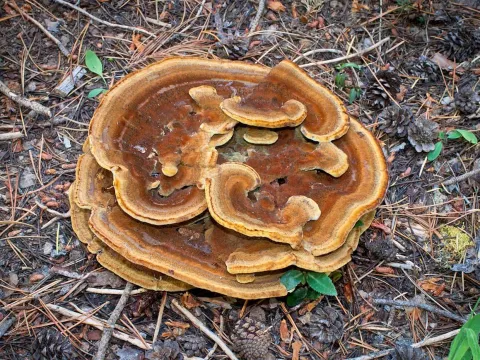
Phaeolus schweinitzii
Phaeolus schweinitzii
Phaeolus schweinitzii, commonly known as the velvet top fungus or dyer's polypore, belongs to the kingdom Fungi, division Basidiomycota, and class Agaricomycetes. It is a major pathogen responsible for brown cubical rot in the roots and butt of conifer trees.
What the section contains
Phaeolus schweinitzii
The fruit bodies are typically annual, appearing at the base of infected trees or on roots. They are sessile or short-stalked, featuring a velvety, rusty-brown cap with a yellowish margin when young.
The tissue of the fruit body is soft and spongy initially, but as it matures and dries, it becomes brittle. It possesses a distinct, somewhat resinous or pine-like odor that is useful for field identification.
The fungus primarily attacks the heartwood of the roots and the base of the trunk. It degrades cellulose and lignin, leading to the characteristic cubical structure of the decayed wood, which crumbles into powder.
Dissemination occurs via basidiospores released from the underside of the fruit bodies. These spores are carried by wind to fresh wounds on roots or the lower stems of susceptible host trees.
Phaeolus schweinitzii mainly infects coniferous species such as pine, spruce, Douglas fir, and larch. It is considered a significant economic pest in both commercial forestry and ornamental arboriculture.
The decay weakens the root system, causing the tree to lose its stability. This often results in windthrow, where trees are toppled over by moderate winds because their main anchor roots have rotted away.
In forest stands, the fungus spreads through root contacts, creating expanding infection centers. This can lead to significant volume losses and the degradation of timber quality in affected areas.
Infected trees often exhibit a decline in growth, yellowing foliage, and crown thinning. The tree may survive for several years while the rot progresses upward from the root crown into the stem.
The fungus is particularly destructive in old-growth stands where cumulative root damage and environmental stressors make trees more susceptible to pathogen colonization.
The most reliable sign of infection is the presence of annual fruit bodies near the tree base in late summer or autumn. These structures often emerge directly from the soil above infected roots.
Crown symptoms include a gradual thinning of the needles, premature senescence, and overall poor vigor. Such symptoms are often visible long before the tree actually falls.
Resinosis, or excessive sap flow at the base of the stem, is a common indicator that the tree is attempting to compartmentalize a site of infection.
Wood decay analysis reveals a reddish-brown, cubical rot pattern. In late stages, white mycelial mats can often be found within the crevices of the decaying wood.
On windthrown trees, the roots will show a brittle, dark brown consistency, often with missing sections of root tissue, confirming the presence of the root rot pathogen.
Sanitation is the primary control strategy. Infected trees should be removed promptly, including the extraction of major stumps and root systems to reduce the local spore load and contact transmission.
Preventing mechanical injuries during forest thinning or construction activities is crucial, as spores require a point of entry to establish a new infection on a healthy host.
Maintaining soil health and preventing soil compaction around the root zone helps trees maintain natural defenses. Healthy, well-nourished trees are more resilient to the initial stages of infection.
Biological control using beneficial fungi has shown some success in experimental settings by competing with P. schweinitzii for space and nutrients in the soil environment.
Strategic silviculture, such as planting mixed species or avoiding long-term monocultures, can slow the rate of spread and mitigate the impact of this pathogen within vulnerable forest sites.