
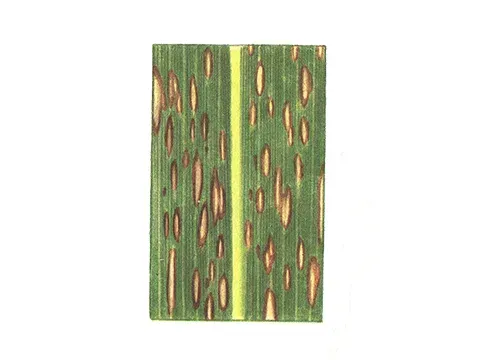
Northern corn leaf blight
Drechslera turcica
Northern corn leaf blight (NCLB), caused by the fungus Drechslera turcica (synonym Exserohilum turcicum), is one of the most significant foliar diseases of corn worldwide. It belongs to the Ascomycota division and is a serious threat to maize productivity in temperate and humid regions.
What the section contains
Northern corn leaf blight
The fungus overwinters as mycelium and conidia in infected crop residues left on the soil surface. Under favorable conditions, particularly high humidity and moderate temperatures, these spores are released and disseminated by wind and splashing rain to the lower leaves of the developing corn plants.
Upon landing on a susceptible leaf, the spores germinate and penetrate the tissue. The fungus colonizes the leaf tissue by secreting enzymes that degrade cell walls, which leads to the formation of the characteristic necrotic lesions associated with the disease.
The life cycle of Drechslera turcica can be completed within a few weeks under optimal conditions. This allows the pathogen to produce multiple cycles of secondary inoculum throughout the growing season, potentially leading to rapid disease development and widespread field infection.
Taxonomically, it is recognized as a necrotrophic pathogen. Its ability to survive on organic matter ensures that the primary inoculum is usually present in fields that have been continuously cropped with maize, making rotation a vital management component.
The disease primarily affects corn, but it can also infect sorghum and certain wild grasses. In susceptible hybrids, the infection can spread from the lower leaves to the upper canopy, severely reducing the photosynthetic capacity of the plant during the critical grain-fill stages.
Yield losses are directly proportional to the amount of leaf area destroyed by the blight. Significant premature defoliation disrupts the transport of sugars to the ear, resulting in reduced kernel weight, poor ear fill, and overall lower grain quality.
Besides direct yield loss, NCLB-infected plants are prone to structural weakness. The loss of leaf function often leads to increased susceptibility to stalk rots and lodging, which can cause heavy losses during harvest if ears drop or stalks break before the combine reaches them.
Grain quality is a major concern as infected plants may produce chaffy, light-weight kernels. Furthermore, the presence of the pathogen creates an entry point for other ear rot fungi, which can introduce harmful mycotoxins into the grain, rendering it unsuitable for feed or food processing.
In high-yield environments, the economic damage caused by a severe NCLB outbreak can be substantial, often requiring expensive chemical interventions. Preventing early-season infection is essential to maintain the profitability of the corn crop.
Symptoms typically appear from mid-summer onwards, once the canopy has closed and the microclimate within the field becomes more humid and stagnant. The disease is most prevalent in areas with prolonged periods of leaf wetness and moderate temperatures.
Epidemics are triggered by persistent rainy weather, heavy dews, or foggy conditions. If these conditions coincide with the tasseling and silking phases of corn, the impact on grain yield is maximized because the plant requires full functional leaf area to support ear development.
Towards the end of the season, as temperatures drop, the fungus shifts its reproductive strategy to prepare for overwintering. It continues to produce conidia on the senescing leaf tissues, which then fall to the ground with the crop debris.
Monitoring should be intensive during the vegetative growth stages leading up to silking. An agronomist must examine the lower leaves to identify early signs of infection, which serves as a warning for potential later outbreaks if conditions remain conducive for the pathogen.
The survival of the fungus in soil residues means that fields with a history of NCLB are at higher risk every season. Crop rotation is the most effective way to break this seasonal cycle and reduce the volume of the initial inoculum load in the field.
The most distinctive symptom of NCLB is the development of long, elliptical or "cigar-shaped" lesions on the leaves. These spots start as small, pale-green flecks that elongate into tan or grey necrotic lesions as they mature.
Under humid conditions, the centers of these lesions become covered with a dusty, dark-olive to black layer of fungal spores. This sporulation is the diagnostic feature of Drechslera turcica and distinguishes it from other foliar blights, such as bacterial wilt or common rust.
If the infection is severe, the lesions merge, covering most of the leaf surface. This gives the entire field a scorched or blighted appearance, as the leaf tissues die, curl, and turn brittle. The progression usually starts from the ground level and moves upwards.
While leaf damage is the primary sign, in highly susceptible varieties, the disease can also manifest as lesions on the husk leaves of the ear. This can lead to kernel infection or colonization of the ear by the pathogen, which is a major quality issue.
- Cigar-shaped necrotic lesions on leaves.
- Dark-olive spore clusters visible in the lesion centers.
- Rapid progression of leaf necrosis from lower to upper foliage.
- Overall scorched appearance of the plant canopy.
The primary control method is the deployment of resistant corn hybrids. Modern hybrids are often bred with specific resistance genes that provide robust protection against Northern corn leaf blight, significantly lowering the risk of economic damage.
Cultural practices, such as deep tillage to bury crop residues, are effective in reducing the amount of overwintering inoculum. Crop rotation with non-host species, such as soybeans or wheat, is highly recommended to starve the fungus of its host material.
Fungicide applications are recommended when the disease threshold is reached, especially in high-yield potential fields. Products containing triazoles or strobilurins are effective at protecting the flag leaf and upper canopy when applied at the appropriate growth stage.
Balanced soil fertility is crucial. Adequate potassium levels help strengthen cell walls, making them more resistant to fungal penetration. Conversely, excessive nitrogen can create overly lush, dense canopies that trap moisture and favor disease development.
Managing plant density is also a form of control. Proper spacing ensures better air circulation throughout the crop, allowing leaves to dry out faster after dew or rainfall, which creates a less favorable environment for the pathogen to germinate and infect the plant.