
Cytospora canker
Cytospora cincta
Cytospora canker is caused by the fungus Cytospora cincta, a member of the ascomycete group. It acts as a facultative parasite, primarily attacking the bark and cambium of stone fruit trees, leading to tissue necrosis.
What the section contains
Cytospora canker
The pathogen survives within the infected bark as mycelium and pycnidia during dormant periods. Under humid conditions, conidia are released and dispersed by wind, rain, and insects to healthy plant tissues.
The fungus enters the tree exclusively through mechanical wounds, including pruning cuts, winter sunscald, or frost cracks. Healthy trees with intact bark are resistant to the invasion of this pathogen.
Development is characterized by the formation of pycnidia, which produce spores that spread the infection throughout the orchard. Weakened trees, particularly those suffering from poor environmental conditions, are the most susceptible.
The fungus quickly colonizes dead or stressed bark tissues, gradually spreading its mycelium deeper into healthy parts of the plant, which eventually leads to the death of the affected tree limb.
The disease affects a wide range of stone fruits, including peaches, apricots, cherries, and plums. Older, poorly maintained orchards are especially vulnerable to severe outbreaks.
Infection results in the destruction of bark tissues, disrupting nutrient and water transport within the tree. This leads to the characteristic dieback of branches and, in severe cases, the entire tree.
The productivity of infected trees declines rapidly. As the infection progresses, fruit yield drops significantly, and the tree becomes a constant reservoir of spores for the entire orchard.
Cytospora cankers create entry points for secondary pests, such as bark beetles, which accelerate the tree's decline and ultimate mortality. The loss of limbs reduces the tree's structural integrity.
The disease significantly shortens the lifespan of stone fruit trees, leading to economic losses due to the need for premature tree removal and replacement.
Early signs include sunken, brownish-red lesions on the bark. These areas become firm and dry as the infection progresses, though they do not always peel away immediately.
Gummosis, or the oozing of sap from the bark, is a common defensive reaction of the tree against the invading fungus, often appearing as amber or dark sticky drops.
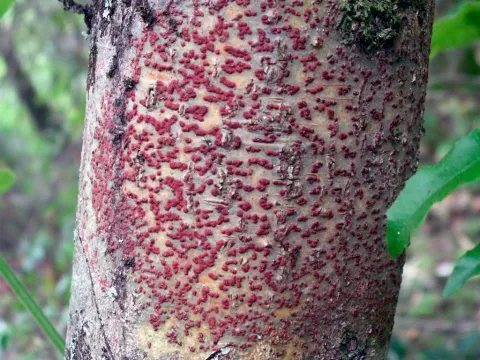
Small, pinhead-sized pimples—the pycnidia—appear on the surface of dead bark. In wet weather, these produce yellow or orange tendrils of spores that are easily visible upon close inspection.
Leaves on infected branches turn yellow, wither, and curl, yet they often remain attached to the dead branch for extended periods, giving the tree a scorched appearance.
A cross-section of an infected branch reveals necrotic, dark-colored wood underneath the bark, which is often sharply delineated from healthy tissue by a distinct border.
The primary control strategy involves rigorous sanitation. Infected branches must be pruned well below the site of the canker, and all tools must be disinfected to prevent the spread of spores.
All pruning wounds and large cuts must be sealed with wound paint or natural-oil-based paints to prevent the pathogen from entering the exposed wood.
Applying copper-based fungicides in the early spring, before bud break, helps reduce the fungal spore population and protects the tree from initial infections.
Maintaining tree vigor through proper irrigation and balanced fertilization is crucial for building natural resistance against the fungus and helping the tree heal from minor injuries.
- Regular whitewashing of trunks to prevent sunscald and frost damage.
- Protection of the bark from mechanical injury and rodent feeding.
- Immediate removal and burning of all dead or heavily infected branches.