
Chili veinal mottle virus
Chili veinal
Description
How to identify
The Chili veinal mottle virus (ChiVMV) belongs to the Potyvirus genus within the Potyviridae family. It is a highly significant RNA-based phytopathogen affecting a wide range of Solanaceous crops.
Systematically, the virus is classified as an obligate parasite. It cannot exist outside the host plant cells, relying entirely on the host's cellular machinery to replicate its viral particles and spread throughout the vascular system.
The primary transmission route in field conditions is non-mechanical, facilitated by specific insect vectors. Aphids are the most common carriers, transmitting the virus from infected to healthy plants during their feeding process.
The virus can overwinter in wild Solanaceous weeds, which serve as reservoirs of infection during the off-season. Mechanical transmission via contaminated tools is also possible but generally plays a secondary role in disease spread.
Genetic diversity within ChiVMV populations varies by geographic region, which complicates the development of resistant pepper varieties and necessitates a robust, integrated approach to phytosanitary monitoring.
What it damages
This phytopathogen primarily targets bell peppers and chili peppers, causing significant damage to the commercial quality of the produce. It can also infect tomatoes, eggplants, and certain tobacco species, resulting in systemic infection.
The economic impact of the virus is manifested in substantial yield losses. Plants infected early in the growth cycle often fail to set fruit or exhibit severe stunting, rendering them economically non-viable for farmers.
Fruits harvested from infected plants suffer from reduced commercial quality, often becoming deformed, undersized, and exhibiting uneven discoloration. Taste and nutritional profiles may also be negatively affected due to disrupted metabolic functions.
In seedlings, infection leads to poor transplant survival rates. Furthermore, infected plants show increased susceptibility to secondary fungal and bacterial pathogens due to an overall weakened immune system.
The scale of loss is largely determined by the plant's growth stage at the time of infection and the population density of aphids in the field. During peak outbreaks, yield losses can reach 50–80%, severely impacting farm profitability.
When it appears
The active spread phase of the virus aligns with the peak population activity of insect vectors. In temperate climates, this typically occurs from early summer to autumn, when aphid populations reach their seasonal maximum.
The initial source of infection in the spring comes from overwintered weeds or perennial plants that supported aphid populations during winter. Early detection of infection hotspots is critical to prevent a widespread epidemic.
Environmental conditions such as warm, dry weather promote rapid aphid reproduction, which directly correlates with an increased incidence of Chili veinal mottle virus on pepper plantations.
The lack of crop rotation and continuous cultivation of Solanaceous crops on the same land for several years promotes the development of epizootics by maintaining a persistent pool of infection in the soil and surrounding habitat.
Toward the end of the season, virus transmission intensity may decline as insect activity drops, although plants that have already been infected will continue to display symptoms until the plant dies.
Signs of infestation
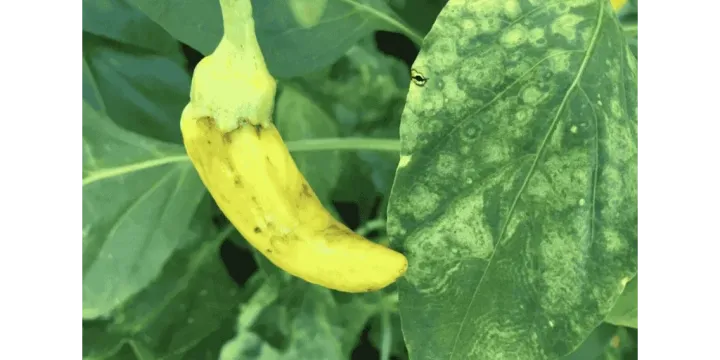
The primary diagnostic sign is the characteristic darkening of veins on leaves, which gives the virus its name. The leaf surface often displays mottled, mosaic-like patterns.
Common external symptoms include:
- severe leaf deformation and curling;
- stunting (dwarfism) of the entire plant;
- chlorotic spots and strips along the main veins;
- shortening of internodes;
- spotting and necrotic lesions on fruit surfaces.
Unlike fungal infections, the virus does not produce spores or mycelium; however, systemic vascular damage leads to premature yellowing and leaf drop, usually beginning in the lower foliage.
In some cases, symptoms may remain latent, especially under optimal lighting and nutrient conditions, even though the virus continues to replicate within the tissues and reduce yield potential.
For definitive diagnosis and differentiation from other potyviruses or herbicide damage, laboratory confirmation using ELISA (enzyme-linked immunosorbent assay) or PCR-based diagnostic methods is necessary.
Control measures
Effective management is based on integrated pest management (IPM) focusing on insect vector control. The application of systemic insecticides to manage aphid populations is a mandatory component of pepper crop protection.
Agronomic practices include strict weed control both within the plot and in surrounding areas, as these wild hosts serve as natural reservoirs for the virus and breeding grounds for insect vectors.
Utilizing resistant or tolerant pepper hybrids is the most reliable strategy for preventing yield loss. Breeding programs are actively focused on developing resistance for regions with high infectious pressure.
Spatial isolation of pepper fields from other Solanaceous crops, particularly tomatoes and potatoes, significantly reduces the risk of cross-infection and the spread of the virus through aphid migration.
Strict hygiene protocols during cultivation are essential: disinfecting tools, washing hands after handling suspicious plants, and the immediate rogueing (removal) of infected plants at the first sign of symptoms.
Causes diseases · 1
Discussion
No discussions yet — be the first.