
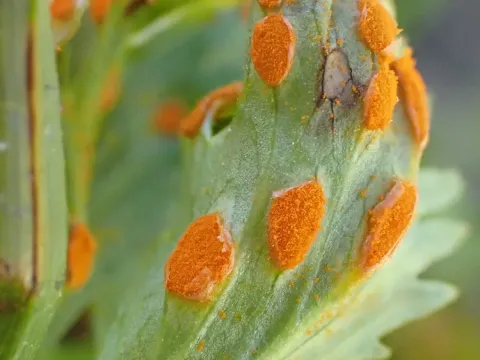
Calyptospora columnaris
Calyptospora columnaris
Calyptospora columnaris is a highly specialized fungal pathogen belonging to the order Pucciniales (Rust fungi). It is an obligate parasite, meaning it requires living host tissue to complete its biological life cycle.
What the section contains
Calyptospora columnaris
This pathogen is characterized by a heterecious life cycle, which involves two taxonomically unrelated hosts. The completion of its development depends on the presence of both fir trees (Abies spp.) and specific Vaccinium species.
From a taxonomic perspective, it is a member of the Pucciniastraceae family. Its microscopic identification relies on the morphology of aecia and urediniospores, which are distinct enough to be classified by plant pathologists.
The fungus is structurally adapted for wind dispersal, which allows it to travel across vast distances in agricultural landscapes. Its complex developmental stages represent an evolutionary strategy for survival in diverse environments.
Understanding the biology of Calyptospora columnaris is essential for accurate diagnostics. Field observations must often include checks of nearby fir tree plantings to confirm the source of primary inoculum.
On fir trees, the pathogen causes the development of aecia on needles, leading to chlorosis and subsequent needle shed. While rarely fatal to large trees, it significantly impairs their physiological vigor.
The primary economic impact occurs on cultivated blueberries (Vaccinium corymbosum). Infection by this fungus manifests as blueberry rust, a disease that attacks leaves, stems, and sometimes berries, causing severe physiological stress.
The fungus disrupts photosynthesis, which is critical for fruit development and sugar accumulation. As a result, infected plants produce lower quality berries, leading to direct revenue losses for farmers.
In addition to yield reduction, the disease weakens the overall plant structure. Affected bushes are less capable of surviving harsh winter conditions, leading to increased mortality rates and the need for frequent replanting.
The cumulative damage often forces producers to implement expensive fungicide programs, increasing the cost of production and reducing the net profitability of the blueberry enterprise.
The infection cycle typically begins in early spring, when spores from fir needles are dispersed by wind onto emerging blueberry leaves. High humidity and moderate temperatures are the most critical factors for initial infection.
During the summer months, secondary infection cycles occur. If weather conditions remain humid and cool, the fungus can spread rapidly throughout the plantation, resulting in significant foliage damage.
As the season approaches autumn, the fungus transitions to its teliospore stage. This stage is designed for overwintering, ensuring the survival of the pathogen until the next growing season starts.
Environmental conditions play a decisive role in disease outbreaks. Prolonged rainy periods and fog are considered primary triggers, while hot and dry weather acts as a natural limiting factor for fungal growth.
Synchronicity between the hosts' phenological stages and the fungus's spore production cycle is vital for the severity of the disease in any given year. A failure in this synchronization usually results in a low-intensity year for the infection.
Initial symptoms on blueberry foliage are small, bright yellow or orange spots on the undersides of the leaves. These spots are the sites where the fungus produces its asexual spores, which spread the disease.
- Development of orange-colored powdery pustules on leaves.
- Premature yellowing and defoliation of infected blueberry bushes.
- Twisting and distortion of young, actively growing shoots.
- Lower berry sugar content and poor quality at harvest.
- White columnar aecia appearing on the needles of nearby fir trees.
The appearance of white column-like structures on fir needles is a diagnostic hallmark of this pathogen. When found near blueberry fields, this is a clear indication that a disease outbreak is likely to follow.
Early detection is crucial for managing the rust. Scouting for the first signs of pustules on the leaf underside allows for timely intervention before the disease becomes widespread within the field.
Once the characteristic orange color is observed, it confirms the presence of an active rust infection. Rapid identification is the key to minimizing the spread through the entire crop canopy.
The most effective strategy is the physical separation of blueberry fields from fir tree plantations. Avoiding the presence of the alternate host is the primary biological method of prevention.
Sanitation practices are essential, including the removal and disposal of infected plant material. Autumn cleanups and the destruction of fallen leaves help to significantly reduce the primary inoculum for the next year.
Chemical control involving fungicides is often necessary in commercial production. Preventive sprays, especially those using systemic compounds, are effective when applied at the first signs of the season's infection risk.
Maintaining optimal airflow within the canopy through proper pruning is a vital cultural practice. Dry conditions around the foliage are less conducive to spore germination and fungal invasion.
Balanced plant nutrition ensures that blueberry bushes remain vigorous and capable of mounting a defense against the pathogen. A healthy, well-managed crop is always more resilient to fungal attacks than a stressed one.