
Cadophora gregata
Cadophora gregata
Cadophora gregata is a pathogenic fungus belonging to the kingdom Fungi and the phylum Ascomycota. It is the primary causal agent of brown stem rot, a major disease affecting soybean crops worldwide.
What the section contains
Cadophora gregata
This pathogen functions as a vascular parasite, colonizing the plant's xylem tissue. By obstructing the vascular system, it inhibits the transport of water and essential nutrients from the roots to the upper parts of the plant.
Historically identified as Phialophora gregata, the fungus is now classified under the genus Cadophora. Research has identified different pathotypes that vary in their aggressiveness toward specific soybean cultivars.
The fungus is highly resilient, capable of surviving for several years in soil and on infected crop debris in the form of dormant mycelium or thick-walled spores.
Accurate identification usually requires microscopic analysis of stem tissues, where the pathogen's characteristic structures can be observed within the discolored xylem.
Soybean is the primary host for this pathogen. Infections cause substantial yield losses, often ranging from 20% to over 50%, depending on the environmental conditions and the resistance of the soybean variety.
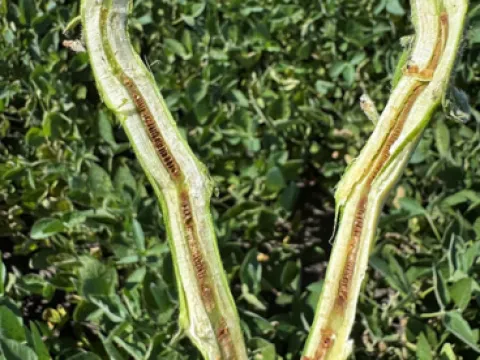
The disease initiates in the root system and progresses upward through the stem. As the infection colonizes the vascular bundles, it leads to internal browning and necrosis of the stem pith.
Infected plants exhibit premature wilting and foliar chlorosis. A hallmark symptom is the retention of dead, dried leaves on the stems, which distinguishes this disease from other wilts.
The reduction in nutrient uptake leads to smaller, poorly filled seeds, significantly degrading the quality of the harvested produce and decreasing overall seed weight.
Furthermore, the pathogen interferes with the symbiotic relationship between the plant and nitrogen-fixing bacteria, weakening the plant's nutritional capacity during the critical filling stage.
The development of the disease is most active during the soybean growing season. Visible symptoms typically manifest during the reproductive stages, specifically as the pods begin to fill.
Cool and moist environmental conditions favor the infection and spread of the pathogen. High soil moisture is particularly conducive to the movement of spores into the root zone.
Spore dissemination occurs via water splash from rain or through the movement of contaminated soil by agricultural equipment across fields throughout the season.
The fungus overwinters in crop residues left on the soil surface. Consequently, agricultural practices that leave large amounts of debris provide a ready inoculum source for subsequent seasons.
Continuous soybean cultivation leads to an increase in the pathogen population, making the disease progressively more severe with each subsequent year of monoculture.
The primary diagnostic sign is the darkening (browning) of the internal stem pith and xylem tissues, which is most prominent in the lower sections of the plant.
Foliar symptoms appear as yellowing between the leaf veins (interveinal chlorosis), which eventually turns brown and necrotic, while the leaves remain attached to the plant.
In severe infections, the internodes of the stem may be shortened, resulting in stunted overall plant growth compared to healthy neighboring plants.
The root system may appear superficially normal, but the internal vascular discoloration confirms the presence of the pathogen within the plant's structural tissues.
- Internal browning of stem pith and xylem.
- Interveinal yellowing and eventual browning of leaves.
- Retention of dead leaves on the stems.
- Reduced pod number and seed size.
The most effective management strategy involves the use of resistant soybean cultivars, which can significantly mitigate the impact of the disease on yield.
Implementing a crop rotation program with non-host species for a period of at least 3 to 4 years is essential to reduce the inoculum level in the soil.
Good agricultural practices, such as the incorporation of crop residues into the soil, accelerate the decomposition of infected matter and reduce fungal survival.
Seed treatment with systemic fungicides can provide early-season protection, helping young seedlings resist initial infection as they emerge from the soil.
Sanitation of farm equipment is vital, as the pathogen can be easily transported between fields in infested soil particles, leading to the establishment of new infection sites.