
Xanthomonas vesicatoria
Xanthomonas vesicatoria
Description
How to identify
Xanthomonas vesicatoria is a Gram-negative aerobic bacterium belonging to the kingdom Bacteria and the genus Xanthomonas. It is a highly specialized phytopathogen responsible for bacterial spot disease in solanaceous crops.
The pathogen consists of rod-shaped cells equipped with a single polar flagellum, allowing for motility within water droplets. It does not form spores, making it vulnerable to desiccation and direct sunlight exposure.
In the natural environment, the bacterium survives in infected plant debris, seeds, and on solanaceous weeds. It can persist in the soil for significant periods if protected by residual plant tissues.
The organism thrives under warm and humid conditions, entering plant tissues through stomata or mechanical wounds. Once inside, the bacteria colonize the intercellular spaces, leading to localized tissue necrosis.
Laboratory identification of the pathogen involves culturing on selective media, where it produces a characteristic yellow pigment known as xanthomonadin, which serves as a key diagnostic feature.
What it damages
The primary hosts for this pathogen are tomatoes and bell peppers. The disease affects all aerial parts of the plants, including leaves, stems, petioles, and developing fruits.
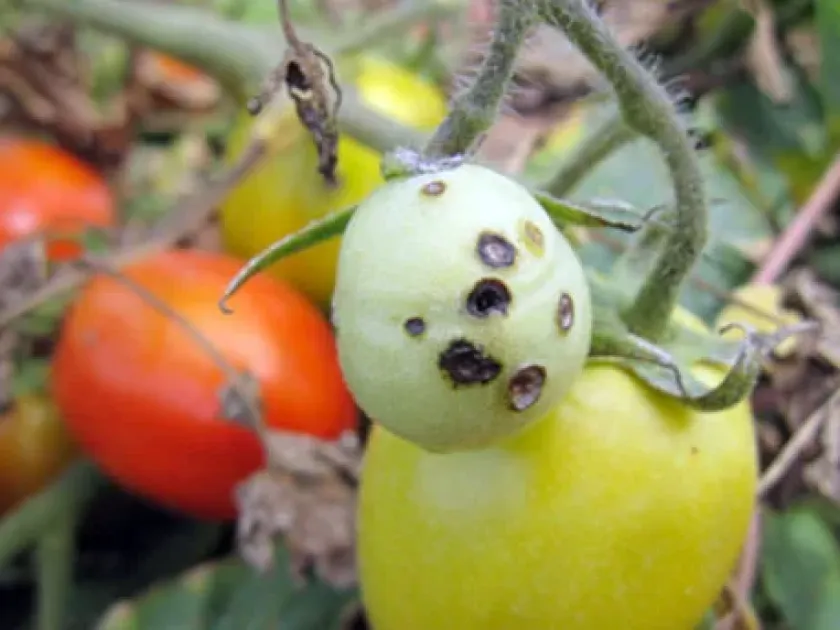
On fruits, the infection presents as raised, water-soaked spots that eventually develop into rough, scabby lesions. This damage renders the fruits commercially unmarketable.
On the leaves, the infection manifests as numerous small spots that may coalesce, leading to extensive leaf yellowing, wilting, and premature abscission. This significantly reduces the photosynthetic area of the plant.
Stem infections are less common but can result in the formation of ulcers, which may lead to stem twisting or structural weakness in high-humidity environments.
Economic losses arise not only from direct fruit damage but also from reduced plant vigor and total yield loss due to early senescence of the foliage.
##season##The infection develops most rapidly when ambient temperatures range between +24°C and +30°C. These temperatures are optimal for the proliferation of the bacterial population.
High relative humidity (above 80%) and the presence of free moisture (dew or rain) on the leaf surface are critical factors for the rapid spread of the disease within agricultural fields.
Field outbreaks are most frequent during mid-summer, especially during periods of heavy rainfall. In greenhouse conditions, the disease can occur year-round if microclimate management is inadequate.
The bacteria are disseminated through rain splashing, overhead irrigation systems, and direct physical contact between plants or the use of non-disinfected pruning tools.
Insect pests can also act as mechanical vectors, transporting the bacteria from infected plants to healthy ones while feeding or moving across plant surfaces.
Signs of infestation
The initial signs appear as small, translucent, water-soaked spots on the underside of the leaves. Over time, these spots darken, turning brown or black.
A yellow halo of chlorotic tissue often surrounds the lesions. In severe cases, the foliage curls, dries out, and falls off prematurely.
- Appearance of black, raised scabby spots on fruit surfaces.
- Water-soaked, dark lesions on stems and petioles.
- Flower necrosis leading to poor fruit set.
- Premature yellowing and leaf drop.
- Reduction in quality and marketability of the produce.
Unlike fungal pathogens, bacterial spot does not produce visible mycelial or spore growth on the lesions, which is a key factor for field diagnosis.
Control measures
The foundation of effective management is the use of high-quality, certified, disease-free seed. Seed treatment with appropriate chemical or biological agents is essential before planting.
Crop rotation is critical to prevent the accumulation of the pathogen in the soil. It is recommended not to plant solanaceous crops on the same field for at least 3–4 years.
Sanitation is vital; all infected plant debris must be removed or destroyed after harvest to eliminate the primary overwintering sites. Deep plowing helps speed up the decomposition of infected residues.
During the growing season, preventive sprays with copper-based bactericides are effective in suppressing bacterial growth and protecting the leaf surface from new infections.
In greenhouses, strict control of humidity through proper ventilation and the use of drip irrigation—to avoid wetting the foliage—significantly reduces the risk of disease spread.
Discussion
No discussions yet — be the first.