
Downy mildew of hemp
Pseudoperonospora cannabina
Description
How to identify
The causative agent of the disease is the oomycete Pseudoperonospora cannabina, which is a highly specialized pathogen infecting only Cannabis sativa plants.
This pathogen belongs to the Peronosporaceae family and operates by colonizing the intercellular spaces of the host plant tissue.
The organism survives in the soil and on crop debris as thick-walled oospores, which can withstand cold winters and unfavorable conditions.
Under favorable humidity, oospores germinate to produce sporangia, initiating the primary infection cycle of the crop.
Secondary infections occur through the rapid production and wind-dispersal of zoosporangia, facilitating widespread field contamination.
What it damages
Downy mildew significantly impacts the photosynthetic capacity of hemp plants, leading to reduced overall vigor and stunt growth.
Heavy infections result in extensive leaf necrosis and premature leaf drop, which drastically reduces the yield of fiber and biomass.
The disease can adversely affect the quality of cannabinoids and terpenes in industrial hemp varieties intended for medicinal purposes.
In cases of severe outbreak, the integrity of the plant structure is compromised, making it susceptible to secondary pathogens and mechanical damage.
Economic losses can be substantial, particularly in high-density plantings where the disease cycle completes rapidly.
When it appears
The disease typically emerges during periods of high humidity, frequent rainfall, and moderate temperatures during the growing season.
The pathogen thrives when night temperatures are mild and dew persists on leaves, allowing for zoospore mobility and infection.
Dense canopy development often traps moisture, creating an ideal microclimate for the development of Pseudoperonospora cannabina.
Outbreaks are most common during the rapid vegetative growth phase when the plant is most vulnerable to systemic infection.
Prolonged wet weather in late spring or early summer is the primary trigger for the first appearance of downy mildew symptoms in the field.
Signs of infestation
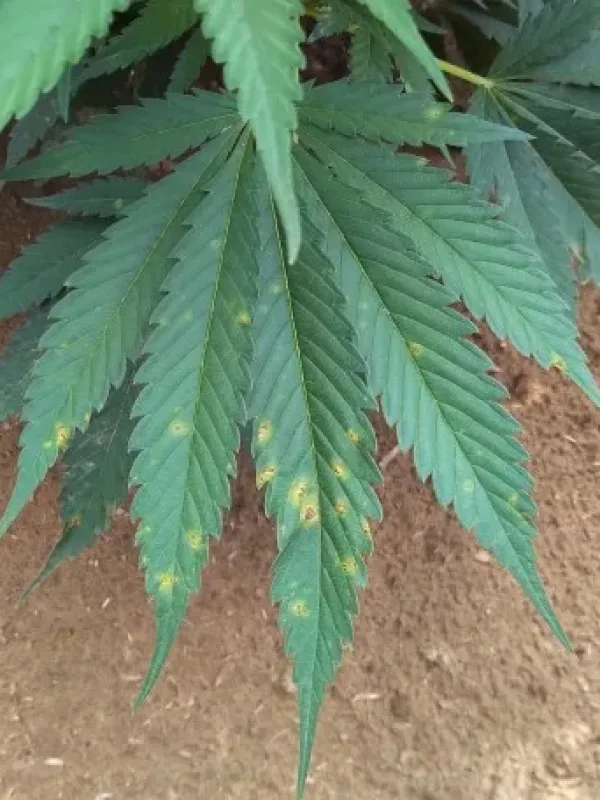
Initial symptoms include the appearance of pale green or yellowish chlorotic spots on the upper leaf surface, restricted by leaf veins.
A fine, greyish or purplish mildew-like growth appears on the underside of the leaves, corresponding to the location of the chlorotic spots.
As the infection progresses, the spots turn necrotic, becoming brown and brittle, eventually leading to leaf desiccation.
Severe infection often causes leaf curling, yellowing of the foliage, and eventual defoliation starting from the bottom of the plant.
- Yellowish angular leaf spots on the upper surface.
- Greyish fuzzy growth on the underside of leaves.
- Browning and necrosis of infected leaf tissue.
- Premature leaf shed and stunted growth.
- Deformation and curling of leaves.
Control measures
Crop rotation is the most effective cultural practice, avoiding hemp cultivation on the same land for at least three to four years.
Ensuring adequate plant spacing to promote airflow and faster leaf drying is critical to minimizing infection risks.
Removal and destruction of crop residues immediately after harvest help eliminate the primary inoculum source for the next season.
Preventive application of copper-based fungicides or other targeted oomycete-active treatments can protect plants during high-risk weather windows.
Selection of resistant or less susceptible cultivars is a key component in integrated pest management (IPM) for hemp production.
Causes diseases · 1
Discussion
No discussions yet — be the first.