
Downy mildew of sunflower
Plasmopara halstedii
Description
How to identify
The causative agent of the disease is Plasmopara halstedii, an oomycete belonging to the Chromista kingdom. It functions as an obligate parasite specifically targeting sunflowers and other Asteraceae members.
The pathogen survives in the soil primarily as oospores, which are extremely resistant to environmental stress and can remain viable for many years, acting as the main source of primary infection.
The life cycle involves the production of zoospores that require moist soil conditions to travel and infect the roots of young seedlings, establishing a systemic infection within the host plant.
The mycelium grows throughout the internal tissues of the sunflower, reaching the growing point and ensuring the plant remains infected for its entire life cycle, causing chronic physiological distress.
Asexual reproduction occurs via sporangiophores and sporangia produced on the underside of leaves, which are disseminated by wind or rain splash, facilitating secondary infections across the field.
What it damages
Downy mildew causes severe growth retardation, often leading to dwarfism where plants remain stunted with shortened internodes compared to healthy counterparts.
Systemic infection negatively impacts the development of the root system, causing the plants to become susceptible to lodging and environmental stressors like drought.
The disease frequently leads to complete failure in seed head formation. If a head does form, it is typically very small, deformed, and held in an upright position rather than drooping.
Productivity losses can be catastrophic, with some fields experiencing up to 80% yield reduction if conditions favor rapid disease spread during the critical germination phase.
Seed quality is significantly degraded, resulting in lower oil content and reduced viability, which makes infected material unsuitable for future planting seasons.
Signs of infestation
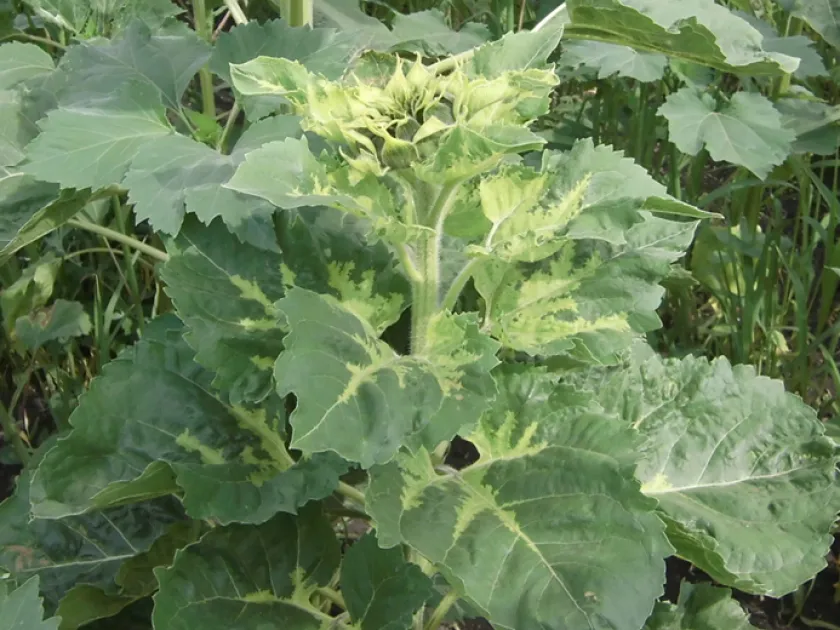
Initial symptoms are characterized by chlorotic patches on the cotyledons and early true leaves, which gradually spread along the leaf veins creating a marbled or mosaic appearance.
The most diagnostic feature is the presence of a dense, white, fuzzy growth on the underside of the leaves, visible during periods of high humidity or early morning dew.
Infected plants display distinct dwarfism and reduced vigor compared to healthy sunflowers, making them stand out in the crop canopy as stunted, yellowish individuals.
Necrotic spots may eventually develop as the tissues die, leading to leaf distortion and curling as the pathogen continues to sap nutrients from the host plant.
- Stunted growth and short internodes.
- White downy growth on the underside of leaves.
- Deformed, upright seed heads.
- Yellowing of leaf tissue between veins.
- Premature wilting and necrosis.
Control measures
The primary defense strategy is the use of resistant sunflower hybrids. Breeding programs continuously monitor local races of the pathogen to introduce effective resistance genes.
Seed treatment with systemic fungicides is a crucial practice. These chemical barriers protect the emerging roots from soil-borne inoculum during the most vulnerable seedling stage.
Implementing a long-term crop rotation strategy is essential to break the pathogen's life cycle and prevent the excessive buildup of oospores in the soil profile.
Field sanitation is critical; this includes the immediate removal and destruction of sunflower volunteers and weeds that could host the pathogen during the off-season.
Optimal field drainage and the avoidance of over-irrigation are important cultural practices that reduce the moisture levels required for oospore germination and secondary spread.
Causes diseases · 1
Discussion
No discussions yet — be the first.