
Late blight
Phytophthora taxon
Description
How to identify
Late blight is caused by the oomycete Phytophthora infestans, a pathogen that thrives in moist and cool environments and poses a massive threat to agriculture.
The organism reproduces through sporangia which can germinate directly or produce motile zoospores, allowing the pathogen to swim in films of water.
It belongs to the class Oomycota; although it behaves like a fungus, it is genetically distinct and requires specific management strategies for control.
The pathogen maintains its presence through asexual reproduction during the growing season and can produce oospores for long-term survival in the soil.
Genetic diversity within the species allows it to adapt rapidly to different hosts and environments, making it one of the most challenging pathogens to manage.
What it damages
The primary hosts of late blight are plants in the Solanaceae family, including potatoes, tomatoes, peppers, and eggplants, which can be wiped out entirely.
Infection leads to rapid tissue necrosis, which destroys the plant's ability to photosynthesize and ultimately halts the development of roots and fruits.
Potato tubers affected by the pathogen show surface lesions and internal decay, making them entirely unmarketable and highly susceptible to secondary rot.
Tomato fruits are severely impacted by the development of dark, firm, necrotic spots that render them unsuitable for consumption or industrial processing.
Epidemic outbreaks can result in total yield loss within a few days if weather conditions are optimal for the pathogen's rapid colonization.
When it appears
The disease is most prevalent in mid-to-late summer, triggered by high humidity levels and moderate temperatures typically ranging from 15°C to 22°C.
Frequent rainfall and persistent dew provide the necessary surface moisture for the zoospores to mobilize and penetrate the plant tissue successfully.
The cycle from initial infection to the release of new spores can be as short as 3 to 5 days under optimal conditions, enabling a sudden explosion of disease.
Cooler nighttime temperatures combined with morning fog are particularly conducive to the spread of sporangia across large agricultural areas.
In greenhouse operations, improper ventilation and irrigation management can extend the season of susceptibility throughout the entire year.
Signs of infestation
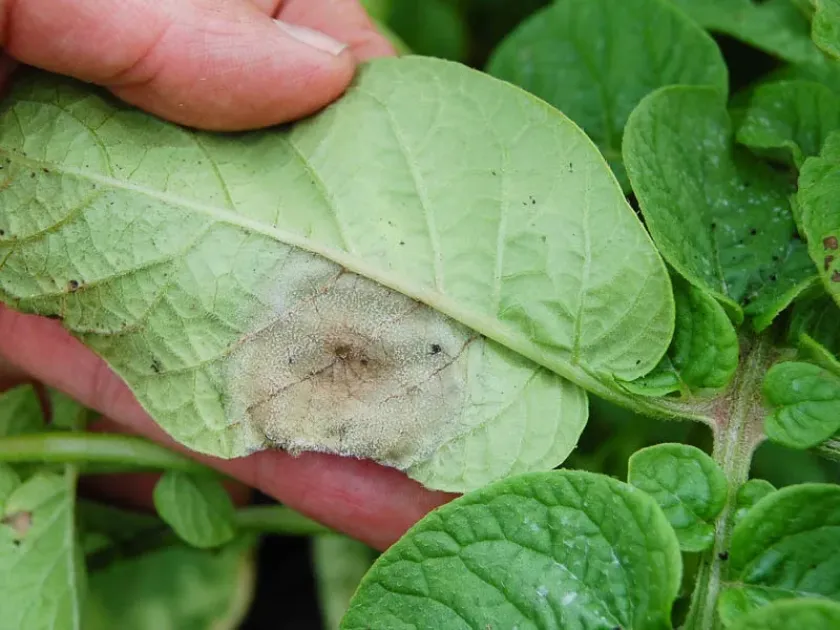
Initial symptoms are characterized by irregular, dark brown or black lesions on the leaves, which expand rapidly as the disease progresses.
A white, velvety fungal-like growth is often visible on the underside of the leaves, especially after periods of rain or heavy morning dew.
Stems become brittle and develop dark, necrotic cankers, causing the plant to collapse and wither within a remarkably short amount of time.
Infected fruits display firm, dark, irregularly shaped lesions that eventually cover the entire surface, leading to eventual softening of the tissue.
Tuber tissues exhibit a reddish-brown granular necrosis, often visible on the surface as sunken, slightly metallic-looking patches.
Control measures
Effective management requires an integrated approach starting with the use of pathogen-free, certified seed tubers and resistant cultivars.
Cultural practices such as proper plant spacing, adequate soil drainage, and the destruction of infected cull piles are critical for reducing inoculum.
Regular monitoring of weather data helps agronomists predict risk periods and schedule fungicide applications before infection actually occurs.
Chemical control must involve alternating systemic and contact fungicides to minimize the risk of the pathogen developing resistance to active ingredients.
- Selection of blight-resistant plant varieties.
- Implementation of crop rotation cycles.
- Timely removal and destruction of infected crop debris.
- Application of protective and curative fungicides.
Causes diseases · 1
Discussion
No discussions yet — be the first.