
Phytophthora root and stem rot
Phytophthora sojae
Description
How to identify
Phytophthora root and stem rot is a devastating disease caused by the soil-borne pathogen Phytophthora sojae. Biologically, this organism is an oomycete, often referred to as a water mold, which thrives in saturated soil conditions.
The pathogen persists in the soil as thick-walled oospores, which are highly resistant to environmental stress. In the presence of moisture, these oospores germinate and produce zoospores that swim through the soil water film to locate host roots.
The disease impacts all growth stages, from pre-emergence germination to mature pods. It is notorious for causing systemic infection, often leading to total stand failure in poorly drained field areas.
Accurate identification is complex due to the existence of multiple pathogenic races. Diagnosis typically involves laboratory examination of the stem and root tissues to confirm the presence of the pathogen.
Genetic resistance is the primary management tool. Breeders utilize specific Rps-genes to confer immunity against various races, though the pathogen's ability to mutate requires constant monitoring of local race populations.
What it damages
This pathogen exclusively affects soybean crops, targeting root and stem tissues. It causes significant losses in regions with heavy clay soils or areas prone to waterlogging after heavy rainfall.
The infection destroys the root system, severely restricting water and nutrient uptake. This physiological stress leads to yellowing, wilting, and eventually the total collapse of the plant during critical development stages.
Economic damage is substantial, ranging from thin plant stands and stunted growth to entire field loss. Yield reduction is directly proportional to the intensity of the infection within the field.
Beyond quantity, the quality of harvested grain is often compromised. Infected plants frequently produce smaller, shriveled seeds, which are unfit for human consumption or future seed production.
Financial impacts include the costs associated with replanting, specialized seed treatment applications, and lower overall profitability due to reduced hectarage yield.
When it appears
Infection can occur throughout the entire growing season. The most critical window is the early growth period, as seeds and seedlings are highly susceptible to pre-emergence damping-off.
The disease peaks during periods of excessive rainfall. Saturated soil conditions provide the necessary environment for the pathogen's mobile zoospores to migrate and infect soybean root hairs.
Optimal temperatures for pathogen development range from 15 to 25 degrees Celsius. These conditions often coincide with the rapid growth stages of soybean crops in temperate climates.
During dry weather, the disease pressure may subside, but the damage already inflicted on the root system is usually irreversible, leading to poor pod fill and premature plant senescence.
As the season ends, the pathogen enters a dormant state. Oospores persist in plant debris and soil, ensuring the inoculum is present for the next cycle when favorable moisture returns.
Signs of infestation
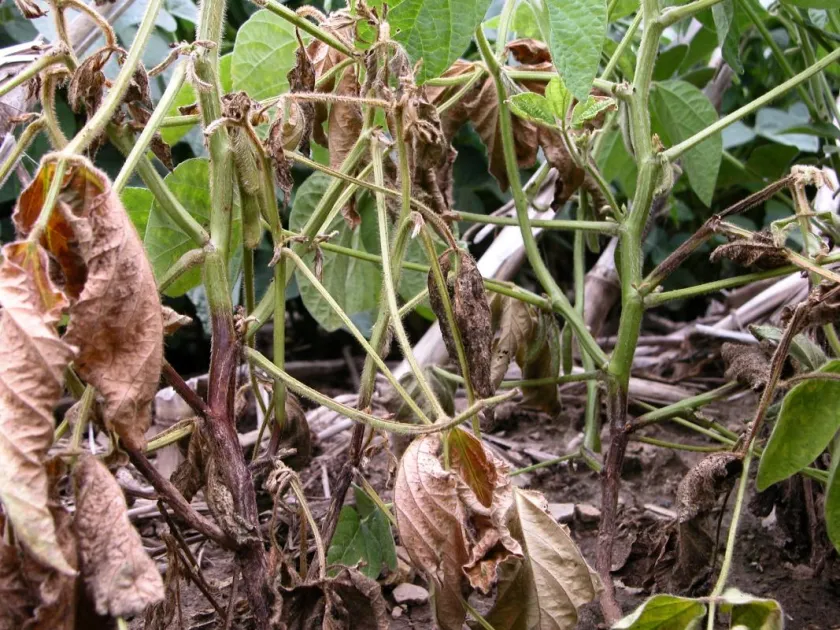
Early symptoms include brownish, water-soaked rot on seedlings, often resulting in poor emergence. Stands appear thin with visible bare patches where plants failed to establish.
In adult plants, the characteristic sign is a dark brown, necrotic lesion that extends from the soil line up the stem for several centimeters. This tissue often becomes soft and decayed.
Internal stem tissue reveals discolored vascular bundles. In highly humid conditions, a sparse, greyish fungal growth may be visible at the soil line on the affected stem.
Common field symptoms include:
- Interveinal yellowing of leaves.
- Wilting and eventual browning of foliage.
- Destruction of root system, leaving only the taproot core.
- Easy removal of diseased plants from the soil due to root decay.
Infected areas often manifest as irregular patches in the field, typically matching low-lying spots where water accumulation occurs after storms.
Control measures
The most effective strategy is the cultivation of soybean varieties with robust genetic resistance (Rps-genes). Selecting varieties adapted to local race prevalence is crucial for successful management.
Improving field drainage is a fundamental agronomical practice. Techniques like tile drainage and avoiding soil compaction minimize the duration of water saturation, limiting zoospore motility.
Seed treatments with systemic fungicides, such as metalaxyl or mefenoxam, are standard practice. These chemicals provide a protective zone around the germinating seed and early roots.
Implementing a long-term crop rotation strategy reduces inoculum pressure. Rotating soybeans with non-host crops prevents the continuous buildup of oospores in the soil over time.
Monitoring fields closely during early growth stages allows for early intervention. While chemical rescue treatments are limited, understanding the disease spread helps in future field management and variety selection decisions.
Causes diseases · 1
Discussion
No discussions yet — be the first.