
Late blight
Phytophthora infestans
Description
How to identify
The causative agent of late blight is Phytophthora infestans, an oomycete or water mold. Despite historical classification, it belongs to the kingdom Stramenopila (or Chromista).
Biologically, it is a hemi-biotrophic pathogen, meaning it initially requires living host tissue to feed, but eventually kills the host tissue to continue its life cycle.
It reproduces through sporangia, which can either release motile zoospores in wet conditions or germinate directly to infect plant cells via specialized structures called appressoria.
The pathogen is highly variable genetically, with new strains constantly emerging that can overcome host plant resistance genes, leading to severe agricultural challenges.
Microscopic examination reveals branched sporangiophores emerging from stomata, bearing lemon-shaped sporangia that are easily dispersed by wind and splashing rain.
What it damages
Late blight is notorious for causing the most devastating diseases in potato and tomato crops worldwide, historically responsible for significant crop failures.
The pathogen causes rapid necrosis of foliage, stems, and fruits. A healthy field can be reduced to black, decaying vegetation within just a few days under favorable conditions.
Tuber infection is a critical aspect of damage, where the pathogen moves from the foliage into the soil, causing brown, granular rot that renders the crop inedible.
In addition to primary tissue damage, secondary bacterial infections often colonize the weakened, dying plant parts, accelerating the decay of the entire crop.
Economic losses are massive, spanning from crop yield reduction to increased costs for pesticide applications and losses due to storage rotting of contaminated tubers.
When it appears
The disease typically initiates when environmental conditions provide prolonged periods of leaf wetness, often associated with cool temperatures and high relative humidity.
Infection cycles accelerate rapidly during moderate temperatures between 15°C and 25°C, coupled with rain or heavy dew that allows zoospores to swim toward the host.
The latent period, the time between infection and the appearance of new spores, is very short, allowing for multiple infection cycles within a single growing season.
Outbreaks often occur in mid-to-late summer, particularly following stormy weather which facilitates the long-distance spread of sporangia through wind currents.
The disease can persist in crop debris or cull piles, which serve as primary sources of inoculum at the start of the subsequent planting season.
Signs of infestation
Initial symptoms present as small, dark, water-soaked spots on the lower leaves, which expand rapidly as the disease progresses through the plant canopy.
Under humid conditions, a characteristic white, fuzzy growth appears on the underside of infected leaves, representing the sporulation of Phytophthora infestans.
Stems often show dark brown or black lesions that cause the tissue to become brittle and eventually collapse, leading to the death of the upper plant parts.
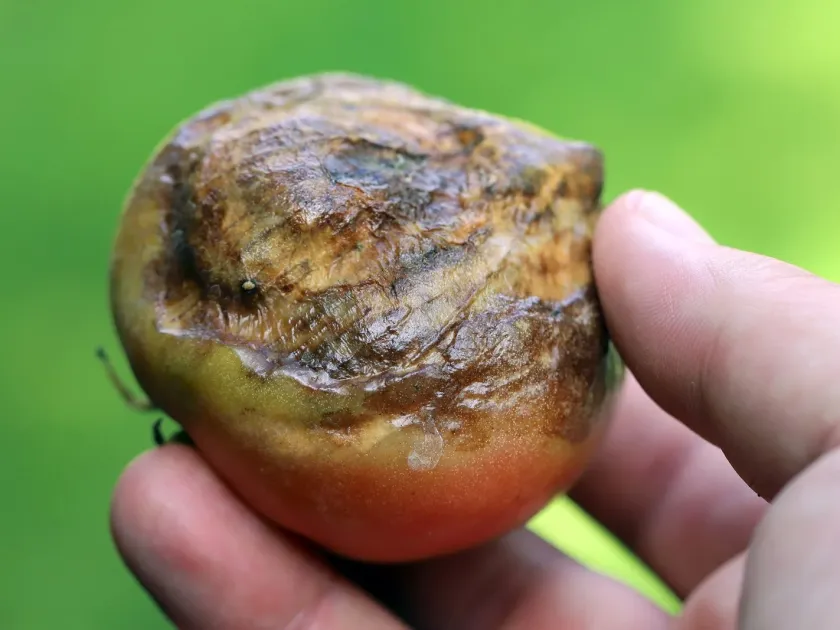
Tomato fruits develop firm, dark, irregularly shaped lesions that eventually soften and rot as the pathogen consumes the internal tissue of the fruit.
- Dark, water-soaked leaf spots.
- White mold growth on leaf undersides.
- Blackened lesions on stems.
- Firm, dark rot on tubers and fruits.
Control measures
Integrated Pest Management (IPM) is essential, starting with the use of certified, disease-free seed potatoes and resistant cultivar varieties if available.
Strategic fungicide application is the primary chemical control method. Growers must use protectant fungicides before infection occurs and systemic fungicides if disease pressure is high.
Cultural practices, such as ensuring good soil drainage and proper spacing, help reduce humidity within the crop canopy, making it less favorable for the pathogen.
Managing cull piles and destroying infected plant debris immediately after harvest reduces the amount of overwintering inoculum in the field.
Regular field scouting is critical for early detection, allowing for rapid intervention before the pathogen can cause an uncontrollable epidemic across the field.
Causes diseases · 1
Discussion
No discussions yet — be the first.