
Raspberry rust
Phragmidium rubi-idaei
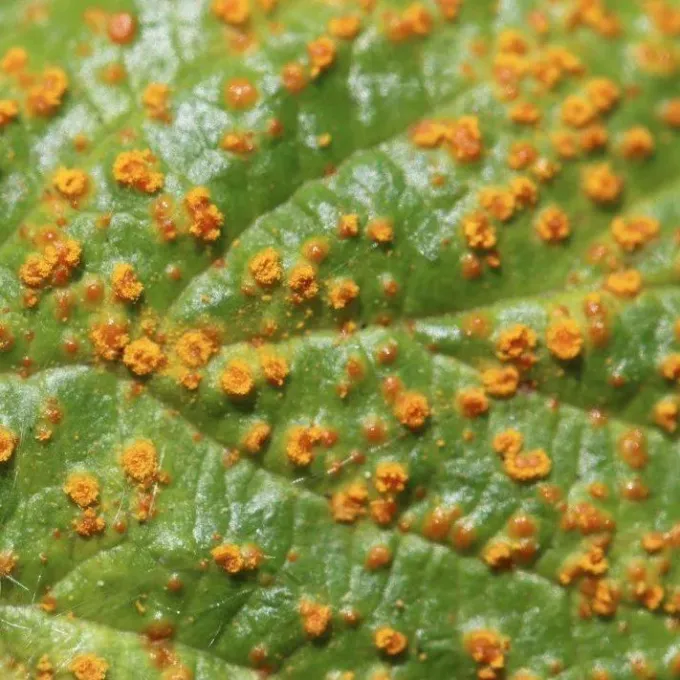
Description
How to identify
The causal agent of raspberry rust is the fungus Phragmidium rubi-idaei, classified within the phylum Basidiomycota. It is a highly specialized, obligate parasite that specifically targets plants of the Rubus genus.
The fungus completes a complex life cycle on a single host plant, producing several types of spores (aeciospores, urediniospores, and teliospores). This monocyclic nature allows it to persist and multiply effectively within a raspberry patch throughout the season.
The pathogen overwinters primarily as teliospores on fallen, infected leaves and plant debris. With the onset of spring warmth and sufficient moisture, these spores germinate to initiate primary infections on emerging leaves and shoots.
The spread of the disease is largely facilitated by wind and rain splashes, which transport spores from infected tissues to healthy leaves. This mechanism enables rapid transmission within dense plantings.
Taxonomically, the fungus belongs to the family Phragmidiaceae. Its proliferation is strongly correlated with periods of high humidity and moderate temperatures, which are essential for spore germination and colonization of the host tissue.
What it damages
The disease affects all aerial parts of the raspberry plant, including leaves, petioles, and young canes. Significant loss of photosynthetic foliage directly impacts the plant's ability to produce sugars, leading to reduced growth and vigor.
Infected canes often exhibit cracks and localized lesions, which can weaken the structural integrity of the plant. This damage makes the canes more susceptible to winter injury, often resulting in dieback during colder months.
Fruit yield is negatively affected by both the reduced leaf surface and direct pathogen pressure. Affected berries may become malformed, smaller, and less palatable, significantly decreasing their commercial and nutritional value.
Premature leaf drop is a common consequence of heavy infection, which forces the plant to deplete its reserves before winter dormancy. This loss of stored energy inevitably results in lower productivity for the following season.
In commercial operations, raspberry rust can lead to significant economic losses, necessitating consistent monitoring and integrated pest management strategies to keep the infection levels below the economic threshold.
Signs of infestation
Early symptoms appear in spring as small, yellow-orange pustules on the upper surface of the leaves. Similar, though often more elongated, pustules develop on the leaf petioles and veins, causing them to twist and warp.
By mid-summer, the lower surface of the leaves displays distinct, bright orange powdery pustules containing urediniospores. This mass of spores gives the underside of the leaves a dusty, rust-like appearance.
As summer transitions to autumn, these orange pustules are replaced by dark brown or black ones. These represent the teliospore stage, which allows the fungus to survive the winter in the soil and on debris.
Canes may show greyish, sunken lesions with orange borders. These stem infections can persist and serve as a reservoir for the pathogen to re-emerge the following season if not properly pruned.
- Yellowish-orange spots on young foliage.
- Bright orange powder on the underside of leaves.
- Twisting and distortion of leaf petioles.
- Dark brown or black lesions on stems.
- Premature leaf senescence and defoliation.
Control measures
The primary control method is sanitation: removing and destroying infected plant parts and clearing all fallen leaves in autumn to eliminate the overwintering inoculum of Phragmidium rubi-idaei.
Maintaining proper plant spacing and thinning canes to improve air circulation is crucial to reducing humidity within the canopy. Drip irrigation should be used instead of overhead watering to prevent spore dispersal.
Chemical control involving copper-based fungicides can be applied early in the spring. During the growing season, systemic fungicides may be used if the infection risk is high and early symptoms appear.
Selecting disease-resistant raspberry cultivars is the most effective long-term strategy. Always source new planting material from reputable, certified nurseries to ensure that the stock is free from latent fungal pathogens.
Balanced fertilization, particularly avoiding excessive nitrogen applications late in the season, helps maintain sturdy tissue growth. Healthy plants with strong cell walls are naturally more resistant to the initial penetration by fungal spores.
Causes diseases · 1
Discussion
No discussions yet — be the first.