
Phoradendron macrophyllum
Phoradendron macrophyllum
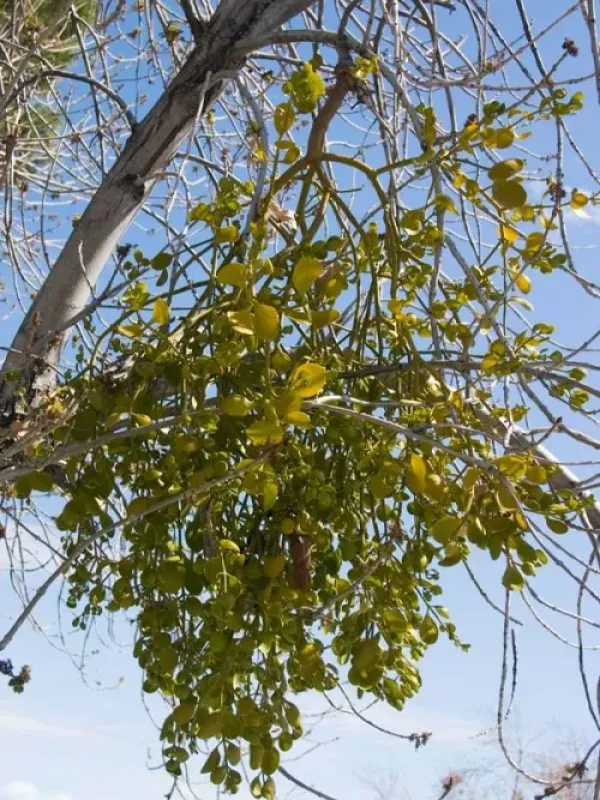
Description
How to identify
Phoradendron macrophyllum, commonly known as a type of mistletoe, is an obligate hemiparasitic shrub belonging to the Santalaceae family. It is a perennial plant that survives by parasitizing the branches of host trees.
The plant appears as a dense, evergreen bush with leathery, elliptical leaves. Its stems are woody and branched, and it develops specialized structures called haustoria that penetrate the host tree's bark to access xylem sap, drawing water and nutrients.
This species is dioecious, meaning individual plants are either male or female. Small, inconspicuous flowers appear, and after pollination, the female plants produce white to pale pink berries containing sticky seeds.
Systematically, it is a member of the genus Phoradendron within the plant kingdom. While often confused with other mistletoe species, Phoradendron macrophyllum is native to North America and relies on birds for seed dispersal.
The presence of this parasite is most noticeable during the winter months, when the evergreen mistletoe stands out against the bare branches of deciduous host trees.
What it damages
This phytopathogen affects a wide range of broadleaf tree species. Common hosts include cottonwoods, willows, maples, walnuts, oaks, and various orchard trees in urban and natural landscapes.
By attaching itself to the host's vascular system, the parasite disrupts the normal flow of nutrients and water. This places significant physiological stress on the tree, particularly during periods of drought or extreme temperature.
Severe infestations often lead to the formation of "witches' brooms" and stunted growth near the infection site. The structural integrity of the affected branches may be compromised over time.
If the parasite population becomes dense enough, it can cause branch dieback and significantly reduce the lifespan of the host tree by exhausting its stored reserves.
From an agronomic and economic perspective, this parasite degrades the health of ornamental urban plantings and can reduce the yield of commercial orchards by diverting essential resources.
When it appears
The lifecycle is closely linked to avian dispersal. Birds consume the berries and transport the sticky seeds to new branches, where they adhere to the bark and begin to germinate if conditions are suitable.
Active growth and nutrient uptake through the haustoria occur primarily during the spring and summer months, coinciding with the peak metabolic activity of the host tree.
Seeds require direct contact with the host's cambium layer to successfully initiate parasitism. The germination process is sensitive to environmental moisture levels.
While Phoradendron macrophyllum is evergreen and remains metabolically active year-round, its growth rate slows during colder weather, utilizing nutrients stored during the growing season.
New infections can occur throughout the year as long as bird populations are active and suitable host tissues are available for seed attachment.
Signs of infestation
The primary sign of infestation is the appearance of evergreen clusters within the canopy of deciduous trees. The foliage of the parasite is distinctively thicker and leathery compared to the host leaves.
Host trees often react to the haustorial penetration by forming localized swellings, burls, or deformed growth patterns at the point of attachment.
The portion of the branch beyond the infection site may show signs of yellowing, wilting, or premature leaf drop, indicating that the parasite is successfully intercepting the water supply.
- Distinct evergreen clumps in the canopy of bare trees.
- Burls and swellings at the site of parasite attachment.
- Stunted growth of branches distal to the mistletoe cluster.
- Gradual decline in the host tree's overall vigor.
The presence of white berries during late autumn and winter acts as a clear indicator that the plant is mature and capable of further reproduction and spread.
Control measures
The most effective control method is mechanical removal. Pruning out the infested branches at least 15–30 cm below the point of attachment is necessary to remove the entire haustorial system.
Regular sanitary pruning and routine canopy maintenance are essential to prevent the buildup of the parasite within ornamental and orchard settings. Removing infected branches early prevents the cycle of re-infection.
Chemical control options are generally limited and complex. There are no highly specific systemic herbicides that reliably kill the parasite without potentially causing damage to the host tree itself.
Maintaining high tree vigor through proper irrigation and fertilization in managed landscapes helps the host tree compartmentalize potential infection sites and resist colonization.
In cases where valuable trees are severely infected, consultation with a certified arborist is recommended to ensure the safe and proper removal of the parasite without causing further harm to the tree.
Causes diseases · 1
Discussion
No discussions yet — be the first.