
Tobacco blue mold
Peronospora tabacina
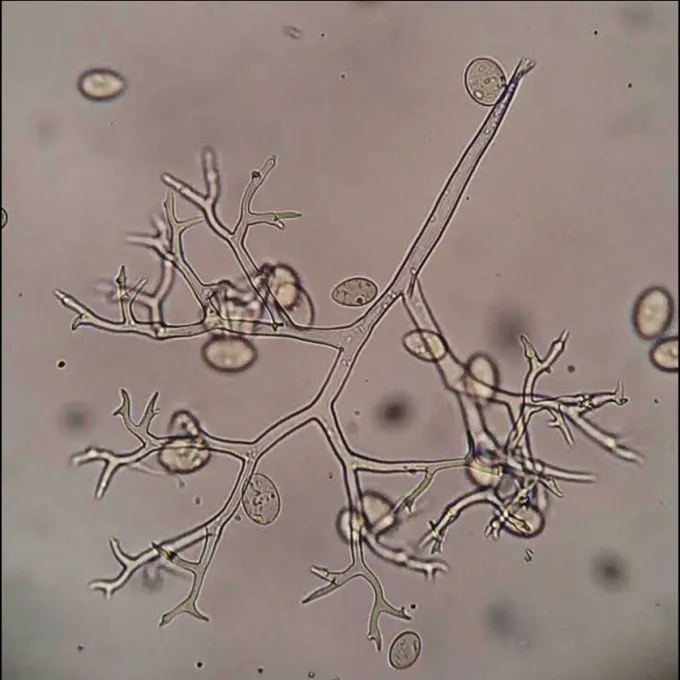
Description
How to identify
The causative agent of the disease is Peronospora tabacina, an oomycete pathogen belonging to the Chromista kingdom, known as tobacco blue mold.
The pathogen persists in the soil via oospores, which are highly resilient structures that remain viable for several seasons under various environmental conditions.
During the growing season, the pathogen reproduces via sporangia, which are easily disseminated by wind currents over long distances to infect healthy tobacco crops.
The mycelium grows intercellularly within the tobacco leaf tissues, eventually emerging through the stomata to produce clusters of sporangia for further infection.
The development of the disease is strictly dependent on favorable weather conditions, specifically high relative humidity and temperatures ranging from 15°C to 25°C.
What it damages
Tobacco (Nicotiana tabacum) is the primary host, and the pathogen causes significant economic losses in both commercial fields and nursery seedlings.
The damage manifests as a severe reduction in leaf quality, where the leaves become necrotic and brittle, rendering the tobacco useless for industrial processing.
Seedling infestations are particularly devastating, often resulting in complete crop failure within the nursery before the transplanting stage occurs.
In mature plants, the disease inhibits growth, stunts development, and reduces the overall yield significantly, causing major losses for producers.
Under favorable outbreak conditions, the disease can spread rapidly throughout an entire region, destroying nearly 100% of the tobacco production.
Signs of infestation
Initial symptoms include the appearance of yellow, chlorotic, and irregular spots on the upper surface of the leaves, which expand as the infection progresses.
The most diagnostic feature is the development of a bluish-gray, fuzzy mold on the underside of the leaves, consisting of the pathogen’s reproductive structures.
As the infection advances, these spots turn brown and necrotic, leading to leaf tearing and the development of holes within the leaf tissue.
In humid conditions, the diseased tissues may undergo secondary rotting, which emits a foul odor and accelerates the destruction of the leaf lamina.
Affected seedlings exhibit stunted growth, wilting, and characteristic curling of the young leaves, often leading to rapid collapse and plant death.
Control measures
Sanitation practices, including the deep plowing of infected crop residues, are essential to reduce the primary inoculum and soil-borne oospore populations.
Adherence to strict crop rotation cycles, avoiding tobacco planting for at least 3 years in the same plot, is recommended to break the infection cycle.
Managing the greenhouse environment by improving ventilation and controlling moisture is critical to preventing the onset of blue mold in seedling stages.
Fungicide applications using systemic or contact products are vital components of integrated pest management strategies to protect standing crops.
The deployment of genetically resistant tobacco varieties is the most sustainable and efficient approach to mitigating the threat posed by Peronospora tabacina.
Causes diseases · 2
Discussion
No discussions yet — be the first.