
Beet downy mildew
Peronospora schachtii
Description
How to identify
The causal agent of this disease is the obligate parasite Peronospora schachtii, belonging to the kingdom Chromista, phylum Oomycota. This pathogen is highly specialized and exclusively infects plants within the Amaranthaceae family, particularly beets.
The biological life cycle of the pathogen involves asexual reproduction via zoospores and sexual reproduction, which results in the formation of oospores. Oospores are extremely resilient, surviving in soil and plant debris for several years and serving as the primary source of initial infection.
During the growing season, the disease spreads through conidia, which are disseminated by wind, rain splashes, or irrigation. High relative humidity and moderate temperatures are essential for conidial germination and host infection.
The mycelium develops within the leaf tissue, colonizing intercellular spaces. Under high humidity, the fungus emerges through the stomata to produce characteristic conidiophores and conidia, forming a visible growth on the leaf surface.
The pathogen can also overwinter in steckling roots stored in clamps or within biennial seed crops, ensuring the transmission of the disease to new planting cycles.
What it damages
Downy mildew primarily affects sugar beets, table beets, and fodder beets, as well as seed crops. Economic impact is highest during seasons with cool, damp weather, which promotes rapid disease development.
Infection significantly reduces the leaf surface area available for photosynthesis, which hampers root growth and sugar accumulation. In severe cases, it leads to premature death of the foliage.
Damage is manifested as a loss in root yield by 15–30% or more, alongside a substantial decline in sugar content and commercial quality. Seed crops suffer from deformed inflorescences and reduced seed germination rates.
Infected plants become more susceptible to secondary pathogens, such as Cercospora leaf spot or Phoma root rot, further complicating the field's health status.
The reduced physiological vigor of the roots often leads to higher susceptibility to storage rots, causing significant losses post-harvest.
When it appears
Primary infection sites typically appear in spring on seed crops or first-year seedlings if contaminated residues remain in the soil. Cool weather accompanied by frequent dews or fog is the primary trigger for outbreaks.
The optimal temperature range for mycelial development and sporulation is between +10°C and +18°C. Temperatures exceeding +25°C typically inhibit the growth of the pathogen and slow the progression of the disease.
The fungus produces multiple generations of conidia throughout the growing season, allowing for rapid spread across the field whenever humidity levels remain favorable for sporulation.
The period of canopy closure is considered critical, as the dense foliage creates a microclimate with high humidity, providing ideal conditions for the pathogen to thrive.
Towards the end of the season, disease development may slow down, but the pathogen produces oospores, which successfully overwinter in the soil to initiate the next cycle of infection.
Signs of infestation
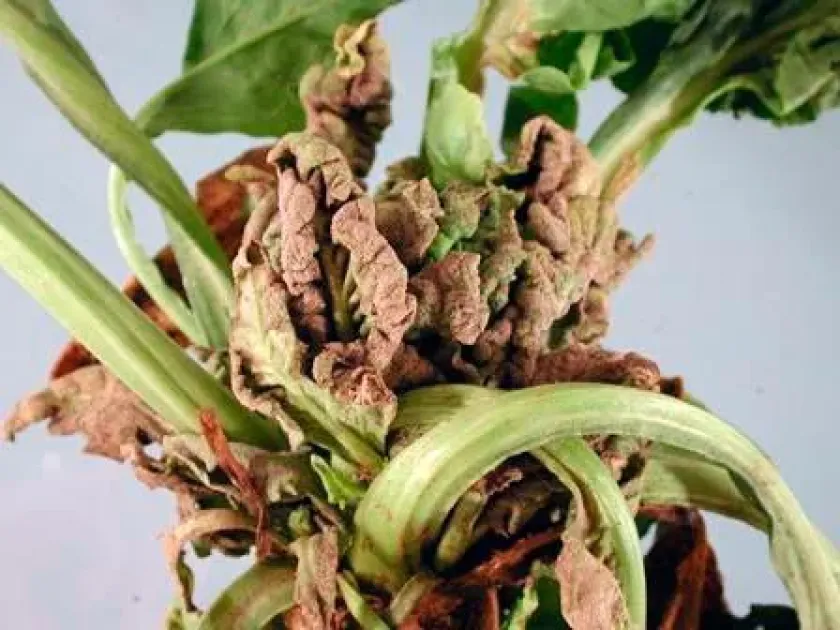
Early symptoms include a change in the color of young heart leaves, which become pale green, yellowish, and eventually curled. The leaf blade thickens and the margins curl downward, giving the leaf a distorted appearance.
On the underside of infected leaves, particularly during periods of high humidity, a dense grayish-purple mold develops, which consists of the fungus's reproductive structures.
Affected tissues gradually become brittle, necrotic, and eventually die. In advanced stages, the plant appears severely stunted, with a rosette of diseased leaves centered at the base.
In seed crops, the disease affects flower stalks, which may become twisted, brittle, and covered in fungal growth. Flower buds can dry out prematurely, leading to significant yield loss.
- Curling and distortion of young leaves.
- Yellowing of leaf blades.
- Grayish-purple fungal growth on the underside of leaves.
- Twisting and brittleness of flower stalks.
- Premature leaf necrosis and death.
Control measures
The primary control strategy involves crop rotation, with a minimum interval of 3–4 years before planting beets again on the same field. Spatial isolation of seed crops from commercial beet fields is essential to reduce the inoculum load.
Implementing thorough post-harvest tillage and deep plowing is crucial to bury infected plant residues, which accelerates their decomposition and reduces the viability of oospores in the soil.
The use of resistant or tolerant cultivars and hybrids is highly recommended, as is the rigorous inspection of seed lots to prevent the introduction of the disease into clean areas.
During the growing season, chemical protection using approved fungicides (including copper-based, triazoles, or strobilurins) may be applied, depending on disease pressure and local regulations.
Managing plant density and optimizing irrigation practices to prevent excessive moisture in the crop canopy are vital steps in creating unfavorable conditions for downy mildew outbreaks.
Causes diseases · 1
Discussion
No discussions yet — be the first.