
Downy mildew of brassicas
Peronospora parasitica
Description
How to identify
The pathogen Peronospora parasitica is an obligate oomycete parasite belonging to the family Peronosporaceae. It is the primary cause of downy mildew in a wide range of cruciferous plants.
This microorganism reproduces via sporangia that develop on specialized branched structures called sporangiophores. These structures emerge through the stomata of the host plant leaves.
Peronospora parasitica requires high humidity and moderate temperatures to complete its life cycle. It is highly host-specific, primarily targeting members of the Brassicaceae family.
The pathogen can survive in the soil or on crop debris as oospores, which are thick-walled resting spores capable of withstanding harsh environmental conditions for several seasons.
Understanding the life cycle is crucial for effective disease management, as the pathogen's rapid spread depends heavily on environmental moisture and plant density.
What it damages
Economic damage is most significant in cabbage, broccoli, cauliflower, radish, and oilseed rape. The disease affects all growth stages, from seedlings to mature plants.
Seedling blight is a common consequence of infection in nursery beds, leading to stunted growth, leaf distortion, and high mortality rates among young plants.
In mature plants, the loss of leaf surface area reduces photosynthetic capacity, which directly results in reduced head size or lower seed yield in oilseed crops.
The cosmetic value of produce is also severely compromised by necrosis and potential secondary decay, especially when infected heads are stored under suboptimal conditions.
Total crop failure may occur if conditions remain favourable for the pathogen throughout the vegetative growth period, necessitating intensive fungicide intervention.
When it appears
The disease thrives in cool, moist environments. Optimal development occurs with temperatures between 10°C and 20°C combined with high relative humidity above 85%.
Spore dispersal is most active during periods of rain and fog, which facilitate the movement of motile zoospores that require water films on leaf surfaces for germination.
Infection cycles can be very rapid, with new generations of sporangia produced within days during warm, humid spring or autumn periods.
The pathogen remains dormant during winter as mycelium within living plant tissue or as oospores in the soil, ready to infect early-season cruciferous weeds and subsequent crops.
Field monitoring should be intensified during periods of prolonged morning dew or overcast weather, as these are primary triggers for sudden outbreaks.
Signs of infestation
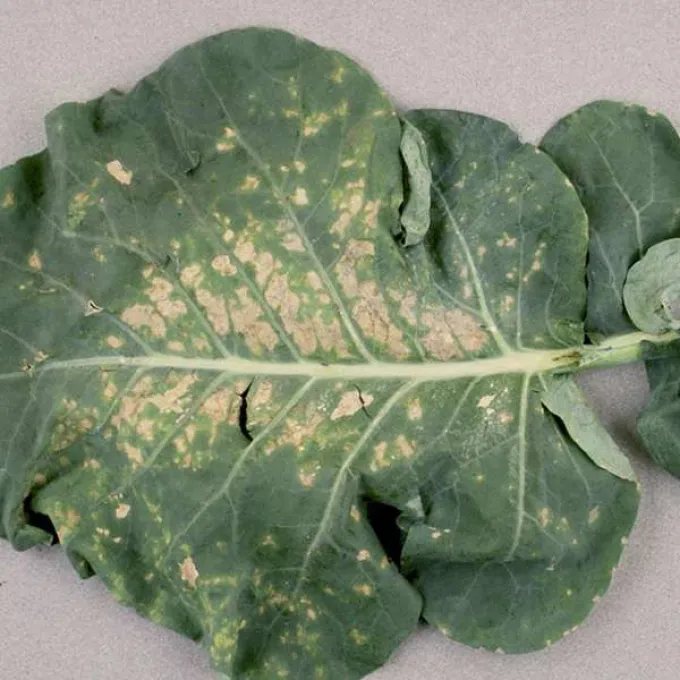
Initial symptoms are characterized by chlorotic, yellow-green spots appearing on the upper surface of the leaves, often bounded by leaf veins, giving them an angular appearance.
The lower surface of these spots shows a sparse, white or light-grey fungal growth, which is the mass of sporangiophores producing millions of spores.
- Yellowing of leaf tissue leading to necrotic brown patches.
- Leaf distortion and curling in young, developing seedlings.
- Premature yellowing and abscission of lower foliage.
- Development of dark, sunken lesions on cabbage heads.
- Stunted root development and overall plant weakness.
Under heavy infection pressure, individual spots may coalesce, causing the entire leaf to wither and die prematurely, which significantly weakens the plant.
Control measures
Crop rotation is the most effective cultural practice; it is recommended to wait at least 3-4 years before planting cruciferous crops in the same area.
Good sanitation, including the removal and destruction of crop residues and control of brassica-family weeds, helps to eliminate the pathogen's survival sources.
Improving airflow within the crop canopy by adjusting plant spacing reduces humidity levels near the leaf surface, thereby inhibiting spore germination.
Chemical control programs often utilize systemic and contact fungicides applied at the first sign of symptoms or as a preventive measure in high-risk areas.
Selecting resistant cultivars and ensuring high-quality, disease-free seeds are the foundation of integrated pest management strategies for this pathogen.
Causes diseases · 2
Discussion
No discussions yet — be the first.