
Soybean downy mildew
Peronospora manshurica
Description
How to identify
The causative agent of the disease is an obligate parasite, the oomycete Peronospora manshurica, classified within the kingdom Chromista. It is a highly specialized pathogen that affects exclusively soybean crops.
The pathogen belongs to the group of downy mildew fungi. Its biological cycle includes the formation of zoospores for rapid dispersal and thick-walled oospores for survival in soil for several years.
Infected seeds serve as the primary source of the disease. When planted, the oospores on the seed coat initiate the infection in emerging seedlings, which then spreads to neighboring plants through wind and splashing rain.
During the growing season, the pathogen produces conidiophores that emerge through the stomata on the underside of the leaves. This creates a visible greyish-purple fungal growth, which is a diagnostic hallmark of the infection.
Environmental conditions play a crucial role in disease development. High humidity and moderate temperatures between +15°C and +20°C are optimal for spore germination and rapid spread within the field.
What it damages
Downy mildew affects all aerial parts of the soybean plant, including cotyledons, true leaves, and occasionally pods. Cotyledon infection often leads to stunted growth or seedling mortality.
The primary economic damage is caused by premature defoliation. As leaves turn yellow and drop off, the plant's photosynthetic capacity significantly decreases, hindering biomass accumulation and grain filling.
When pods are infected, the pathogen can penetrate and cover the seeds with a light-grey, matted layer of oospores. This reduces seed quality and makes the seed a vector for long-distance disease transmission.
Crop losses are primarily manifested as reduced seed weight (lower 1000-seed weight) and poor overall yield. Under severe infection pressure, yield reduction can range between 10% and 20%.
Secondary effects include the weakening of the plant's physiological state, making the crop more susceptible to opportunistic pathogens and environmental stressors, leading to reduced overall fitness.
Signs of infestation
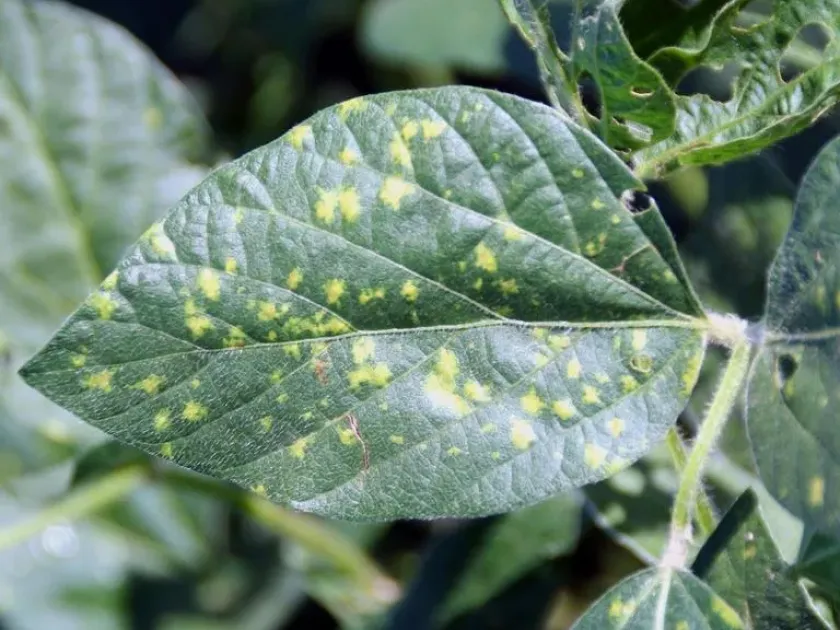
Initial symptoms appear on the cotyledons as yellowish-green spots. Later, small chlorotic lesions develop on the upper surface of true leaves, often delineated by leaf veins, resulting in an angular appearance.
On the underside of these lesions, a distinct greyish-purple fuzz develops. This fungal growth consists of masses of conidiophores and conidia that are easily disseminated by air currents.
As the disease progresses, the lesions enlarge and coalesce. The infected leaves eventually turn yellow, wither, and drop prematurely, causing the lower portion of the stem to become bare.
Seeds harvested from heavily infected plants often show a characteristic dull, greyish-white coating. This layer is composed of dense oospores and indicates that the seed is contaminated.
- Chlorotic, angular lesions on the upper leaf surface.
- Greyish-purple fungal growth on the underside of leaves.
- Premature yellowing and leaf shedding.
- Dull, powdery coating on contaminated seeds.
Control measures
The most important control measure is the use of healthy, certified seeds. Seed treatment with systemic fungicides is recommended to eliminate surface-borne oospores and prevent primary infection.
Crop rotation is essential for breaking the infection cycle. A rotation cycle of at least 3-4 years without soybeans allows for the natural biological degradation of oospores in the soil.
Tillage practices that incorporate crop residues deep into the soil help reduce the primary inoculum load for the next season. Maintaining adequate plant spacing also helps improve canopy air circulation.
In-season control involves the application of foliar fungicides, such as copper-based products or systemic strobilurins, during the early stages of disease development to prevent widespread damage.
The utilization of resistant soybean varieties remains the most effective long-term strategy. Breeding programs focus on developing cultivars with genetic resistance to locally prevalent strains of P. manshurica.
Causes diseases · 1
Discussion
No discussions yet — be the first.