
Spinach Downy Mildew
Peronospora effusa
Description
How to identify
Spinach downy mildew is caused by the oomycete Peronospora effusa, an obligate parasite belonging to the Peronosporaceae family. Unlike true fungi, it is a water-mold pathogen that thrives in moist environments.
The pathogen utilizes haustoria to penetrate the plant cells and absorb nutrients. This process causes rapid debilitation of the host plant, as the pathogen diverts energy away from the plant's growth.
Reproduction occurs through sporangia produced on branched conidiophores. These spores are wind-dispersed and can travel long distances, allowing the disease to spread rapidly across large fields.
The organism also produces thick-walled oospores, which allow it to survive in the soil or on crop debris for several years, ensuring infection potential for future seasons.
Due to its high evolutionary potential, Peronospora effusa frequently develops new races, making the management of resistant varieties a constant challenge for breeders.
What it damages
Downy mildew is the most economically significant disease of spinach worldwide. It can lead to complete yield loss if conditions are conducive to disease development.
The pathogen specifically attacks the leaves, which are the harvested product. Even mild infection renders the spinach unmarketable due to unsightly lesions and necrotic spots.
Infected leaves lose their nutritional value and are prone to secondary rot during post-harvest storage and transport, leading to significant losses in the retail supply chain.
For commercial growers, an outbreak of downy mildew often necessitates the destruction of the entire crop, leading to massive financial losses and the need for rigorous field sanitation.
The damage is compounded by the fact that the disease can strike suddenly, often right before harvest, catching growers unprepared and unable to intervene effectively.
When it appears
The disease development is highly dependent on environmental conditions, specifically preferring cool temperatures ranging from 10°C to 20°C (50°F to 68°F).
High relative humidity (above 80%) is a critical factor for the germination of sporangia and the subsequent infection of leaf tissue.
Incidence typically peaks during damp weather, heavy dew, or frequent rainfall. In greenhouse production, poor ventilation combined with high humidity provides an ideal environment for the pathogen.
Spore dissemination is facilitated by air currents, making cloudy, breezy days with high moisture levels particularly dangerous for crop health.
Early-season outbreaks are common if the soil is contaminated with oospores from previous infected cycles, leading to systemic infection of young plants.
Signs of infestation
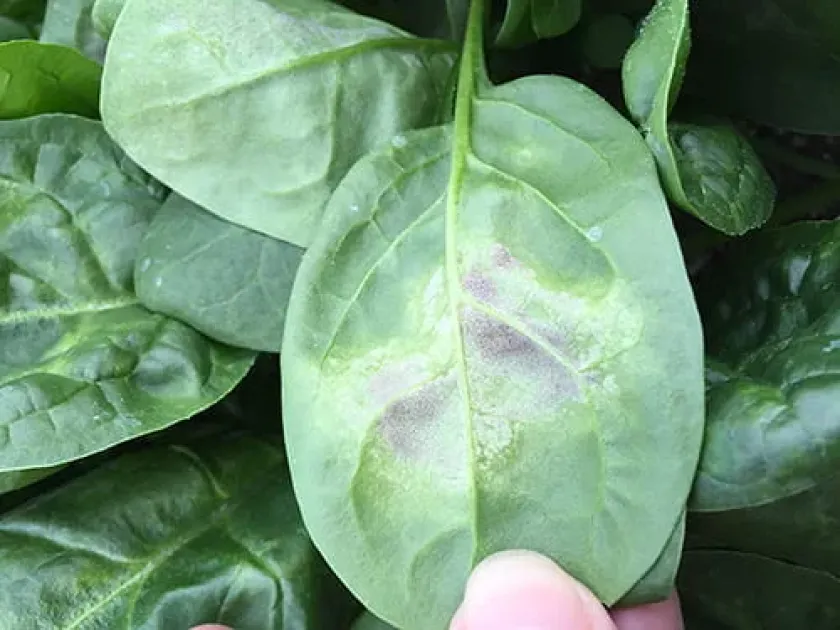
The initial symptoms appear as faint, yellowish-green spots on the upper leaf surface, often bounded by leaf veins, which may later turn chlorotic and necrotic.
A distinctive grey or purple downy growth, consisting of fungal-like spores, appears on the underside of the leaf directly beneath the yellowish lesions.
As the infection progresses, affected leaves may become distorted, curl downwards, and eventually wither and die, starting from the base of the plant.
- Yellow chlorotic patches on upper leaf surfaces.
- Characteristic grey, velvety mold on the undersides.
- Leaf curling and deformation.
- Necrotic brown spots on mature leaves.
- Rapid collapse of the entire leaf rosette.
Under persistent wet conditions, these patches coalesce, causing the entire leaf tissue to turn yellow and eventually decay into a mushy state.
Control measures
The primary control strategy is the use of resistant spinach varieties. Growers should select cultivars that are labeled as resistant to the prevalent races in their region.
Crop rotation is essential. Rotating spinach with non-host crops for at least 3 years helps deplete the population of soil-borne oospores.
Good cultural practices such as ensuring adequate plant spacing and promoting airflow help reduce leaf wetness, thereby suppressing pathogen development.
Drip irrigation is highly recommended to avoid wetting the leaves, which is the primary trigger for sporangia germination and infection.
In cases where disease pressure is high, professional fungicides may be applied. It is crucial to follow local regulations regarding application rates and pre-harvest intervals.
Causes diseases · 1
Discussion
No discussions yet — be the first.