
Onion downy mildew
Peronospora destructor
Description
How to identify
The causal agent is Peronospora destructor, an obligate pathogen classified as an oomycete within the Chromista kingdom. It exclusively attacks plants of the Allium genus, relying on the host for survival.
The pathogen grows mycelium within the intercellular spaces of onion leaves. Under favorable humidity, it produces sporangiophores that emerge through stomata to form the visible downy growth on the leaf surface.
Taxonomically, it is distinct from true fungi. It reproduces both sexually, forming thick-walled oospores for long-term survival in soil, and asexually, producing sporangia for rapid spread.
The biological cycle is strictly dependent on environmental moisture. Once the sporangia land on a healthy leaf, they require a film of water to germinate and penetrate the plant tissue.
Early diagnosis is vital for management, as the disease can spread throughout an entire field within days during optimal climatic conditions for the pathogen's development.
What it damages
Onion downy mildew affects various crops, including common onions, shallots, leeks, and garlic. It causes significant economic damage to both commercial bulb production and seed crops.
The disease destroys leaf tissue, leading to a loss of photosynthetic capacity. Consequently, bulb development is severely stunted, leading to smaller, lower-quality harvests.
In seed crops, the pathogen infects the scapes, causing them to collapse. This results in reduced seed yield and poor seed viability, which can devastate seed production enterprises.
Infected plants are often weakened and more susceptible to secondary rots, such as Botrytis or Erwinia, further reducing the storage potential and shelf life of the bulbs.
Under severe outbreak conditions, crop losses can reach catastrophic levels, making it one of the most destructive diseases in onion cultivation worldwide.
When it appears
Development typically initiates in early spring. The pathogen survives the winter as dormant mycelium in stored bulbs or as oospores in soil debris from previous infected crops.
The infection intensifies during periods of high humidity (90%+) and moderate temperatures ranging from 15°C to 20°C. Frequent rain and heavy morning dew facilitate spore production.
The spread of the disease is highly seasonal. Field outbreaks often coincide with mid-season weather patterns that provide consistent moisture, favoring the rapid germination and dispersal of sporangia.
Wind-driven rain or irrigation water serves as a primary mechanism for local dispersal. Once the first symptoms appear, the disease can spread exponentially if high moisture persists.
Drier conditions and temperatures above 25°C significantly inhibit the pathogen's growth, acting as a natural check, though the pathogen may persist in a latent state until conditions improve.
Signs of infestation
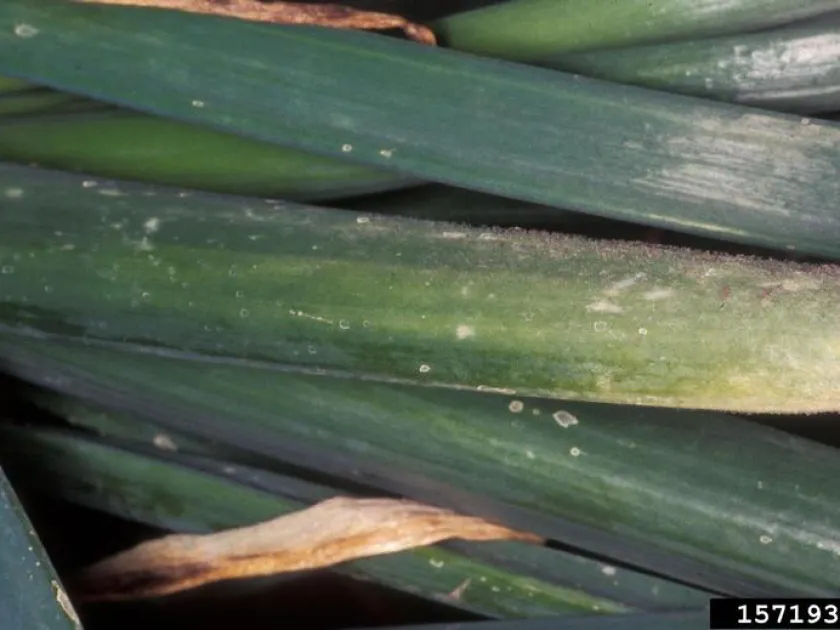
Symptoms begin as pale green or yellowish elongated patches on the leaves. These patches may eventually coalesce, causing the leaf to turn pale and distorted.
The most diagnostic feature is the appearance of a violet-gray, fuzzy mildew on the surface of the lesions, usually visible early in the morning when humidity is at its highest.
As the infection progresses, the leaves collapse, starting from the tips, and eventually dry out, turning brown. This leads to the characteristic "dying back" appearance of the foliage.
Seed-bearing scapes show similar symptoms, including distinct lesions and sporulation, which weaken the structure and often result in the breaking of the flower stalk.
- Yellowish elongated spots on foliage;
- Violet-gray fuzzy growth on leaves;
- Leaf tips curling and browning;
- Premature collapse of the foliage;
- Reduced bulb size and quality.
Control measures
Effective management begins with the use of healthy, pathogen-free sets. Thermal treatments, such as heating bulbs at 35–40°C for several days, can reduce internal infection.
Crop rotation is essential. A break of at least 3 to 4 years between Allium crops is recommended to reduce the survival of oospores in the soil.
Proper field management includes ensuring adequate spacing between plants to maximize airflow, which helps keep the foliage dry and prevents the humidity levels favored by the pathogen.
Chemical control involves the application of fungicides, specifically targeting the pathogen during the early stages of infection or when weather forecasts predict high humidity.
Post-harvest sanitation is critical. Removing and destroying all crop debris prevents the pathogen from overwintering and reduces the risk of infection in the following season.
Causes diseases · 1
Discussion
No discussions yet — be the first.