
Dickeya dadantii
Dickeya dadantii
Description
How to identify
Dickeya dadantii is a Gram-negative, facultative anaerobic bacterium belonging to the Pectobacteriaceae family. Formerly classified within the genus Erwinia, it was reclassified due to taxonomic advancements.
This pathogen is notorious for its aggressive production of pectinolytic enzymes. These enzymes dissolve the middle lamella between plant cells, leading to the rapid liquefaction of host tissues.
The bacterium is known for its ability to thrive at higher temperatures compared to other soft rot-causing bacteria, which enhances its virulence in warmer environments and climates.
It can survive in diverse reservoirs including infected plant debris, soil, irrigation water, and asymptomatic carrier plants, making it a persistent threat in agricultural systems.
Laboratory diagnosis involves selective media culturing, biochemical testing, and advanced molecular techniques such as PCR to specifically identify the pathogen amidst other pectolytic bacteria.
What it damages
Dickeya dadantii has a broad host range, causing devastating economic losses in numerous important crops. It is a major causal agent of bacterial soft rot and stem rot worldwide.
Major crops affected include potatoes, tomatoes, peppers, and various ornamental species such as orchids, dahlias, and hyacinths. It can damage roots, tubers, bulbs, and stems.
The impact is most severe during post-harvest storage, where a single infected tuber or bulb can lead to the total decay of the entire stored lot due to the release of contaminated fluids.
In the field, the pathogen causes stunted growth, wilting, and plant death. This results in significant yield reductions and potential quarantine restrictions that affect international trade of plant material.
The economic burden includes not just the loss of yield, but also the costs associated with disease management, sterilization of equipment, and the destruction of contaminated crop batches.
When it appears
The disease is highly active during the growing season when environmental conditions favor bacterial multiplication, specifically warm temperatures and high humidity.
The life cycle involves colonization of the plant's intercellular spaces. Once established, the bacteria rapidly multiply and secrete enzymes that degrade tissue integrity, leading to the characteristic rot.
Primary transmission occurs through contaminated planting material such as tubers, cuttings, or bulbs. Asymptomatic planting material acts as a silent vehicle for the spread of the pathogen.
Secondary spread is facilitated by surface water, irrigation, tools, and insects. Rain splash events are particularly effective at dispersing bacteria from infected plant surfaces to healthy neighboring plants.
Survival in the soil during winter or dry spells is possible if the bacteria are associated with host residues or root zones of tolerant weeds, allowing for rapid re-emergence when conditions improve.
Signs of infestation
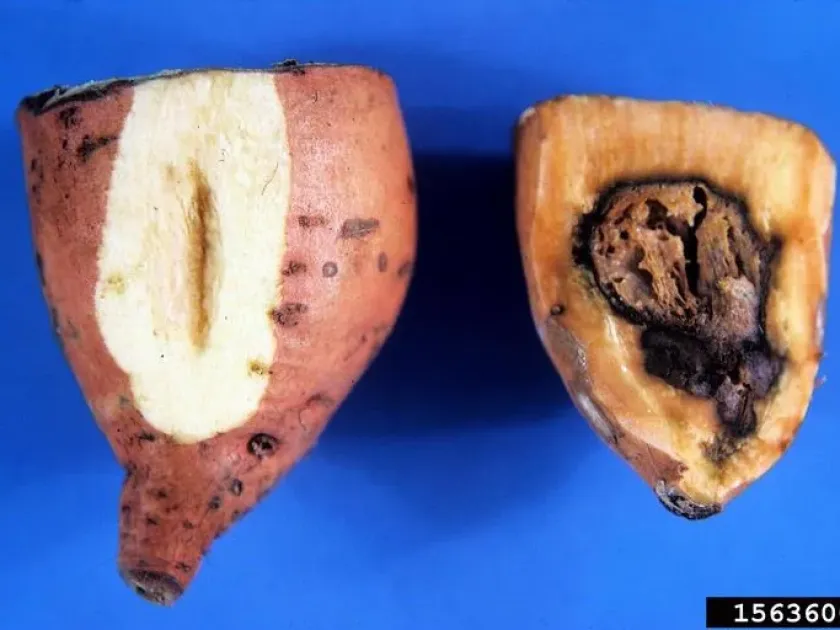
The most diagnostic sign is the appearance of soft, water-soaked lesions that rapidly progress into a mushy, foul-smelling rot of the plant parenchyma.
- Wilting of stems or leaves, often occurring during the hottest part of the day.
- Darkening of the stem base, often leading to lodging.
- Internal decay of tubers or bulbs manifesting as necrotic, cream-to-brown colored tissue.
- A distinct, unpleasant odor emitted by decomposing plant matter.
- Discoloration of vascular bundles within the stems or stalks.
In the early stages, signs may be subtle, such as minor yellowing or slight softening at the crown of the plant, which is often overlooked until the decay becomes systemic.
As the disease advances, the structural integrity of the plant collapses entirely, turning the infected organ into a semi-liquid, slimy mass that attracts further secondary pathogens.
Control measures
The primary control measure is the use of disease-free, certified seed tubers or planting stock. Inspecting materials for any visual symptoms before planting is a critical first step.
Good agricultural practices, including robust crop rotation and diligent sanitation, are essential. Removing all crop residues and infected plant parts minimizes the primary inoculum level in the field.
Water management is vital; avoiding waterlogged soil and reducing humidity in greenhouse environments through proper ventilation significantly discourages the bacteria.
Disinfection of tools, crates, and storage facilities is mandatory to prevent cross-contamination. Sanitation protocols should be rigorously applied whenever handling plant tissues.
Currently, there are no curative chemical treatments, making integrated disease management and preventative strategies the only effective way to mitigate the impact of Dickeya dadantii.
Causes diseases · 1
Discussion
No discussions yet — be the first.