
Clavibacter michiganensis
Clavibacter michiganensis
Description
How to identify
Clavibacter michiganensis is a Gram-positive, non-spore-forming actinomycete bacterium. It is the primary causal agent of bacterial canker, one of the most destructive diseases affecting tomato plants globally, both in open fields and greenhouses.
This pathogen belongs to the Actinomycetota phylum and is known for its systemic movement through the vascular system of the host plant. It colonizes the xylem, where it proliferates and produces polysaccharides that obstruct the flow of water and nutrients.
The bacterium is highly persistent, capable of surviving in soil, decaying crop debris, and infested seeds for several months to years. Its ability to form biofilms on tools and surfaces makes sanitation a critical aspect of disease management.
Identification is often challenging because symptoms can be confused with fungal wilts or nutritional disorders. Laboratory diagnostics, including ELISA and PCR, are essential to confirm the presence of the pathogen in symptomatic or asymptomatic plant material.
Biological and genetic diversity within the species allows it to adapt to various environmental conditions. This resilience, combined with its high transmission rate, classifies it as a significant quarantine organism in many agricultural regions.
What it damages
The primary host of Clavibacter michiganensis is the tomato plant (Solanum lycopersicum). While it can infect other Solanaceous species such as peppers and nightshades, the economic impact is most profound in tomato production.
In greenhouses, the disease can spread rapidly due to high-density planting and frequent handling of plants. A single infected plant can quickly become a source of inoculum for the entire facility, leading to severe yield losses.
The pathogen interferes with the plant's physiological processes, resulting in reduced vegetative growth, stunting, and poor fruit development. In extreme cases, complete plant collapse occurs shortly after the onset of symptoms.
Beyond quantity, fruit quality is significantly impacted. Infected fruits exhibit characteristic lesions that make them unsellable, forcing growers to discard substantial portions of the harvest.
Mechanical transmission is a major factor in crop damage. Pruning, staking, and harvesting operations are common pathways for the pathogen to move from infected to healthy plants, often creating localized clusters of the disease.
When it appears
The bacterium thrives in warm, humid conditions, typically between 20°C and 28°C (68°F to 82°F). These temperatures support rapid bacterial multiplication within the vascular bundles of the plant.
Springtime represents a high-risk period, as young seedlings are susceptible to infection from contaminated seeds or soil. During this stage, the disease can go undetected until the plants start showing signs of water stress.
Summer conditions, particularly following rainfall or intensive overhead irrigation, facilitate the spread of the bacteria. Moisture helps the pathogen move from surface debris into plant tissues through natural openings or wounding sites.
Autumn marks the transition phase where the bacteria prepare for overwintering. By surviving in soil particles or non-decomposed residues, the pathogen remains ready to initiate a new infection cycle the following season.
In greenhouses, the absence of a distinct winter season allows the pathogen to cycle continuously. If sanitation measures are neglected, the bacterial population can grow steadily, increasing the risk of recurring outbreaks.
Signs of infestation
The most common initial symptom is the chlorosis of leaflet margins, which often progresses into a distinct "V-shaped" yellowing. Eventually, the edges become necrotic, and the entire leaf may wilt and shrivel.
Internal symptoms are revealed when stems are cut; the vascular tissue shows clear browning or a light tan discoloration. In severe infections, the pith may disintegrate, leaving hollow spaces inside the stem.
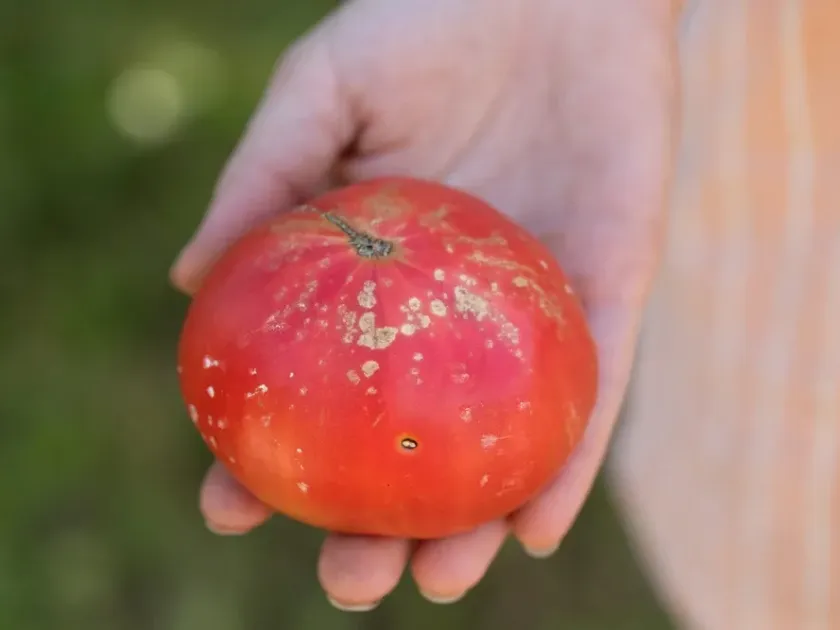
Fruit symptoms are highly characteristic and often referred to as "bird's eye" spots. These are small, white, circular lesions with a dark center, which may enlarge and lead to fruit deformation.
Stunting and persistent wilting are clinical markers of systemic infection. Unlike water-stress wilting, plants affected by bacterial canker do not recover at night, as their xylem system is physically blocked by bacterial biofilms.
- V-shaped yellowing on leaflet edges.
- Permanent wilting of branches or entire plants.
- Brown discoloration of the vascular ring inside the stem.
- Small "bird's eye" spots on the surface of tomato fruits.
- Occasional splitting or necrotic cankers on the stems.
Control measures
The most effective strategy is the use of certified, disease-free seed and high-quality transplants. Seed treatments, such as hot water or chemical disinfection, help reduce initial inoculum levels.
Rigorous sanitation protocols are mandatory for greenhouse environments. This includes disinfecting tools with bleach or specialized solutions, cleaning clothing, and ensuring that trays and growing media are sterilized before use.
If an infection is detected, immediate removal and destruction of the affected plants are necessary. Growers should also treat the surrounding area to minimize the risk of spread via irrigation water or splashing.
Crop rotation remains a fundamental agricultural practice. Avoiding Solanaceous crops in infested soil for at least three to four years allows for the natural decline of bacterial populations.
Monitoring programs and early detection are key to preventing large-scale outbreaks. Implementing preventive sprays with copper-based bactericides can help protect healthy plants, though they are more effective as a preventative measure than as a cure.
Discussion
No discussions yet — be the first.