
Southern blight
Athelia rolsfii
Description
How to identify
Southern blight is caused by the soil-borne basidiomycete fungus Athelia rolfsii (anamorph: Sclerotium rolfsii). It is a highly destructive pathogen known for its wide host range, infecting over 500 species of plants worldwide, primarily in warm climates.
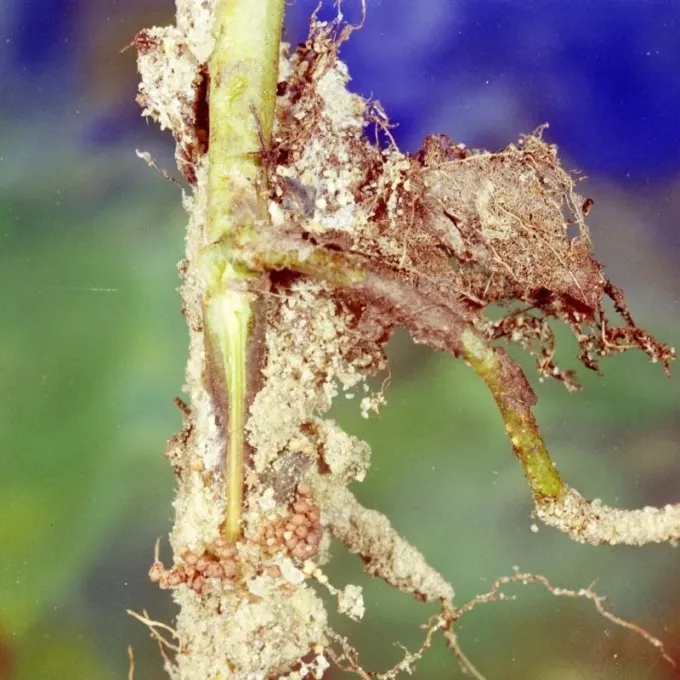
The fungus is characterized by rapid vegetative growth, producing a dense, white, thread-like mycelium that spreads across the soil surface and covers the lower stems of infected plants. This mycelium is often described as fan-like in its appearance.
A distinctive feature of Athelia rolfsii is the production of sclerotia — spherical, hard, brown structures ranging from 1 to 2 mm in diameter. These resemble mustard seeds and serve as the primary survival and dispersal unit for the fungus.
The fungus does not produce conidia, relying instead on mycelial growth and the movement of contaminated soil, water, or farm equipment to spread between fields and greenhouse benches.
In laboratory settings, the fungus is identified by its rapid growth on agar media and the consistent, mass production of dark, mustard-seed-sized sclerotia, which confirms the presence of the pathogen.
What it damages
Southern blight causes severe damage to numerous economically important crops, including tomatoes, peppers, beans, peanuts, and various ornamentals. It is particularly devastating in warm, humid regions and high-tunnel farming systems.
The pathogen attacks the lower stem near the soil line, secreting oxalic acid and extracellular enzymes that degrade plant cell walls. This leads to the rapid collapse of the vascular system and death of the plant.
In seedlings, the pathogen can cause complete stand loss or "damping off." In mature plants, the sudden onset of wilt, often despite adequate soil moisture, is a hallmark of the infection caused by this fungus.
Fruits that come into contact with contaminated soil become rapidly infected. They develop soft, watery lesions that are eventually covered by white mycelial mats and numerous small, brown sclerotia.
Because the fungus is highly aggressive and survives well in organic matter, it can quickly move through a crop row, destroying patches of plants and causing significant yield losses if not managed.
When it appears
Athelia rolfsii is a thermophilic organism, thriving at temperatures between 27°C and 35°C (80°F to 95°F). It shows little to no activity below 15°C, which restricts its impact in colder climates unless managed in indoor facilities.
High soil moisture is essential for the germination of sclerotia and the subsequent colonization of host tissues. Prolonged wet conditions are the primary driver of outbreaks during the growing season.
The sclerotia are extremely persistent and can remain viable in the soil for several years in the absence of a host. They require specific environmental triggers, often related to organic matter content and temperature, to germinate.
Spread within a field occurs as the mycelium grows radially from the initial point of infection through the upper layers of the soil, connecting to neighboring plants and spreading the disease systematically.
In greenhouse settings, where temperatures and humidity are kept consistently high, the pathogen can persist and cause damage throughout the entire year, necessitating strict sanitation protocols.
Signs of infestation
The initial symptom of Southern blight is the sudden, permanent wilting of the plant. Unlike other wilt diseases, this happens rapidly, and the leaves may remain green for a short time after the initial signs of stress.
Close inspection of the base of the stem at the soil line reveals a characteristic white, silky mycelial growth. This mycelium often extends slightly into the surrounding soil, acting as a bridge to other plants.
As the disease progresses, small, round, tan-to-brown sclerotia appear within the white mycelial mats on the stem or on the soil surface. This is a definitive sign of Athelia rolfsii.
The tissues of the lower stem eventually turn dark and become soft and mushy due to tissue decay. This rot is usually odorless, which helps distinguish it from various bacterial soft rots.
In the field, the disease typically appears in patches. These patches expand as the season progresses, with plants at various stages of decline surrounding the central, most severely affected area.
Control measures
Managing Southern blight requires an integrated approach starting with long-term crop rotation. Rotating out of susceptible crops for at least three years, preferably using resistant grass or cereal crops, helps reduce soil inoculum levels.
Deep plowing is an effective cultural practice, as burying crop debris and sclerotia deep in the soil reduces their ability to germinate and infect new hosts, and exposes them to antagonistic soil microbiota.
Improving drainage and avoiding over-irrigation are critical to reducing the humidity at the soil surface. Proper spacing and airflow management in greenhouses also help prevent the buildup of the microclimate required by the fungus.
Chemical control options include the targeted application of fungicides (e.g., azoxystrobin or fludioxonil) directed at the base of the plant. However, chemicals are best used as part of a broader strategy, as efficacy can be limited by soil type.
Biological control using Trichoderma species has proven effective for some crops. These beneficial fungi act as hyperparasites, colonizing and destroying the sclerotia of Athelia rolfsii in the soil before they can cause infection.
Causes diseases · 1
Discussion
No discussions yet — be the first.