
Aspergillus tamarii
Aspergillus tamarii
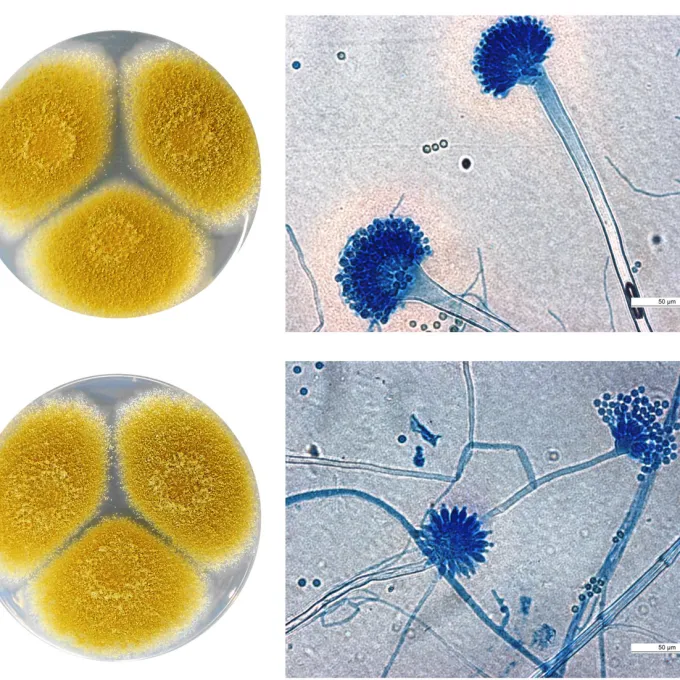
Description
How to identify
Aspergillus tamarii is a microscopic mold belonging to the kingdom Fungi, genus Aspergillus. This species acts primarily as a saprotroph but can exhibit pathogenic properties under favorable conditions.
The fungus develops mycelia on various organic substrates, forming distinct colonies. Its sporulation structures, known as conidiophores, have a specific morphology that allows for rapid identification under a microscope.
Systematically, this species is closely related to the Aspergillus flavus group but can be distinguished by the morphology of its conidial heads and the color of its spores, which range from yellow-brown to dark brown.
The fungus is capable of producing secondary metabolites, including harmful mycotoxins, which pose significant risks to both plants and the health of humans and animals consuming contaminated products.
Accurate identification in field or laboratory settings requires mycological analysis of infected samples, as the mold is often visually confused with other common Aspergillus species.
What it damages
The primary damage caused by Aspergillus tamarii occurs during the storage of agricultural commodities. It affects a wide range of crops, including cereals, oilseeds (peanuts, soybeans, sunflowers), and legumes.
The pathogen breaks down storage nutrients in seeds, leading to a drastic reduction in seed germination rates and the degradation of the nutritional quality of the final product.
Infected products develop a distinct musty odor, lose commercial value, and become unsuitable for processing due to the accumulation of fungal metabolic byproducts.
In the field, the fungus may develop on fruits damaged by insects or birds, penetrating tissues through micro-cracks and causing localized rotting hotspots.
Contamination is particularly dangerous during the crop drying period, as improper technological processes create hotspots within grain bulks, fostering rapid fungal growth.
When it appears
Active development of the pathogen occurs during periods of high humidity and elevated temperatures, typical of tropical/subtropical climates, or when storage conditions are compromised.
In warehouse environments, fungal development is not strictly seasonal, as the pathogen adapts to artificially maintained conditions if grain moisture content exceeds critical levels.
Fungal spores are ubiquitous in soil and air, ensuring a constant infectious background near crop fields and storage facilities.
The period of most intensive spread coincides with post-harvest handling, when grain moisture and temperature fluctuate, creating an environment highly conducive to spore germination.
Contamination can occur year-round if there are damaged plant residues, which serve as long-term reservoirs for maintaining the fungal population in the environment.
Signs of infestation
The external sign of infection is the appearance of a characteristic growth on the surface of seeds or plant debris. The color of this fungal layer varies from yellowish to dark brown.
As the infection progresses, plant tissue degradation occurs, visible as dark spots, while in bulk grain, it manifests as localized heating and caking due to intense fungal metabolism.
- Darkening of the seed coats.
- A characteristic dusty/powdery appearance when disturbed.
- Increased internal temperature of the grain heap.
- Deterioration of organoleptic properties (smell, taste).
Microscopic examination of colonies reveals large, well-defined brown conidial heads, which serve as a diagnostic feature for this species.
In severe cases, the product becomes entirely unusable as the fungus deeply penetrates the endosperm, resulting in fragile and decayed seeds.
Control measures
The key protection method is strict adherence to moisture control during grain storage, which should be kept below established safety thresholds (typically below 13-14%).
Effective control involves high-quality cleaning of seed lots to remove debris, broken, or injured seeds, which serve as the primary substrate for fungal colonization.
The application of modern fungicidal seed treatments before storage or planting significantly reduces the risk of initial pathogen infection.
Regular disinfection of warehouse facilities, grain elevators, and transport equipment is essential to prevent spore accumulation in handling zones.
Monitoring grain pile temperature is highly recommended to detect hotspots of self-heating early, allowing for timely aeration or redistribution of the grain mass.
Causes diseases · 1
Discussion
No discussions yet — be the first.