
Ringless honey fungus
Armillaria tabescens
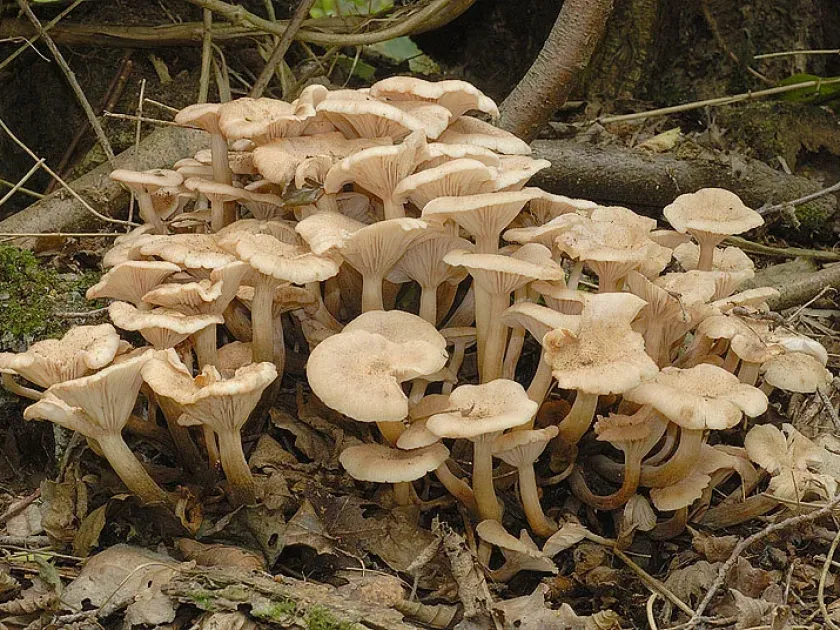
Description
How to identify
The ringless honey fungus (Armillaria tabescens) belongs to the kingdom Fungi and the genus Armillaria. Its primary identifying feature is the complete absence of a ring on the stipe, which distinguishes it from most other species.
These fungi grow in dense clusters at the base of infected trees or on buried roots. The caps are typically yellowish-brown and covered with fine, darker scales.
The fungus produces cord-like structures known as rhizomorphs. These black, root-like strands grow through the soil and are responsible for the spread of the fungus from one tree to another.
Microscopic inspection of the wood beneath the bark reveals thick, white, fan-shaped mycelial mats. These mats are a clear indicator of Armillaria infection.
It acts as a facultative parasite, surviving on decaying organic matter in the soil and only attacking living trees when they are stressed or in contact with the infected root system.
What it damages
This pathogen primarily targets broad-leaved trees, including oak, birch, and various fruit-bearing orchard species. Conifers are less commonly affected but still susceptible.
The fungus attacks the root collar and main roots, causing white rot. It effectively destroys the lignin and cellulose in the wood, leading to the collapse of the tree's structural integrity.
Infestation disrupts water and nutrient transport, leading to canopy thinning, branch dieback, and eventually the death of the tree.
Infected trees often lose their anchorage in the ground. Consequently, they become highly susceptible to being toppled by strong winds, which can be a significant hazard.
The damage is cumulative; as the fungus spreads through the root system, it creates persistent hotspots in orchards that can devastate young plantings over several years.
When it appears
Fruit bodies typically emerge in late summer and autumn, particularly following periods of heavy or consistent rainfall, which triggers the development of the mushrooms.
However, the fungus remains active throughout the year within the wood and soil. Soil temperatures between 15 and 25 degrees Celsius are ideal for its aggressive growth.
Rhizomorphs continue to extend through the soil during the entire growing season, provided that moisture levels are sufficient to support their metabolic activity.
During the winter months, the fungus survives as mycelium within the infected roots and stumps, remaining viable even in cold climates because it is protected by the woody substrate.
New infections are often established via spore dispersal, but the most rapid spread in an established grove occurs through direct contact between healthy and infected roots.
Signs of infestation
The most visible sign of infection is the presence of black, shoe-lace-like rhizomorphs under the bark at the base of the trunk or on major root systems.
Externally, the tree may show signs of yellowing, smaller-than-average leaves, and a general lack of vigor. Branch dieback often starts at the very top of the crown.
Some tree species may produce excessive resin or gum at the base of the stem as a defensive response to the pathogen's intrusion into the vascular tissues.
Peeling back the bark in the infected area often reveals a white, mushroom-scented fungal mat covering the sapwood.
- Mushroom clusters appearing at the base of trees.
- Bark loosening at the lower trunk level.
- Premature yellowing and leaf drop.
- White fungal mycelium under the bark layers.
Control measures
The primary control measure is the immediate removal of infected trees, including the entire root system. If the roots are left behind, they remain a source of infection.
Avoid planting new susceptible species in sites where Armillaria has recently occurred. The fungus can persist in buried wood fragments for many years.
Maintaining optimal tree health through proper irrigation and fertilization is crucial, as healthy trees have better natural resistance to fungal pathogens.
To prevent spread in large orchards, digging trenches around infected trees can physically sever root connections, effectively isolating the pathogen.
Avoid mechanical damage to the trunk and root collar during cultivation, as wounds provide entry points for the fungus to establish itself in the tree's vascular system.
Causes diseases · 3
Discussion
No discussions yet — be the first.