
Armillaria mellea
Armillaria mellea
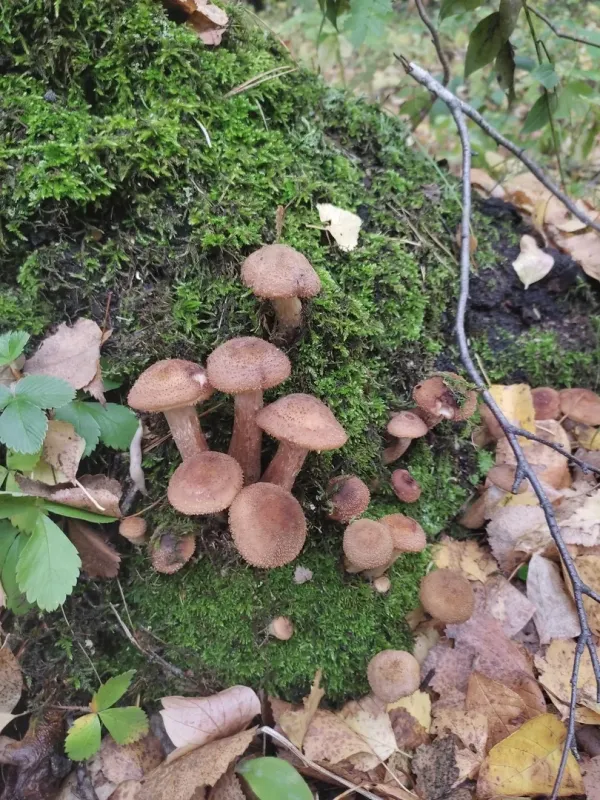
Description
How to identify
Armillaria mellea, widely known as the honey fungus, is a basidiomycete fungus and a significant plant pathogen. It belongs to the Physalacriaceae family and thrives as a facultative parasite.
The fungus is identifiable by its honey-colored clusters of mushrooms growing at the base of infected trunks. These mushrooms represent the reproductive stage of the organism.
Below ground, it produces dark, cord-like structures called rhizomorphs. These structures allow the fungus to forage through the soil and infect the roots of nearby healthy trees.
Its complex life cycle allows it to exist as a saprophyte on decaying wood, maintaining a reservoir of infection that can persist in the soil for many years.
This pathogen is globally distributed and is responsible for causing extensive decay in a wide range of woody hosts, including forest trees and orchard crops.
What it damages
The pathogen causes white root rot, a destructive disease that compromises the host's vascular system. It targets the roots and the lower trunk, leading to the rapid decline of the tree.
Susceptible species include apple, cherry, and various conifers. The fungus penetrates the bark and colonizes the cambium, gradually girdling the base of the tree and cutting off nutrient flow.
Infected trees often show severe stress symptoms, including wilting, reduced canopy density, and premature leaf drop. Eventually, the tree loses structural integrity and becomes a safety hazard.
The damage is particularly insidious because the infection progresses underground before any symptoms become visible on the above-ground portions of the plant.
Economically, Armillaria mellea is a major concern for commercial fruit production, as infected orchards can suffer significant yield losses and require extensive tree removal.
When it appears
The fruiting season, characterized by the appearance of mushroom clusters, occurs primarily in late summer and autumn when moisture levels are sufficient.
The vegetative spread of the fungus via rhizomorphs is continuous throughout the growing season, provided soil moisture and temperature conditions are optimal.
Optimal growth temperatures for the fungus typically range from 20 to 25 degrees Celsius. However, the organism is highly resilient and survives winter in wood debris and root fragments.
High soil moisture promotes the elongation of rhizomorphs, accelerating the spread of the infection to new host plants in the surrounding area.
The infection cycle is lengthy, with colonization of the host's roots often occurring months or years before the tree begins to show visible signs of decline.
Signs of infestation
Early symptoms include stunted growth, chlorosis, and reduced vigor. Affected trees may show a decline in the size of their leaves and the length of annual shoot growth.
A diagnostic sign is the presence of white mycelial mats (fans) located between the bark and the wood at the root collar. These mats often emit a distinct mushroom scent.
The detection of black, string-like rhizomorphs attached to the roots is a definitive confirmation of an Armillaria infection in the soil environment.
As the disease progresses, the wood becomes soft, white, and stringy. This decay is often accompanied by the formation of black lines within the wood tissue.
The sudden appearance of clustered mushrooms at the tree base during autumn is a clear indication that the tree has been colonized and is in a advanced stage of decay.
Control measures
The most effective strategy involves removing infected trees, including stumps and as many major roots as possible, to eliminate the fungus's food source.
Improving site drainage and preventing soil waterlogging are critical preventive measures, as excessive moisture favors the growth and spread of the rhizomorphs.
Cultural practices, such as maintaining overall tree vigor through proper fertilization and avoiding mechanical injury to the bark, help plants resist infection.
Biological control, including the application of beneficial fungi like Trichoderma species, can help suppress Armillaria activity in the soil.
- Thorough removal of stumps and root systems.
- Disinfection of soil after removing diseased plants.
- Avoidance of site disturbances that damage tree roots.
- Monitoring of healthy trees in proximity to infected specimens.
Causes diseases · 3
Discussion
No discussions yet — be the first.