Local, old valuable sort of the Lower Volga region of folk selection. It is considered one of the representatives of the clone type anisotype. The variety is zoned in the North-Western, Central, Volgo-Vyatka, Middle-Volga and Ural regions of Russia. The general description of Anisovs is given in the description of Red Anise. S. I. Isaev suggests that Striped Anise came into culture earlier than Red Anise, since in old Lower Volga gardens Striped Anise is more often found, which is widespread to the west and north of the Volga River.
Trees are large with a dense crown (in young age have an inverted cone-shaped or even broomlike crown). The main skeletal branches are kneeled, medium thickness, brown, with wavy, rough bark. Fruiting is concentrated on spears and annular growths.
Shoots are quite straight, sometimes there is a slight curvature and kneedness, dark brown with a reddish tint and short internodes, bare or slightly pubescent, with small, few, rounded, rough lenticels.
Leaves in the general mass of medium size, combined with a small number of small leaves, they are somewhat larger than those of Red Anise, of medium width. They have an almost round and oval shape, dark green color. Wrinkled, leathery, slightly shiny, with weak and medium pubescence. The leaf blade is noticeably curved only at the base, slightly folded along the main vein, with irregularities in the middle part, among which characteristic, rounded depressions with a diameter of a pea stand out. The edge of the leaf is uneven, finely serrated, dentate. The base of the leaf is round, the rounded apex ends in a short, smoothly tapering tip. Petiole of the leaf is short, rarely reaches medium length. The leaf blade is located at a right angle to the stem. Stipules are threadlike, small or absent.
Flowers are large with fairly large white petals with yellowish-green tint, cup-shaped. Pistil column is medium in size, slightly pubescent below the fork and very strongly in the fork. Styles are bare. Stigmas are located a little higher and at the level of the anthers.
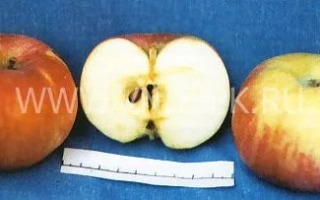
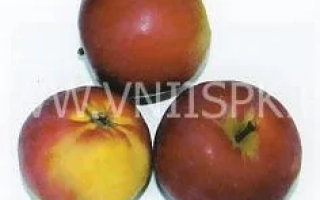
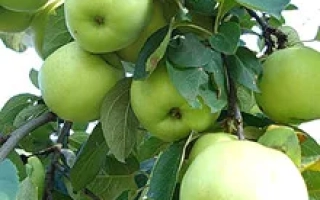
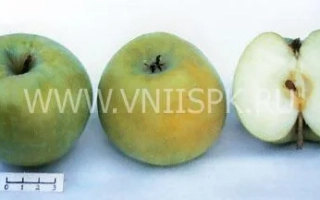
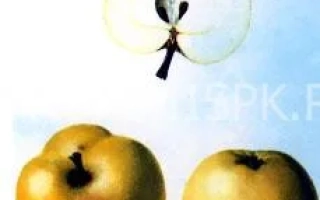
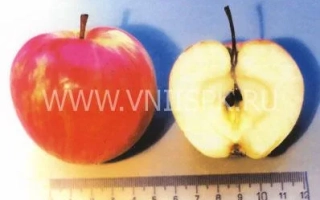
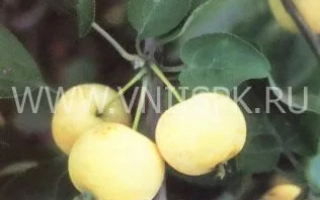
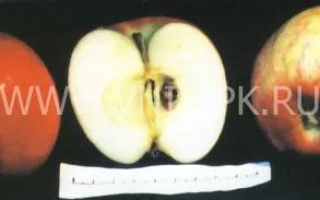
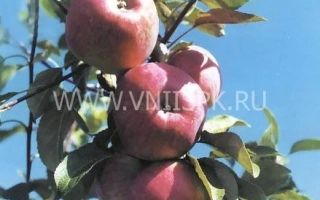
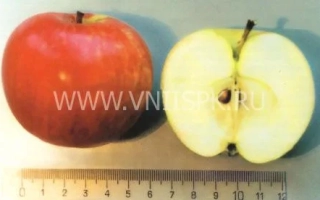
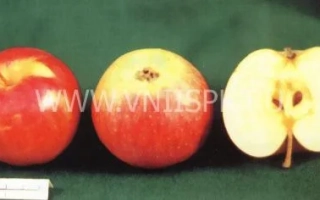
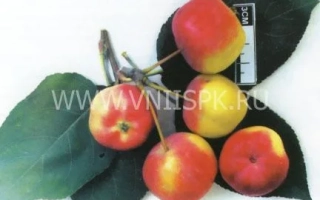
Fruits are medium or somewhat smaller in size, relatively one-dimensional. In weight, the fruits are larger than those of Red Anise. In shape they are quite flattened, round or weakly conical towards the calyx, with a smooth relief or slightly noticeable wide rounded ribs. The skin is smooth. The main color is light green. On half or more of the surface of the fruit there is spotted-striped blush on a pink background, not bright, under an intense bluish waxy bloom on the skin. Pedicel is short, medium thickness, does not extend beyond the funnel. Funnel is quite narrow and deep, but often of medium width and depth, with smooth skin that sometimes has slight delicate russeting, not extending beyond the recess. Calyx is closed, sometimes half-open, saucer is rather small, narrow, with steep edges, almost without folds or with slightly expressed folds. Subcalyx tube is conical or cylindrical, of medium width and depth. Axial cavity is small or not pronounced. Heart is small. Seed chambers are usually slightly ajar. Seminal nest is located in the center of the fruit or somewhat approximated to its apex.
The pulp is white, greenish, fine-grained, juicy, sour-sweet with a peculiar anise aroma. Ripe fruits are usually fragrant, so the variety has gained great popularity at the market. According to chemical composition, the fruits of Striped Anise are close to Red Anise: dry matter on average — 15.1% (maximum — 17.4%), sugars — 11.2 (11.6), titratable acids — 0.65% (0.74%) on raw weight, ascorbic acid — 6.5 mg/100g (7.8), the ratio of sugar to acid — 17.7 (21.1).
Fruits in central and north-western regions, as well as in the middle and upper Volga region are for winter consumption, in the middle part of the Lower Volga region they are for autumn consumption, and in the south of the Lower Volga region — for summer consumption.
The fruits ripen slightly later than Red Anise and last longer. In the Lower Volga region, in the Volgograd region, picking is done in the first half of August and the fruit lasts only 1.5-2 months. The transportability of the variety is high. Commodity quality of the fruit is relatively high.
Fruits are consumed fresh and also for drying, making jam, winemaking and apple test.
The variety is self-infertile, the best pollinators for it are: Yandikovsky, Iyunskoye Chernenko, Belphlere-Chinese and Borovinka.
Trees begin to bear fruit in the 5-6th year after planting, give a high commodity yield. The productivity of the variety is very high, gradually increasing and by the age of 20-25 reaches 250-300 kg from one tree. By its yield this variety is higher than Red Anise. According to S. P. Kedrin (Samara Experimental Horticulture Station), Striped Anise turned out to be the most productive of all Volga varieties. With very high yields, periodicity in fruiting is observed.
Trees under favorable conditions reach an age of 100 years and more. This confirms the environmental sustainability of the variety in the Lower Volga region.
The trees are hardy and undemanding to soils.
The variety is distinguished by very high winter hardiness, drought resistance and heat resistance as well as high resistance to black cancer and average resistance to scab and powdery mildew.
Advantages of the variety: high winter hardiness and drought resistance, high productivity and longevity, and in general, wide ecological adaptability of the variety to environmental conditions; it is valued for its pleasant taste and peculiar anise aroma.
Disadvantages of the variety: small fruit size and relatively short storage time in the Lower Volga region.
Gray Anise turned out to be a valuable initial form for creating new winter-hardy varieties. With his participation, varieties Zvezdochka (Pepinka Litovskaya x Gray Anise) bred by VNIIGiSPR and Doch Vagnera (Gray Anise x Vagner) bred by Moscow State University named after M.V. Lomonosov were obtained.