


SKU #62908
·
40 views
NEW ASTRAKHANI
Watermelon
User rating
0 votes0% positive reviews
No ratings yet — be the first.
Beginning of ripening
70-80 days
Fruit; flesh color
Red
Fruit; weight
3.0-5.0 kg, 5.0-8.0 kg, 8.0-10.0kg
Registration year
2009
About product

The watermelon variety NEW ASTRAKHANI is an early or mid-season variety with a maturity period ranging from 75 to 85 days. The fruits are distinguished by their large size, weighing from 3.6 to 11 kg, with a thick rind up to 2.4 cm, ensuring reliable protection and long-term storage. The watermelon flesh is dark red, of medium density, juicy and tasty, retaining its beneficial properties for appro…
Beginning of ripening
70-80 days
Fruit; flesh color
Red
Fruit; weight
3.0-5.0 kg, 5.0-8.0 kg, 8.0-10.0kg
Registration year
2009
Description
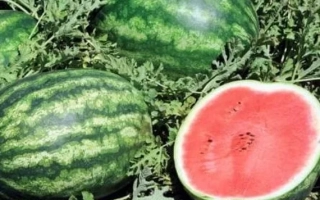
The watermelon variety NEW ASTRAKHANI is an early or mid-season variety with a maturity period ranging from 75 to 85 days. The fruits are distinguished by their large size, weighing from 3.6 to 11 kg, with a thick rind up to 2.4 cm, ensuring reliable protection and long-term storage. The watermelon flesh is dark red, of medium density, juicy and tasty, retaining its beneficial properties for approximately three months after harvesting. The fruit coloration varies from light green to green with dark green stripes, giving them an attractive appearance.
The plant belongs to annual herbaceous species of the Cucurbitaceae family and is characterized by a powerful root system with a central taproot reaching a depth of up to one meter, and numerous lateral roots at a depth of 20-30 cm. The stem sprawls like a vine, reaching a length of 4-5 meters, and has branched lateral shoots with gray-green lobed leaves, the young ones of which are slightly hairy. The watermelon NEW ASTRAKHANI grows well both in open ground and in greenhouses; however, abundant sunlight is necessary for full development. In regions with a short sunny period, cultivation in closed ground is recommended.
The variety is distinguished by its high drought resistance and ease of care, making it suitable for various climatic conditions. Yield on dry land reaches up to 102 centners per hectare, and under optimal conditions and with the right predecessor, such as potatoes, cabbage, or legumes, the yield can reach up to 120 tons per hectare. The fruits withstand transportation over long distances well, which allows maintaining their quality and freshness during sales.
The plant belongs to annual herbaceous species of the Cucurbitaceae family and is characterized by a powerful root system with a central taproot reaching a depth of up to one meter, and numerous lateral roots at a depth of 20-30 cm. The stem sprawls like a vine, reaching a length of 4-5 meters, and has branched lateral shoots with gray-green lobed leaves, the young ones of which are slightly hairy. The watermelon NEW ASTRAKHANI grows well both in open ground and in greenhouses; however, abundant sunlight is necessary for full development. In regions with a short sunny period, cultivation in closed ground is recommended.
The variety is distinguished by its high drought resistance and ease of care, making it suitable for various climatic conditions. Yield on dry land reaches up to 102 centners per hectare, and under optimal conditions and with the right predecessor, such as potatoes, cabbage, or legumes, the yield can reach up to 120 tons per hectare. The fruits withstand transportation over long distances well, which allows maintaining their quality and freshness during sales.
Crop & resistance
Crop
Specifications hover over for a hint about the specification
|
Beginning of ripening
Beginning of ripening
From germination to flowering, it takes 60 to 140 days depending on the variety. |
70-80 days |
|---|---|
|
Fruit; flesh color
Fruit; flesh color
Color of the fruit flesh. There are red, pink, yellow, and brown colors. |
|
|
Fruit; weight
Fruit; weight
Table watermelons weigh 0.6-16 kg. |
3.0-5.0 kg, 5.0-8.0 kg, 8.0-10.0kg |
| Registration year | 2009 |
| Catalog | Catalog → Watermelon |
| Legal data |
Show · 1 |
| Country | Russia |
Store offers
Prices are updated on loadLoading offers…
Aggregator catalog: prices are collected automatically from store websites, normalized by AI and converted at the current exchange rate. Before ordering, confirm the price and availability on the store's website. This block is not indexed by search engines — the data is loaded after the page opens.
Not yet комментариев. Be the first!
Alternatives
Watermelon seeds · similar varieties




See also
Often considered together with this variety





Recently viewed
Products you’ve viewed on this site
Reviews · 0