


SKU #7761
·
760 views
Kodrene
Walnut
User rating
0 votes0% positive reviews
No ratings yet — be the first.
Tree; Growth Power
Tall
Fruit; Nut shape
Egg-shaped
Nut; Nut mass
13.0-14.0 grams
Nut; Shell thickness
1.2-1.4 mm
About product

A vigorous variety. Requires fertile, deep, light soils. Highly resistant to frost, tolerates low temperatures down to -32°C and even -35°C without significant damage. Also resistant to anthracnose and pests. Bud break occurs 4-5 days later compared to medium-bud-break varieties. Female flower bloom occurs at the end of April to early May. Flowering type is protogynous, with a difference of 1-4 d…
Tree; Growth Power
Tall
Fruit; Nut shape
Egg-shaped
Nut; Nut mass
13.0-14.0 grams
Nut; Shell thickness
1.2-1.4 mm
Description
A vigorous variety. Requires fertile, deep, light soils. Highly resistant to frost, tolerates low temperatures down to -32°C and even -35°C without significant damage. Also resistant to anthracnose and pests. Bud break occurs 4-5 days later compared to medium-bud-break varieties. Female flower bloom occurs at the end of April to early May. Flowering type is protogynous, with a difference of 1-4 days. Female flowers appear in buds that are not yet fully opened, which to some extent protects them from spring frosts.
Fruit production — abundant and regular, fruiting type is terminal — intermediate, i.e., from terminal buds and 1-2-3 lateral buds. Production is relatively uniform. Nuts are large, shell seams are strongly fused, poorly expressed, surface relatively smooth, shell relatively thin, easily splits open, kernel is removed whole or in halves, has an attractive appearance. Variety was released in 2005.
Tree habit
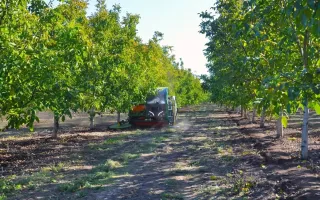
A vigorous tree, at 30 years old reaches 10 m height, has an imposing appearance, foliage abundant, dark green, leaves large, broadly elliptical, trunk straight, cylindrical.
Crown — spherical, spreading, medium density.
Scaffold branches — thick, strong, well consolidated on the trunk, large branching angle, bark gray color.
One-year shoots — thick, healthy, 30-50 cm long, brownish-yellow, with longitudinal lenticels.
Male inflorescences — thick, 10-12 cm long, numerous.
Female flowers — grouped in 2-3 on a thick pedicel.
Fruit
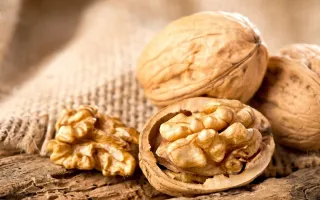
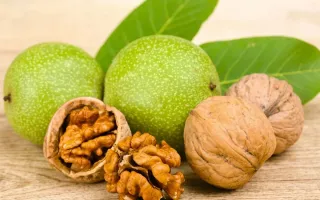
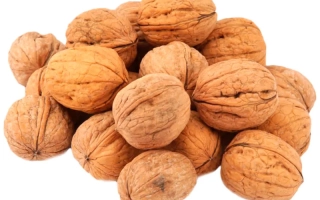
Nuts large, length — 39.3 mm, width — 33.1 mm, thickness — 37.7 mm, mass of one nut — 13.3 ± 0.85 g, uniformity CV=14%.
Shape — broadly oval, with slightly protruding pistil tip, base rounded.
Endocarp — relatively thin, 1.4 mm thick, easily splits open, shell seams strongly fused, poorly expressed, peduncular opening medium size, well covered by conducting bundles, brownish-white color.
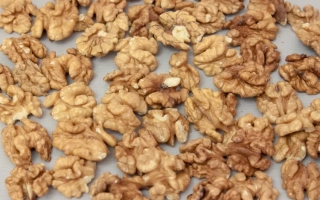
Kernel — complete, with broad blunt ridges, removed whole or in halves, constitutes 50% of nut mass, kernel skin thin, brownish-yellow, pleasant taste, contains 69.5% crude fat.
Fruit maturity — September 20-25.
Advantages — good performance for main economically valuable traits, especially high resistance to winter frosts and spring frosts.
Video · 1 video
Suggest a video →Crop & resistance
Crop
Disease resistance
Specifications
| Tree; Growth Power | |
|---|---|
| Fruit; Nut shape | |
| Nut; Nut mass | 13.0-14.0 grams |
| Nut; Shell thickness | 1.2-1.4 mm |
| Registration year | 2005 |
| Catalog | Catalog → Walnut |
Store offers
Prices are updated on loadLoading offers…
Available at: Сади Буковини · Семена Буковины
Aggregator catalog: prices are collected automatically from store websites, normalized by AI and converted at the current exchange rate. Before ordering, confirm the price and availability on the store's website. This block is not indexed by search engines — the data is loaded after the page opens.
Not yet комментариев. Be the first!





See also
Often considered together with this variety





Recently viewed
Products you’ve viewed on this site
Reviews · 0