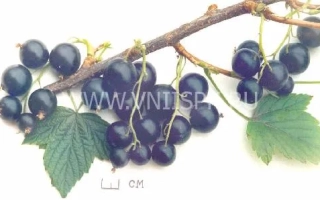
The variety was obtained at the Siberian Institute of Horticulture named after M.A. Lisavensky and the All-Russian Institute of Plant Growing named after N.I. Vavilov from crossing the varieties Saunders and Krasnoyarsk. Authors: M.A. Lisavensky, N.I. Kravtseva, I.A. Kukharsky, N.M. Pavlova. Since 1959, it has been included in the State Register of Varieties Approved for Use in the Northwestern and West Siberian regions.
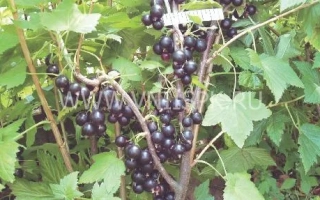
The bush is weak-growing, semi-spreading, sparse. Growing shoots are thick and medium, mostly straight, rarely curved, green, with colored (reddish) tips, hairy. Woody shoots are thick, dark-brown with a lighter brown tip, straight or slightly curved, hairy. Terminal bud is free, conical, with a pointed apex, colored, rose-purple. Buds are single, on strong shoots double or triple, elongated, conical with a pointed apex, asymmetric, deviated from the shoot, hairy. Leaf scar shape is round or round-triangular.
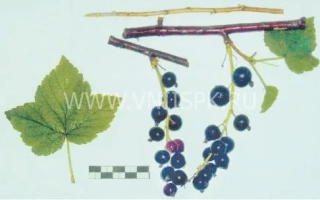
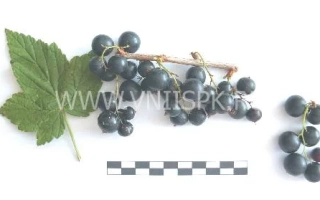
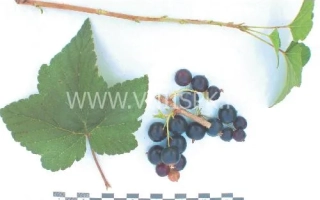
Leaf is five-lobed, large, dark green with bluish tint, weakly glossy, wrinkled, coarse. Leaf blade slightly folded along main veins. Leaf tips curl downward in autumn. Teeth are large, wide, elongated, sharp with a distinct "claw". Main veins are weakly colored, and by autumn the color intensifies to bluish-purple. Central lobe is broad-triangular, wider and longer than lateral lobes, elongated, sharp. Additional protrusions are weakly expressed. Lateral lobes are triangular, short, with pointed tips directed towards the leaf apex. Angle between lateral lobe veins is obtuse. Basal lobes are weakly expressed, veins spread out. Leaf base has a shallow rounded notch or is straight. Petioles are medium length, thick, colored, bluish-purple, curved at an acute (70°) angle to the shoot.
Flowers are large, bell-shaped, pink. Sepals are elongated-oval, narrow, slightly pointed, unevenly colored — from pale-pink to pinkish-purple, hairy, curved and slightly twisted, free. Petals are elongated-egg-shaped or nearly oval with a blunt apex, greenish-white, separate, slightly inclined toward the stigma. Stigma is positioned almost at the same level as stamens or slightly higher. Ovule is weakly hairy, uncolored. Inflorescences are medium length (4.8–5.4 cm), contain 5–9 berries. Inflorescence axis is medium thickness, green, hairy, with medium-density berry arrangement. Berry stalks are medium thickness, longer at the base of the inflorescence, green with "sunburn", hairy.
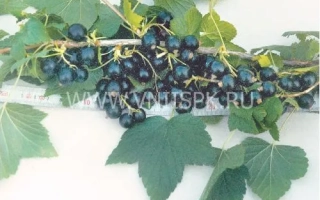
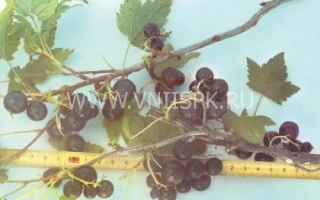
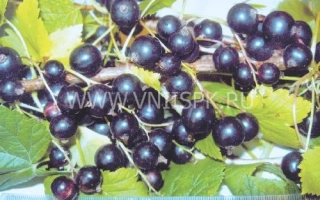
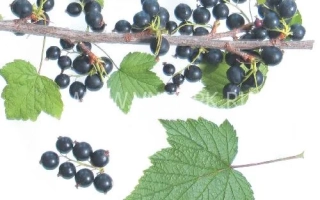
Berries are medium-sized (0.8 g), round, brownish, with thin, firm skin and medium, non-detaching calyx, dry detachment, berry base with swelling. Sensory evaluation 3.5 points. Berries are primarily used for processing. Chemical composition: soluble dry matter — 19.0%, total sugars — 6.9%, titratable acidity — 3.2%, ascorbic acid — 154.2 mg/100 g.
The variety is winter-hardy, previously highly productive, but now actively replaced by modern, more productive and large-fruited varieties. Self-fertility 37.6%. Disease and pest resistance is average. In certain years, it may be severely affected by anthracnose.
Advantages of the variety: high winter hardiness.
Disadvantages of the variety: insufficient disease and pest resistance, mediocre berry taste.