Medium-ripening variety, obtained at the Mountain Horticulture Department of the Siberian Institute of Horticulture named after M.A. Lisavensky through pollination of the form (Minay Shmyrev x Bredtorp) by a pollen mixture from seedlings of the family [(Dikovinka x Bredtorp) x Lyubimitsa Alaya]. Authors: L.N. Zabelina, E.I. Nakvasina. Under state variety testing since 2004.
Medium-height, slightly spreading, moderately dense bush. Growing shoots of medium thickness, straight, light-green with a pinkish tinge. Woody parts brown with short hairs, weakly glossy. Buds large, egg-shaped, bright red, grouped in 1-3 at the middle part of the shoot.
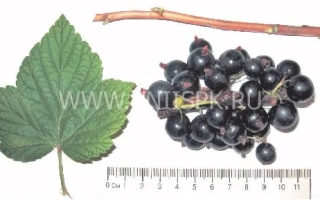
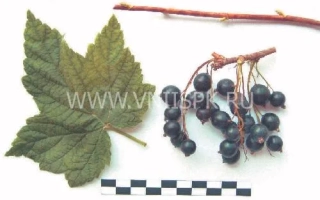
Leaf five-lobed, medium-sized, dark green, strongly wrinkled, slightly concave, matte or weakly glossy. Main vein color light green. Lobes pointed, central one elongated, slightly larger than lateral ones. Angle between central veins of lateral lobes is right. Basal lobes well developed, veins spread out. Leaf base with deep, slit-like or closed notch. Teeth medium-sized, serrated, sharp. Leaf petioles medium length and thickness, with anthocyanin coloration along entire length, positioned at acute angle (45°) to the shoot.
Flowers medium-sized. Sepals light green with bright pink tip, reflexed. Petals light green. Inflorescences medium length (5-6 berries) and density. Axis thick, weakly hairy, bright green. Berry stalks medium length, weakly hairy.
Berries very large (2.6-5.5 g), oval, one-dimensional, black, glossy, with high number of medium-sized seeds, firm skin, tart and refreshing flavor. Receptacle small. Chemical composition: dry solids — 10.2-14.4%, total sugars — 5.7-7.8%, titratable acidity — 2.8-4.0%, ascorbic acid — 87.5-101.3 mg/100 g, pectin substances — 1.3%.
Winter-hardy, early-bearing, self-fertile, resistant to fungal diseases, rust, and bud mite, high-yielding (10.6 t/ha).
Advantages of the variety: high stable yield, early bearing, large berry size, good berry technology, disease resistance.
Disadvantages of the variety: high demand for agronomic care and rapid aging of the bush.