


SKU #4447
·
192 views
Mayak
Currant
User rating
0 votes0% positive reviews
No ratings yet — be the first.
Type of Sort
Blackcurrant
Store offers · 1 from 1 stores
Prices are updated on loadLoading offers…
Available at: Дарвин · КиївСад · Марьина роща
Aggregator catalog: prices are collected automatically from store websites, normalized by AI and converted at the current exchange rate. Before ordering, confirm the price and availability on the store's website. This block is not indexed by search engines — the data is loaded after the page opens.
About product

Late-maturing variety, developed at the South-Ural Research Institute of Fruit and Vegetable Growing and Potato Cultivation by crossing the varieties Pilot A. Maminsky and Selyants Golubki. Author V.S. Ilyin. Under state variety testing since 2005.
Strong-growing, moderately dense, slightly spreading bush. Growing shoots of medium thickness, light-green, green, slightly curved, hairless. Buds…
Type of Sort
Blackcurrant
Description
Late-maturing variety, developed at the South-Ural Research Institute of Fruit and Vegetable Growing and Potato Cultivation by crossing the varieties Pilot A. Maminsky and Selyants Golubki. Author V.S. Ilyin. Under state variety testing since 2005.
Strong-growing, moderately dense, slightly spreading bush. Growing shoots of medium thickness, light-green, green, slightly curved, hairless. Buds of medium size, egg-shaped, solitary, light-brown, weakly hairy, sessile, leaf scar shape conical.
Leaf five-lobed, large, green, matte, wrinkled, sometimes with a weak gloss, leathery, blade slightly concave along the midveins of lateral lobes, wavy. Lobes sharp, central noticeably larger than lateral, elongated, with additional projections. Lateral lobes broad, sharp, directed towards the sides from the central lobe, angle between their midveins straight or obtuse. Basal lobes well expressed, uneven. Leaf base with deep, narrow, triangular notch. Teeth sharp, medium, curved. Petiole long, medium thickness, hairless, light-green or anthocyanin-colored at base, positioned at 30° angle to the shoot.
Flowers medium-sized, broad-cup-shaped, pale-colored, sepals wide, short, reflexed, pale-yellow, sometimes with slight pinkish tint, not fused. Inflorescences long (up to 13 berries), axis thick, curved, hairy.
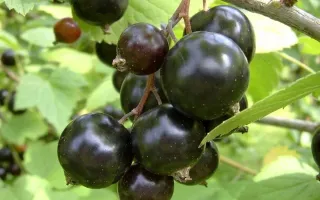
Berries very large (1.8-3.9 g), round-oval, relatively uniform, nearly black, with medium seed count, tart-sweet flavor (4.6 points), universal use.
Cold-hardy, self-fertile, productive, average multi-year yield 6.0 t/ha, maximum — 12.4 t/ha (1.5-3.1 kg/plant), weakly affected by powdery mildew and anthracnose.
Advantages of the variety: low susceptibility to diseases (powdery mildew, anthracnose), cold-hardiness, large berry size, good yield.
Disadvantages of the variety: moderate resistance to septoria.
Crop & resistance
Crop
Disease resistance
Specifications
| Type of Sort | |
|---|---|
| Catalog | Catalog → Currant |
Not yet комментариев. Be the first!
Alternatives
Currant saplings · similar varieties


See also
Often considered together with this variety



Recently viewed
Products you’ve viewed on this site
Reviews · 0