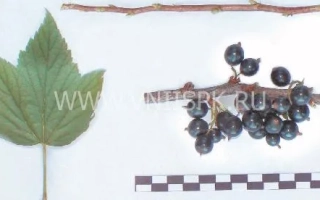
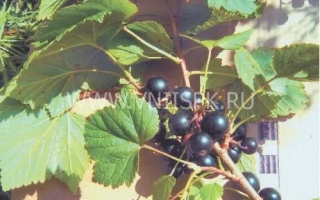
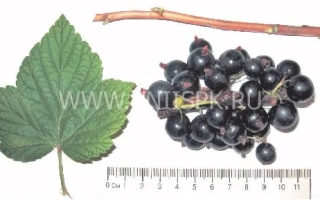
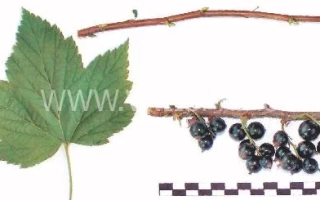
Medium-ripening variety, developed at the All-Russian Research Institute of Fruit Crop Selection from a cross between the 'Exotika' variety and seedling 762-5-82, a progeny of blackcurrant. Breeders: T.P. Ogol'tsova, S.D. Knyazev. Included in the State Register of Varieties approved for use in the Central Chernozem region in 2001.
Medium-height, moderately spreading bush. Growing shoots are straight, medium thickness, green, hairless, glossy. Woody shoots are medium thickness, with bright brown tips, glossy, hairless. Buds are alternate, solitary, small, loose, green, conical, pointed, deviated from the shoot, colored. Terminal bud is free, leaf scar shape is wedge-shaped.
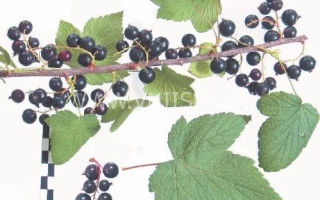
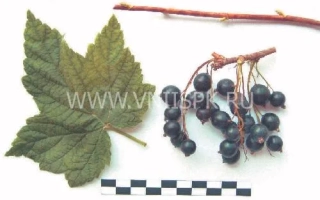
Leaf is five-lobed, medium-sized, leathery, green, glossy, elongated, blade folded along the central vein. Middle lobe is very long with a sharp tip, additional lobes are weakly expressed. Side lobes are short, pointed, upper sides curve toward the base of the leaf, lower sides are smoothly tapered and rounded, angle between their midveins is obtuse. Basal lobes are poorly expressed, their veins direct toward the petiole. Basal notch is deep and open. Teeth are small and sharp, petioles are long, green, hairless.
Flowers are medium-sized, bell-shaped, calyx lobes are pale, not fused, slightly bent. Inflorescences are medium or long up to 8 cm, dense, hanging, axis is medium, petiole is hairy, medium length.
Berries are large (1.3 g), round, one-dimensional, black, glossy with thick skin, with moderate seed content, sour-sweet taste, pleasant (4.2 points). Calyx is round, small, closed, pedicel is medium length. Chemical composition: dry matter — 12.2%, total sugars — 6.8%, titratable acidity — 2.4%, ascorbic acid — 216.0 mg/100 g, anthocyanins — 107.6 mg/100 g, leucoanthocyanins — 317.1 mg/100 g, catechins — 265.5 mg/100 g, total P-active substances — 690.2 mg/100 g.
The variety is relatively winter-hardy, early-bearing, self-fertile (72%), immune to powdery mildew, stem rust, and bud mite, moderately affected by anthracnose and septoria, suitable for mechanical harvesting, average yield 7.6 t/ha (1.1 kg/plant).
Advantages of the variety: immunity to powdery mildew, stem rust, and bud mite, high technological suitability, yield, high ascorbic acid content in berries.
Disadvantages of the variety: affected by anthracnose and septoria, shoots may freeze in some winters, berries have mediocre taste.