
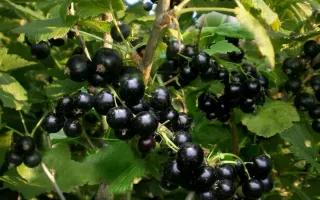


SKU #4434
·
214 views
Kreolka
Currant
User rating
0 votes0% positive reviews
No ratings yet — be the first.
Type of Sort
Blackcurrant
Store offers · 1 from 1 stores
Prices are updated on loadLoading offers…
Available at: Divsad · Garshinka
Aggregator catalog: prices are collected automatically from store websites, normalized by AI and converted at the current exchange rate. Before ordering, confirm the price and availability on the store's website. This block is not indexed by search engines — the data is loaded after the page opens.
About product

The variety is of medium-early maturity, obtained at the All-Russian Research Institute for Fruit Crop Breeding from crossing a form (Belarusian Sweet x Suenderbuen II) and the Zusha cultivar. Authors: T.P. Ogolets \u0432\u0430,\u043d\u044c, S.D. Kniazev. In state variety trials since 2004.
The bush is medium-sized, moderately spreading, of moderate density. Growing shoots are of medium thickn…
Type of Sort
Blackcurrant
Description
The variety is of medium-early maturity, obtained at the All-Russian Research Institute for Fruit Crop Breeding from crossing a form (Belarusian Sweet x Suenderbuen II) and the Zusha cultivar. Authors: T.P. Ogolets \u0432\u0430,\u043d\u044c, S.D. Kniazev. In state variety trials since 2004.
The bush is medium-sized, moderately spreading, of moderate density. Growing shoots are of medium thickness, light green, intensely colored with anthocyanin along their entire length, straight, glossy. Woody ones — thin, gray-brown, matte, the top is brown and matte. Buds are small, elongated, alternate, single, with an acute apex, slightly colored with anthocyanin, pubescent, slightly deflected from the shoot. The apical bud is not free (grouped with 1-2 poorly developed buds), the shape of the leaf scar is rounded-wedge-shaped.
The leaf is five-lobed, medium in size, light green, matte, smooth, weakly wrinkled, the plate is concave along the main veins, colored with anthocyanin at the base of the leaf. The middle lobe is acuminate triangular, elongated, much longer than the lateral ones, additional protrusions are expressed moderately. Lateral lobes are short, sharp, upper edges directed towards the median lobe, the angle between the veinlets of the lateral lobes is acute. Basal lobes are moderately pronounced, veins directed to the lateral lobes. The base of the leaf has an open, small notch. Teeth are fine, blunt, with a slightly expressed \"tip\", petiole thick, short, colored with anthocyanin, located at an obtuse angle to the shoot.
Flowers are large, cup-shaped, sepals are pale pink, freely arranged. The cluster is medium, sinuous, berries in the cluster are tightly packed, the axis is of moderate thickness, colored with anthocyanin.
< br\/>
Berries are large (1.7 g), oval-rounded, black, slightly shiny, with a dry separation, with an average number of seeds, thin skin, sour-sweet taste (4.6 points), delicate, versatile purpose. The calyx is medium, closed, the pedicel is of moderate length, green, with anthocyanin coloration, slightly pubescent. Chemical composition: soluble solids — 13.2%, sum of sugars — 7.8%, titratable acidity — 2.8%, ascorbic acid — 197.1 mg/100 g, anthocyanins — 91.4 mg/100 g, leucoanthocyanins — 231.2 mg/ 100 g, catechins — 93.7 mg/100 g, sum of P-active substances — 416.3 mg/100 g.
< br\/>
The variety is winter-hardy, early-bearing, self-fertile (76%), with high complex field resistance to diseases and bud mite, suitable for mechanized harvesting of the crop, average yield 10.5 t/ha (1.5 kg/ bush).
< br\/>
Merits of the variety: high stable yield, technology, comprehensive resistance to pathogens.
Drawbacks of the variety: affected by spider mite
Crop & resistance
Crop
Disease resistance
Pest resistance
Specifications
| Type of Sort | |
|---|---|
| Catalog | Catalog → Currant |
Not yet комментариев. Be the first!
Alternatives
Currant saplings · similar varieties




See also
Often considered together with this variety


Recently viewed
Products you’ve viewed on this site
Reviews · 0