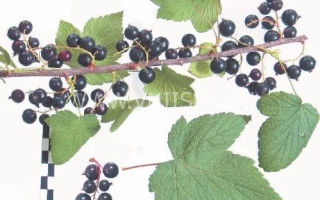
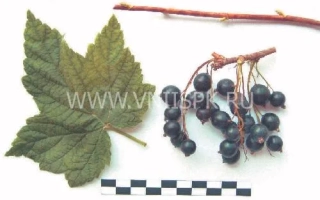
Early maturing variety, developed at the VNIIS named after I.V. Michurin by crossing the varieties Lyubava and Dikovinka. Breeders: T.S. Zvyagina, T.V. Zhidkhina. Under state variety testing since 2006.
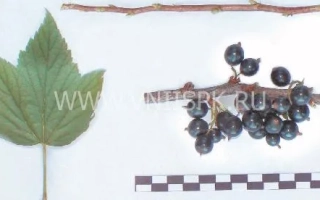
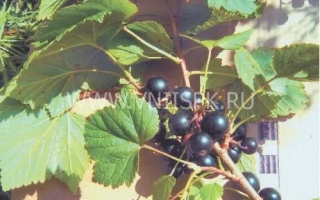
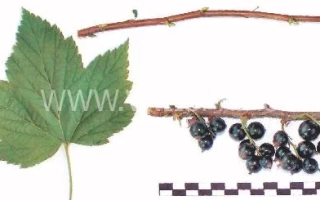
Medium-height, medium-spreading bush. Woody stems are medium and slender, straight, grayish, hairless, matte. Buds are small, elongated-ovate, brownish-red, sessile, strongly deviated from the stems, solitary, leaf scar shape rounded.
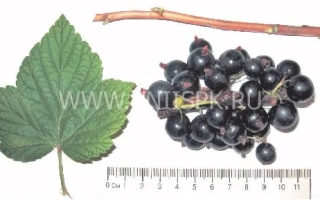
Leaf five-lobed, medium-sized, light green, blade glabrous, shiny, herbaceous, wrinkled, folded along midribs, positioned obliquely downward on the stem, leaf margin curled downward. Lobes are acuminate, central lobe larger than lateral ones. Lateral lobes are widely spaced, angle between their midribs acute. Basal lobes are well developed. Leaf base has a broad, open notch. Teeth are medium-sized, serrated, petiole medium length, thick, anthocyanin-colored, slightly hairy at base of leaf.
Flowers are small to medium-sized, cup-shaped, sepals white, free, spread sideways. Inflorescences are long to medium (5.5–7.8 cm), densely packed berries, axis medium, straight, hairless.
Berries are large (1.3–1.6 g), black, round, with thin skin, medium seed count, sweet flavor (4.9 points), universal use. Receptacle is rounded, medium-sized, closed. Pedicel is short and slender.
Chemical composition: soluble dry matter — 15.0%, total sugars — 11.5%, titratable acidity — 2.0%, ascorbic acid — 153.4 mg/100 g, polyphenols — 951.0 mg/100 g, pectin — 2.3%.
Cold-resistant, self-fertile, resistant to powdery mildew and bud mite, average yield 11.5 t/ha (3.5 kg/plant).
Advantages of the variety: high, stable productivity, berry quality and dessert flavor, disease and pest resistance.
Disadvantages of the variety: occasional slight anthracnose infection in certain years.