Early maturing variety, developed at VNIILupina by crossing the variety Seyanets Golubki with line 32-77 (Bredtorp). Breeders: A.I. Astakhov, L.I. Zueva. Included in the State Register of Varieties approved for use in the Northwestern, Central, and Volga-Vyatka regions in 2000.
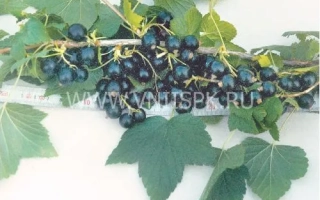
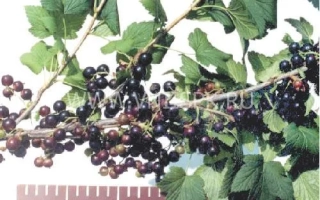
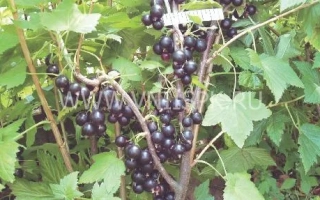
Strong-growing, slightly spreading bush with medium density. Growing shoots are curved, thick, olive-green, hairless. Buds are strongly colored with slight hairs.
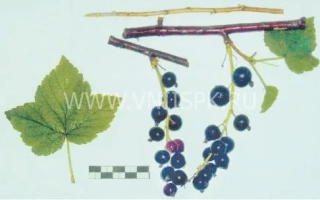
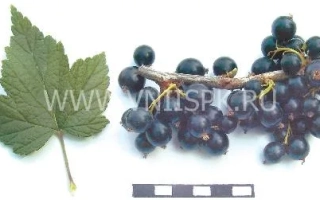
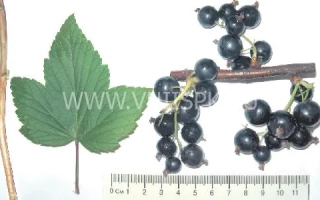
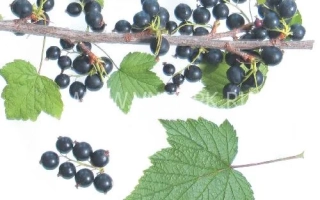
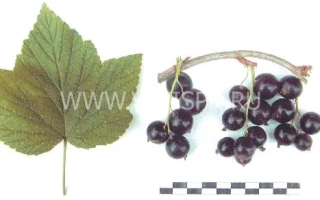
Three-lobed leaves with deep indentations, dark green, slightly shiny, leathery, wrinkled. Leaf tips are sharp. Angle between leaf lobes is acute, sometimes straight. Base is open with moderate indentation. Teeth are sharp, not curled. Petiole is colored along its entire length.
Flowers are medium-sized, reddish-purple, with brightly colored sepals; no hairs on the underside. Inflorescences are medium-length (9-17 flowers), dense, with medium-thick stems that are slightly curved and hairless.
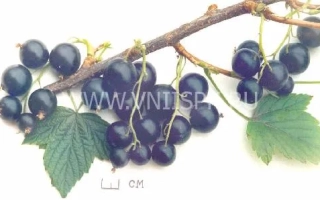
Berries are very large (1.9-3.2 g), round, black, shiny, medium density, tart-sweet flavor (4.5 points), versatile use. Peduncles are medium-length, green, thin. Chemical composition: total sugars — 6.7%, titratable acidity — 2.7%, ascorbic acid — 167.0 mg/100 g.
Winter-hardy, drought-tolerant, self-fertile, resistant to spring frosts, powdery mildew, anthracnose, rust, and bud mites; average yield 9.0 t/ha (1.4 kg/plant), maximum — 13.0 t/ha (2.0 kg/plant).
Advantages of the variety: resistant to stress factors, diseases, and bud mites.
Disadvantages of the variety: strong-growing bush, requires more spaced planting 3.0 x 1.2-1.5 m.