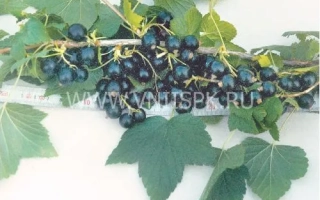
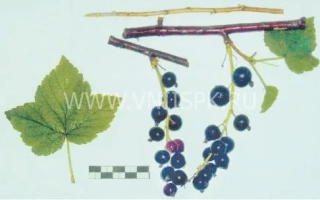
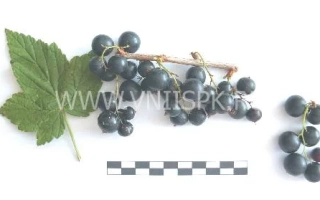
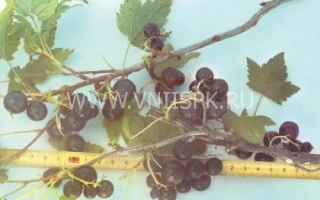
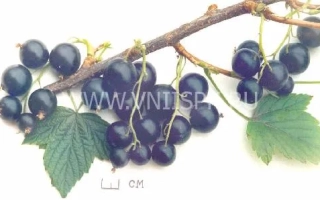
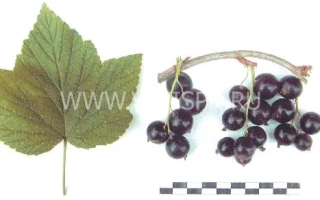
Mid-season ripening variety, developed at Buryat PIAOS (now Buryat NIISS) from crossing of varieties Primorsky Champion and Selenga. Authors: T.I. Voronina, E.G. Sokratova, A.N. Shaphaeva, D.A. Markova. Since 1998, included in the State Register of Selection Achievements approved for use in the East Siberian region.
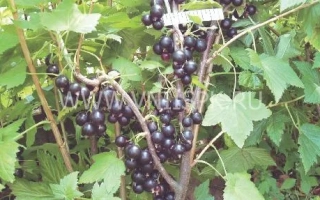
Strong-growing, slightly spreading bush. Growing shoots are thick, straight, light-green, matte, slightly hairy. Buds are medium-sized, egg-shaped, dense, purplish-brown color, acute angle of deviation from the shoot.
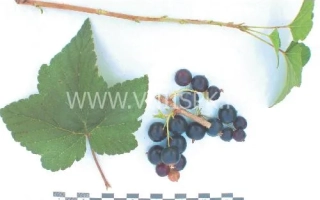
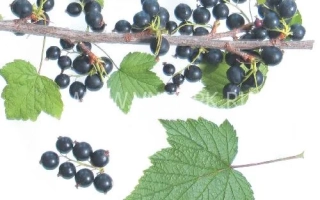
Five-lobed leaf, large, yellowish-green. Leaf blade slightly hairy underneath, shiny, leathery, wrinkled, concave along the central vein. Lobes are sharp with deep notches. Leaf base has a medium-depth notch. Teeth are sharp, short and medium.
Medium-sized, lavender flowers. Stamens are positioned at the level of the pistil. Fruit cluster length 5-8 cm. Cluster axis is straight and hairy.
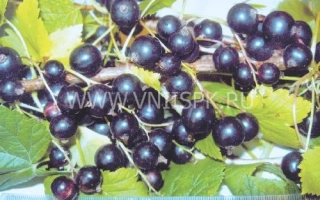
Berries are large (1.1-1.5 g), round, black, shiny, ripening simultaneously, dry detachment, good transportability. Berry stem is medium, green, fleshy, calyx closed. Taste is sour-sweet (4.3 points), refreshing, with aroma. Berries are of universal use. Chemical composition: dry solids — 11.9-13.8%, titratable acidity — 2.1-2.3%, total sugars — 6.8-8.9%, ascorbic acid — 9.1-14.5 mg/100 g, polyphenolic compounds — 201.0-438.0 mg/100 g, soluble pectin — 0.3-0.4%.
Highly winter-hardy, highly self-fertile (72-83%), weak drought resistance, resistant to powdery mildew and bud mite, easily propagated by hardwood cuttings and layering, average yield 8.0 t/ha, maximum — 11.0 t/ha.
Advantages of the variety: high winter hardiness, large berry size, high self-fertility, resistance to powdery mildew and bud mite.
Disadvantages of the variety: weak drought resistance.