


SKU #8486
·
323 views
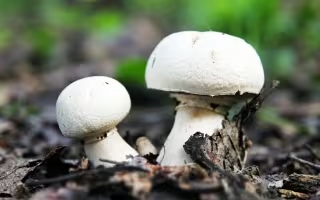
Tiger Mushroom
Mushrooms
User rating
0 votes0% positive reviews
No ratings yet — be the first.
Household Value
Edible Mushroom
Mushroom Type
Gilled mushrooms
About product

Dried mycelium of the mushroom "Tiger Mushroom"
Tiger Mushroom is an edible mushroom (must be boiled for 20-30 minutes before consumption, discard the broth). Tiger Mushroom has a unique chemical composition: contains lentinan polysaccharide, which has the property of strengthening the immune system by increasing the production of T-lymphocytes, as well as contains substances that inhibit the…
Household Value
Edible Mushroom
Mushroom Type
Gilled mushrooms
Description
Dried mycelium of the mushroom "Tiger Mushroom"
Tiger Mushroom is an edible mushroom (must be boiled for 20-30 minutes before consumption, discard the broth). Tiger Mushroom has a unique chemical composition: contains lentinan polysaccharide, which has the property of strengthening the immune system by increasing the production of T-lymphocytes, as well as contains substances that inhibit the growth of bacteria and microbes.
Cap: 8-12 cm in diameter, funnel-shaped, with rolled edges, white, covered with brown or nearly black scales. Gills: narrow, descending along the stem, whitish or cream-colored. Stem: up to 8 cm long, 0.5-1.5 cm in diameter, firm, dirty-white, dark-brown at the base. Flesh: white, firm, slightly reddening when broken, odorless.
Cultivation of mushrooms on plant residues (intensive method):
Substrate: straw or sunflower hulls are used as substrate. Straw and hulls must be of good quality, free from signs of decay and mold. Before processing, straw should be chopped; for home use, chopping to 3-7 cm is sufficient. Chopping makes straw more compact and accessible to the mycelium's enzymes.
Substrate preparation. For home conditions, simple pasteurization methods can be used, such as boiling water. The substrate is poured with water at 80-90°C and held for 3-4 hours for hulls or 7-8 hours for straw. Then water is drained, and the substrate (straw or hulls) must cool to 20-30°C.
Before inoculation and packaging, approximate substrate moisture is determined: if squeezed in hand, water droplets should appear between fingers, indicating optimal moisture content of 70%. If overwatered, water will drip in streams.
Forming substrate blocks. Then, the cooled and squeezed substrate is mixed with mycelium. The prepared compost is placed into a transparent polyethylene bag, tied, and several 3-5 cm cuts are made for air exchange across the bag surface. A ready mushroom block is formed.
Fruiting: Mycelium germination lasts 15-18 days at 14-28°C. During fruiting, natural and active ventilation is used. Substrate blocks should be illuminated only during fruiting; in open areas and rooms with windows, a day-night cycle is considered normal. In areas where fruiting bodies have emerged, carefully make cuts in the film.
Fruiting occurs in waves over 2-3 weeks, with 5-7 days between waves. The first three waves yield the highest harvest. Yield is 35-40% of substrate weight. Dosage: 2% mycelium per total mass of moist, steamed substrate.
Specifications
| Household Value | |
|---|---|
| Mushroom Type | |
| Catalog | Catalog → Mushrooms |
Store offers
Prices are updated on loadLoading offers…
Available at: Ogorod
Aggregator catalog: prices are collected automatically from store websites, normalized by AI and converted at the current exchange rate. Before ordering, confirm the price and availability on the store's website. This block is not indexed by search engines — the data is loaded after the page opens.
Not yet комментариев. Be the first!






See also
Often considered together with this variety


Recently viewed
Products you’ve viewed on this site
Reviews · 0