


SKU #8495
·
331 views
Shiitake RL-7
Mushrooms
User rating
0 votes0% positive reviews
No ratings yet — be the first.
Household Value
Edible Mushroom
Mushroom Type
Gilled mushrooms
Store offers · 2 from 2 stores
Prices are updated on loadLoading offers…
Available at: Agro-market · Епіцентр К · Світ Рослин
Aggregator catalog: prices are collected automatically from store websites, normalized by AI and converted at the current exchange rate. Before ordering, confirm the price and availability on the store's website. This block is not indexed by search engines — the data is loaded after the page opens.
About product

Dried mycelium of the Shiitake RL-7 mushroom
Shiitake RL-7 is a tasty, edible mushroom that can (and should) be consumed raw or mixed with sour cream, salt, and served as a salad. It has healing properties and is successfully used in medicine. Grows: on dead wood of broadleaf trees, mostly from the beech, oak, chestnut families, and others. Cap: diameter 6-18 cm, hemispherical, convex, flatten…
Household Value
Edible Mushroom
Mushroom Type
Gilled mushrooms
Description
Dried mycelium of the Shiitake RL-7 mushroom
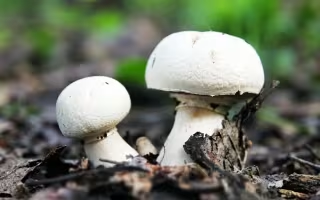
Shiitake RL-7 is a tasty, edible mushroom that can (and should) be consumed raw or mixed with sour cream, salt, and served as a salad. It has healing properties and is successfully used in medicine. Grows: on dead wood of broadleaf trees, mostly from the beech, oak, chestnut families, and others. Cap: diameter 6-18 cm, hemispherical, convex, flattening as it matures. Cap color dark brown, lightening with maturity. Cap edges smooth, often wavy in mature specimens. Gills: white, smooth in young mushrooms, toothed as they mature.
In young mushrooms, the gills are protected by a thin membrane that extends from the stem to the cap edges. As the mushroom matures, the spore covering splits and remnants appear as fringes at the cap edges and stem. Stem: fibrous, central or slightly eccentric. Flesh: thick in the center of the cap, slightly thinning toward the edges, turning brown upon damage.
Stem flesh is fibrous and white, turning brown in mature mushrooms. The remarkable properties of the shiitake mushroom amaze the imagination. Many dangerous microbes retreat before it. Even periodic use of shiitake significantly improves health, helping the body during existing diseases, and creating an impenetrable barrier against external viruses. In ancient Japan, this mushroom was used to treat diabetes and today still shows excellent results in treating this disease.
Thanks to research by Japanese and American scientists, it has been established that substances contained in the mushroom can combat many ailments and are applicable in: malignant and benign tumors. Due to the presence of a unique polysaccharide called lentinan, not found in the plant world, which increases perforin protein-polymer production in cytotoxic T lymphocytes, damaging atypical cells, leading to their death, and simultaneously stimulating the growth of T-cell fractions (T-killers and T-helpers), killer cells, and tumor necrosis factor (TNF).
Mechanism of action — boosting immunity, reducing chronic stress, inflammation, and restoring missing myelin; hypertension, post-heart attack and post-stroke conditions, the mushroom effectively combats atherosclerosis, sharply lowering blood cholesterol levels; any viral infections (herpes, hepatitis, flu), possessing the ability to significantly enhance the body's antiviral protection through recently discovered volatile compounds and fungal phytoncides; activation of specific immunity; restoration of blood formula; neurological and autoimmune diseases — they trigger remission; used in treating excess weight as part of the "Yamakiro" weight loss diet.
Specifications
| Household Value | |
|---|---|
| Mushroom Type | |
| Catalog | Catalog → Mushrooms |
Not yet комментариев. Be the first!






See also
Often considered together with this variety


Recently viewed
Products you’ve viewed on this site
Reviews · 0