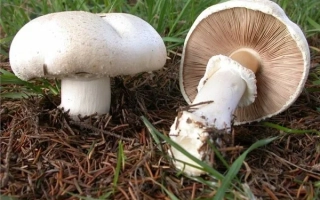
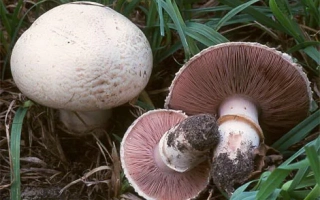
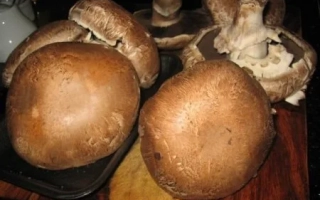
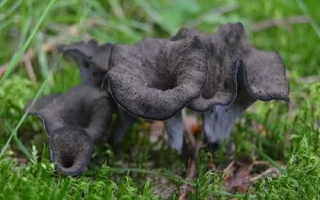
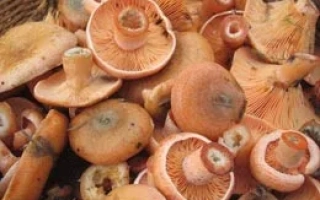
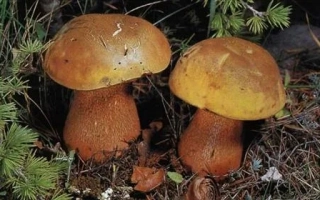
Lug Mushroom — a delicious, nutritious, edible mushroom. It is used in various ways: fresh (boiled for about 10 minutes) in first and second courses, pickled or marinated. Its protein content is comparable to that of the white mushroom. Grows: on open areas with rich humus soils, on meadows, pastures, gardens, vegetable plots, parks, near farms, on cultivated land, in grass, rarely on forest edges, usually in groups from spring to late autumn.
Cap: 8–10(15) cm in diameter, convex in young specimens, flat with curled edges in mature ones, dry, silky, sometimes finely scaly in maturity. Gills: frequent, free, initially white, then pinkish, dark brown in older specimens. Stem: 3–10 cm long and 1–2 cm in diameter, cylindrical, straight, white or uniformly colored with the cap, sometimes brownish at the base, with a thin membranous ring that often disappears with age. Flesh: firm, meaty, with a pleasant mushroom aroma, white, slightly pinkish when cut, then reddening.
Lug Mushroom is the typical species of the genus Agaricus, one of the most common species in this genus. Most basidiomycetes have characteristic lateral structures called clamp connections on their diploid hyphae. The presence of clamp connections in agaric mushrooms is considered a primitive trait. Their presence indicates that the species with clamp connections is more primitive and ancient than those without them.
Microscopic studies of 35-day-old mycelium of A. campestris showed the presence of true clamp mycelium. Alongside single clamp connections, symmetrical pairs are often found on the same cell wall. Apparently, they form as a result of the migration of two nuclei from a dikaryon into synchronously and symmetrically emerging cellular protrusions. Only two (A. campestris and A. subperonatus) out of 11 studied species showed clamp connections. In scientific and popular literature, the cultivated two-spored mushroom (A. bisporus) is sometimes erroneously called A. campestris or Psalliota campestris, sometimes noting that the four-spored basidia of the wild mushroom become two-spored under artificial cultivation.