The Two-ringed Mushroom is an edible mushroom, used fresh (boiling for about 15 minutes), pickled. Grows: infrequently, on fertile, organic-rich soil, in city parks, gardens, vegetable plots, rarely in forests, in grass, on lawns.
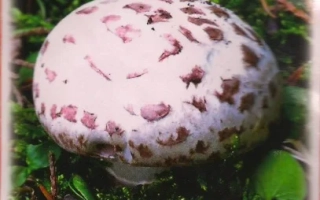
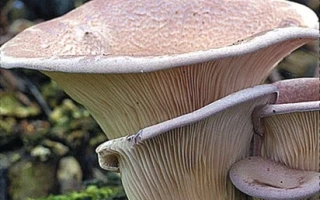
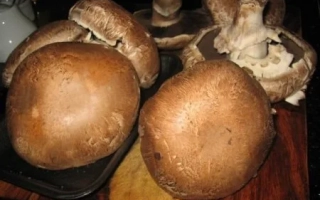
Cap: diameter 4-12 cm, initially spherical, flattened, with curled edge, then convex, with depressed center and curled edges, thick, smooth, matte, dirty-white or ochre-white, sometimes brownish. Gills: frequent, free, initially dirty-pink, then brown and brownish.
Stem: 3-8 cm long and 1-3 cm in diameter, straight, dense, white. Ring — double, with curled edges, located at the middle of the stem. Flesh: thick, dense, fleshy, white, slightly pinkish when cut, with pleasant mushroom aroma.
The Two-ringed Mushroom is cultivated when it is difficult to maintain the temperature required for cultivating the Two-spored Mushroom, or when cultivating the Two-spored Mushroom is difficult due to viral diseases. Cultivation of the Two-ringed Mushroom is less profitable than that of the Two-spored Mushroom, due to a longer cultivation cycle and lower yield. The Two-ringed Mushroom is often used as a substitute for the Two-spored Mushroom in some cases.
Mushroom growers in Western Europe replace one species with another annually during summer. In summer, the yield of the Two-ringed Mushroom is slightly higher than that of the Two-spored Mushroom. This is somewhat like a "crop rotation" that reduces losses from viruses. The main feature of the Two-ringed Mushroom is that the temperature at each technological stage is approximately 5-10 °C higher than for the Two-spored Mushroom.
Compost is prepared in the same way as for the Two-spored Mushroom, but nutrient additives are not applied at sowing or before covering, as they often reduce yield rather than increase it. Mycelium is introduced at a rate of 5-7 liters per ton of substrate. After mycelium inoculation, the surface is immediately covered with plastic or paper, kept moist. The substrate temperature during mycelium growth should be around 30 °C. The substrate colonization rate is the same as for the Two-spored Mushroom. At this stage, a temperature of 28-29 °C is quite acceptable, while 33-34 °C stops growth, and temperatures of 35 °C and above cause mycelium death. Ventilation is carried out as needed during growth to prevent substrate temperature from exceeding optimal levels. Since the risk of substrate overheating is very high — it is necessary to avoid thick compost layers. The substrate colonization rate is 12-14 days. The mycelial threads of the Two-ringed Mushroom are very fine, barely noticeable, delicate. Therefore, it is important not to miss the time for applying the covering layer.
Sorting is carried out the same way as for the Two-spored Mushroom, ensuring the covering layer thickness is not less than 3 cm. After covering, the covering layer is kept moist, and the substrate temperature is maintained at 30 °C.
One week after covering, the covering layer is loosened. Around this time, the substrate temperature rises to dangerous levels, requiring early intensive ventilation. About 10-12 days after covering, the mycelium penetrates the covering layer completely, and intensive ventilation with fresh air begins to reduce the temperature to 25 °C within one to two days. The Two-ringed Mushroom is less sensitive to excess CO2. According to Dutch researchers, the CO2 requirement of the Two-ringed Mushroom is approximately half that of the Two-spored Mushroom, but each square meter of bed must receive no less than two cubic meters of fresh air per hour.
Fruit formation in the Two-ringed Mushroom also has its own characteristics. The mycelium covers the substrate like down, and it must be watered daily without overwatering. Initially, the beds are only misted with water — this is believed to promote the formation of "button-like heads". When primordia reach the size of large peas, normal watering begins. If primordia turn brown and die or the mushroom's center darkens, this indicates excessive watering and associated bacterial disease.
The first wave of mushrooms appears 22-26 days after applying the covering soil and is the most abundant. Young fruit bodies often have irregular shapes, but these defects disappear later. Mushrooms grow in clusters or groups of fruit bodies, most densely along the edges of the beds. During harvest, the temperature is maintained at 25 °C. It is important to harvest mushrooms promptly. The reason is that the weight of the fruit bodies of the Two-ringed Mushroom increases until the caps open, so early harvesting of young "buttons" results in loss of part of the yield. However, after the cap opens, the gills of the mushroom darken quickly, so harvesting must be done daily, sometimes for 8-9 weeks in a row.
Harvested mushrooms can be stored fresh for 2-3 days longer than Two-spored Mushrooms.