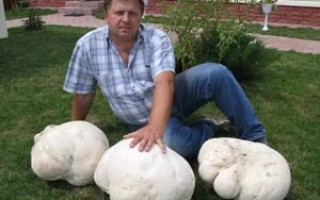
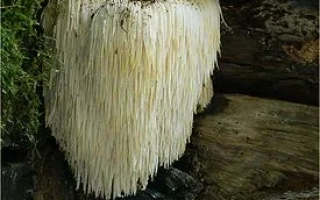
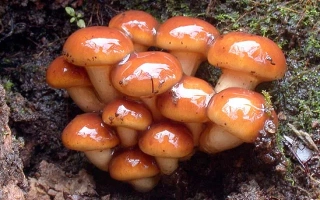
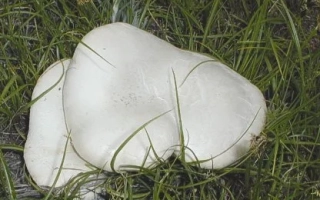
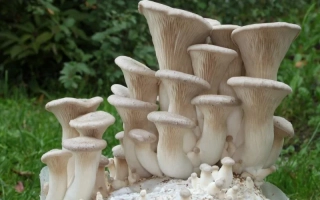
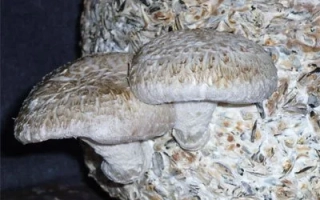
Maitake, Grifola frondosa — a good edible mushroom from the genus Grifola and family Fomitopsidaceae. Fruit body: 20–50 cm in diameter, sometimes up to 80 cm, weighing up to 10 kg, branched, leaf-like, spherical, or oval in shape, divided into numerous lobe-like caps. Cap: small, 3–5 cm, tongue-shaped, lateral, radially wrinkled or fibrous, often irregular, wavy, or lobe-edged, with a thin matte skin of gray, brownish, or grayish-yellow color. Stipe: short, 3–4 cm, lateral or eccentric, fibrous, longitudinally grooved, whitish, fused into a common base. Flesh: elastic, firm, becoming rigid with age, light-colored, with a pleasant sharp odor and sharp taste. Grows rapidly but is listed in Russia's Red Book.
Maitake, English name: maitake; Chinese name: zhu-ling — "ascending star" of mycology, a mushroom whose medicinal properties have been actively studied relatively recently. The Latin name for maitake — "Grifola frondosa" (Grifola frondosa) comes from the name of a mushroom found in Italy. This name refers to the mythical creature griffin — half-lion, half-eagle. The Japanese name "maitake" is associated with its shape, resembling a dancing butterfly. Maitake is one of the most valuable and expensive mushrooms in Asia.
Maitake is widespread in northeastern Japan and China. For hundreds of years, this rare and delicious mushroom has been prized in traditional Chinese and Japanese medicine. Author of books on medicinal mushrooms Kenneth Jones writes that "hunters" of Maitake jealously guarded their collection areas. These collectors traveled alone and concealed the locations of their finds. A mycelium with more than 10 kg of mushrooms was considered a true "treasure island," and its location was even concealed from family. A Maitake hunter might bury his secret location in his grave or whisper it to his son before dying. Indeed, Maitake was collected exclusively in the wild until the mid-1980s.
Professor Takashi Mizuno, one of Japan's leading experts on medicinal mushrooms, notes that some of the earliest references to Maitake as a Chinese medicinal substance appear in the archives of the Han Dynasty (206 BC). In 1995, in his article, Professor Mizuno stated that Maitake was used to improve spleen function, relieve abdominal pain, treat hemorrhoids, and provide a sense of calm.
In recent years, Maitake has become the most widely researched of all herbs and medicinal mushrooms, with numerous publications of research issued by scientists and doctors from various institutes and universities.
In Japan, the Maitake mushroom is called the "geisha mushroom" or "slenderness mushroom," as it helped women maintain excellent shape in ancient times, despite the fact that geishas were required to try all food served by the host. Maitake normalizes carbohydrate metabolism at the liver level. The effect is gradual and long-lasting. Maitake reduces hunger sensation and does not irritate the intestines.
This mushroom protects against hepatitis, suppresses tumors, effectively regulates blood pressure, blood sugar, and cholesterol, and destroys viruses (including the human immunodeficiency virus (HIV)).
It is known that daily use of Maitake extract by healthy individuals strengthens their immune system and significantly reduces the risk of cancer due to its protective mechanisms, helping to reduce the impact of carcinogens and the threat of tumor development, but often the mushroom is the only hope when all other treatments prove ineffective.
Maitake's anti-tumor action is very powerful. The problem with any malignant tumor is that cancer cells do not want to die. They want to live forever and spread throughout the body. In the Maitake mushroom, beta-glucan named Gri-fon-D has been found. This polysaccharide has a unique structure and belongs to the most powerful among the studied polysaccharides to date, activating the body's anti-tumor defense.
Cultivating Maitake on wood: cut logs (deciduous species) into segments up to 1 meter long and 10–20 cm thick. Use fresh wood cut within a month prior to inoculation. Drill holes 4–5 cm deep and 2 cm in diameter into the logs. Wear sterile gloves, insert mycelium into the holes, and cover with bark pieces, sawdust, or moss. Then wrap the log in transparent plastic, making ventilation holes, and place it in a dark, humid room. After the mycelium has colonized the logs, soak them in cold water for 12 hours, then stand them upright. For subsequent fruiting, soak them again every 30–40 days after harvest. Mycelium grows at temperatures of 13–27°C and relative humidity of 78–85%. Cultivation on stumps is similar to cultivation on wood.