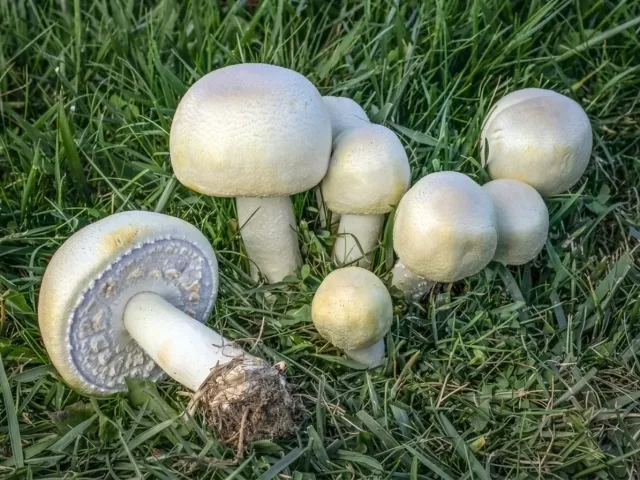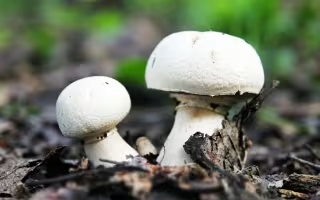
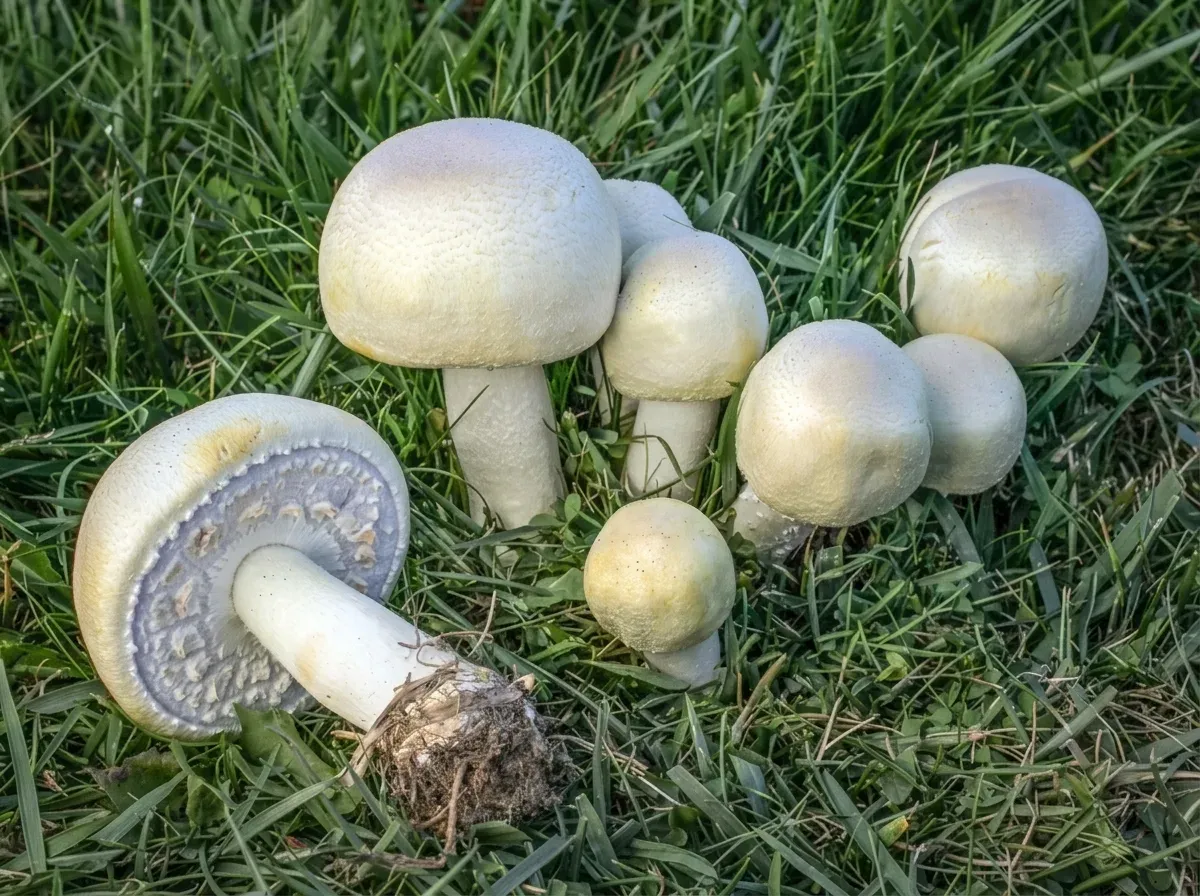
Garden Mushroom, Agaricus bisporus — a species of mushroom from the genus Agaricus. Cap 3-8 cm in diameter, round, with curled edge and remnants of partial veil on it in the form of thin flakes, from almost white to brown. Cap surface smooth, often glossy or radially fibrous in the center, may be scaly. Flesh dense, succulent, turning pink or red when cut. Young gills rose-colored, mature ones dark brown with purple tint. Stipe 3-10 cm tall, 3-4 cm wide, smooth, cylindrical, filled or nearly hollow, with well-defined ring.
Mushrooms account for 75-80% of global mushroom production. They are cultivated in more than 70 countries worldwide, with the United States being the leading producer (about 25% of global production). France is second (200,000 tons/year), where mushrooms have been cultivated for several centuries. Mushrooms are also cultivated on a large scale in countries such as the United Kingdom, the Netherlands, Poland, South Korea, and Taiwan.
Cultivation facilities for mushrooms can be either newly built or adapted.
Newly constructed facilities must ensure good air circulation, allow control of air temperature and humidity, withstand multiple chemical or thermal disinfections, and provide comfortable working conditions. In Southeast Asia, there are known cases of chambers being burned after one cultivation cycle for disinfection purposes.
Adapted facilities for mushrooms include basements, shafts, bomb shelters, barns, etc.
Historical information about mushroom cultivation dates back to the 17th century. In Italy, they collected turf with mycelium from pastures and planted it on beds in well-fertilized soil. Then, the method of closed cultivation gained widespread use, with abandoned quarries being used as facilities, where optimal temperature and humidity were naturally maintained year-round. The Italian mushroom cultivation technique spread to neighboring countries — Switzerland and France, and by the mid-17th century, it was already widespread near Paris, as evidenced by the "Guide to Gardening" of 1652. In the 18th century, this culture spread to other European countries. In 1707, French botanist J. Tournefort described rules for mushroom cultivation, and from 1754, descriptions of mushroom cultivation in greenhouses in Sweden are known. By the end of the 19th century, extensive monographs on this mushroom had already been written.
Mushrooms arrived in Russia in the mid-18th century, most likely cultivated by individual enthusiasts. In 1780, an article by A. T. Bolotov titled "Something about Mushrooms" was published in the journal "Economic Bulletin." In the 1820s, industrial cultivation emerged, and the first mushroom houses in Russia were built by peasant Osinin. The renowned horticulturist and innovator E. A. Grachev took up mushroom cultivation and, starting in 1848, developed his own methods, which were published in 1860-1861 in the "Bulletin of the Russian Society of Horticulture." Grachev's method, specifically developed for the Russian north, is still applicable today. [2].
In 1893-1894, the Pasteur Institute developed methods for obtaining sterile mushroom mycelium, and by 1924, most producing countries had their own laboratories for producing sterile mycelium. Selection work began, and pure mycelium strains were developed. In the 1970s, mushroom cultivation was known in more than 30 countries.
Initially, it was long believed that cultivated mushrooms were a variety of the common mushroom (Agaricus campestris), widely distributed in nature, but in 1906, significant differences were discovered, and later, a separate species, Agaricus bisporus, was described. This species was not known in nature, and it was believed that the new species arose during cultivation. However, in the 1930s, wild Agaricus bisporus were discovered. The spread of this particular species in cultivation can be explained as follows: the wild mycelium used for cultivation contained several closely related species growing under similar natural conditions. Besides Agaricus bisporus, "on the beds" came species such as Agaricus bitorquis and Agaricus subperonatus, but they were gradually displaced by Agaricus bisporus, as they grow significantly worse on composted manure.
Mushrooms are considered a valuable edible fungus, used fresh, for frying, boiling, canning, salad preparation, and pickling.
Dried mushrooms and their powder are used to prepare pies, soups, etc.
Cultivation in rooms, in boxes or plastic bags: a 10-12 cm layer of soil is spread on the bottom, mycelium is sprinkled, then covered with compost at least 20 cm deep. In bags, where fruiting bodies have appeared, cuts are made.
Mushrooms are grown indoors at temperatures of 12-30°C with natural or forced ventilation.
For sowing, ready-made or previously prepared compost is used. Compost composition: dry, unspoiled straw — 12 kg, poultry manure, horse or cow manure (fresh) — 8 kg. Preparation time 22-26 days. The sign of compost readiness is the disappearance of ammonia odor.
Fresh manure (preferably horse, 7-15-day-old), chopped straw (previously soaked for 2-3 days), are mixed. All components are moistened and piled into a heap, compacted. On the 4-5th day, the heap is turned over. Turning is repeated 5-6 times until the manure becomes soft and the straw takes the form of a brown, easily crumbly mass.
The moisture content of the finished compost should be 65-70%, and pH 7.0-7.5. Compost can be prepared quickly in 3-4 days. A mixture of straw, beer waste, peat, and lime (10:10:10:1) moistened to 70% is thoroughly mixed and pasteurized with steam (temperature 60-65°C). The next day, temperature is reduced to 53-55°C, and on the 3-4th day — to 22-25°C. Then, mycelium is sown, mixed with compost. The prepared mass is placed in containers (boxes, plastic bags) and compacted. Throughout the period, moisture is monitored. After several days, white threads will appear penetrating the substrate. At this point, the substrate should be covered with soil mixed with peat in a 1:1 ratio, 2.0 cm thick.
Boxes or bags are kept in a dark place, maintaining air temperature at 18-20°C and compost temperature at 25-27°C. After approximately 20-30 days, the first mushrooms will appear. At this point, temperature is lowered to 14-16°C, and relative air humidity should be no less than 85%. Fruiting occurs in waves and lasts for 6 weeks.
Cultivating Garden Mushroom on a home plot: prepare soil area of 2.5 — 3 m2, loosen it, sow mycelium (in holes 5-7 cm deep, spaced 15-18 cm apart). Spread compost 5-7 cm deep on top. Water by drip irrigation, temperature regime 16-29°C. Fruiting begins after 2-2.5 months. After mycelium spread (12-15 days), cover the mycelium with garden soil 2 cm high. Once a year, spread a 1.5-2 cm layer of manure or dry plant residues over the mycelium as fertilizer.