Shiitake "TL-4080" is a tasty, edible mushroom that can (and should) be eaten raw or topped with sour cream and salt, as a salad. It possesses medicinal properties and is successfully used in medicine.
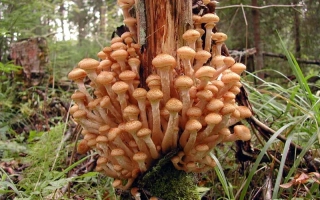
Grows on dead wood of broad-leaved trees, mostly from the beech, oak, chestnut families, and others.
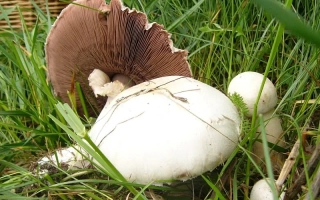
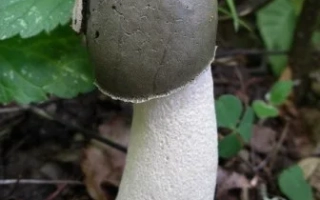
Cap: 5-20 cm in diameter, convex and flattening as it matures, dark brown, lightening with age.
Edges are even, then curl and flatten, often wavy in mature mushrooms.
Gills: white, smooth in young mushrooms and toothed when mature. In young mushrooms, the gills are covered by a thin membrane that extends from the stem to the cap's edge. During maturation, the spore covering ruptures, leaving remnants visible as fringes on the cap's edge and stem.
Stem: fibrous, central or slightly eccentric.
Flesh: thick in the cap's center, slightly thinning toward the edge, turning brown upon damage. Stem flesh is fibrous and white in young mushrooms, brown in mature ones, and dark brown in overripe ones.
When cultivating shiitake mushrooms, the following compost formulations are used:
Variant 1. Fresh, unrotted, dry straw — 12 kg, fresh poultry manure — 8 kg, preparation time — 24-26 days.
Variant 2. Fresh, unrotted, dry straw — 12 kg, fresh horse manure — 8 kg, preparation time — 22-24 days.
Variant 3. Fresh, unrotted, dry straw — 12 kg, fresh cow manure — 8 kg, preparation time — 23-25 days.
Compost preparation: layering straw and manure to form a pile (bur). After layering, the pile is watered daily, without allowing it to dry out, and no waterlogging is required. Turn the pile 4-5 times during the entire substrate preparation period so that the outer layers are inside and the inner layers are outside.
Readiness of the substrate is indicated by the absence of ammonia odor. Ready compost is laid in rows (open ground) at a layer of at least 10 cm, in boxes and polyethylene bags at a layer of at least 20 cm. Variant 4 (no preparation required): 20 kg of mature manure (manure aged over a year, without ammonia odor) of any type except swine.
Planting rate: Planting depth 5-7 cm. Inoculate with mycelium in holes spaced 15-18 cm apart. During mycelial colonization, the bed is covered with straw or burlap to prevent drying. After mycelium colonization (12-15 days), cover the compost surface with a topsoil layer (soil mixed with peat at a 1:1 ratio or regular garden soil) 2 cm thick (6-7 kg).
Fruit production: Optimal temperature range 16-29°C, light regime day-night or 4 hours daily in closed spaces, favorable air humidity should be no less than 85% (if necessary, use drip irrigation). First mushrooms appear approximately 20-30 days after planting. Fruit production occurs in waves and lasts 6 weeks, with intervals between waves of 7-10 days.
Yield: 18 kg per three waves. Usage rate: one package is sufficient for 20 kg of compost. Cultivating shiitake mushrooms on a homestead plot. On open plots, they grow in shaded areas, partial shade under trees, shrubs, raspberry bushes, strawberry beds, on the shaded sides behind buildings or fences, where direct sunlight cannot harm them. Soil on S=2.5-3 m² should be loosened. During this process, weed plants and grass roots, if they do not harm other crops, do not need to be removed. Sow mycelium on the loosened surface. Then evenly spread compost to a layer of 5-7 cm. The mycelium will begin fruiting after 2-2.5 months, during which no visible changes on the soil surface will be noticed. Fruit production lasts from early spring to late autumn.