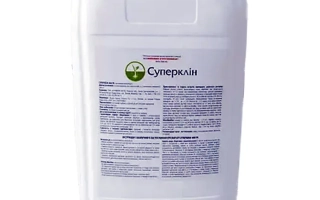
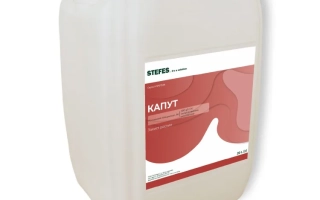
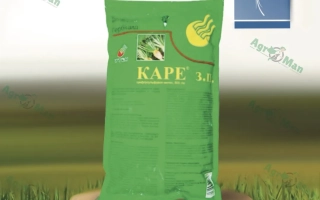
Selective post-emergence herbicide for controlling annual broadleaf and some perennial weeds on cereal and corn crops
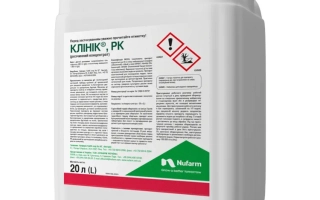
Active ingredient: 2-ethylhexyl ester of 2,4-D, 850 g/l, acid equivalent — 564 g/l
Formulation: concentrate emulsion
Packaging: 5 L, 20 L canisters
Mode of action
The active ingredient penetrates the plant through its above-ground parts and is actively distributed throughout all organs. In sensitive weeds, it stops chlorophyll biosynthesis, leading to inhibition of photosynthesis. By acting on meristematic tissues, it disrupts weed growth and development, causing leaf and stem curling, root thickening, softening and becoming watery, cracking, and dying. Plants lose turgor, leaves lose color and turn yellow.
Features and advantages
— The active ingredient in the form of 2-ethylhexyl ester of 2,4-D is rapidly absorbed by plants, so rain within 1 hour after application practically does not affect the herbicide's efficacy.
— High selectivity for crops when application guidelines are followed.
— Compatible with most pesticides and liquid fertilizers, however, compatibility of each individual component must be checked in each case.
Application recommendations
The product is applied via ground spraying during the tillering stage up to emergence for cereal crops, and during the 3–5 leaf stage for corn. Maximum efficacy is observed when applied during active weed growth — stage 2–4 leaves for annual broadleaf weeds and rosette stage for perennial broadleaf weeds. Optimal temperature for spraying is +12…+20°C. Spraying is prohibited if wind speed exceeds 3–4 m/s. First visible signs of herbicide action (chlorosis, loss of turgor, stem deformation) appear 2–5 days after application.
To prepare the working solution, fill the sprayer tank halfway with water, activate the mixing mode, add the required amount of herbicide. Then add water to full capacity while the mixing mode is active. Working solution application rate: 200–400 L/ha.
To effectively control 2,4-D resistant weeds, the herbicide should be applied in tank mixes with products from the group of sulfonylureas.