


SKU #4377
·
226 views
Currant Volodinka (Autumn Joy)
Currant
Prices in stores
No offers yet — stores have not added prices for this product yet.
Similar varieties with prices
-
Malenkii Prints
from 2.97 €
-
 Tamerlan
from 1.19 €
-
 Selychenaya
from 1.12 €per seedling
-
 Sibilla
from 0.63 €per seedling
Type of Variety
Blackcurrant
Your mark
0 votes
0% positive ratings
Description
Medium-maturing variety, developed at Pavlovsk Experimental Station of the VNIIS named after N.I. Vavilov from crossing the varieties Golubka and Ojebyn. Authors: E.V. Volodina, S.P. Хотимская, N.N. Khabarova. Included in the State Register of Varieties approved for use in the Northwest region in 1996.
Medium-height, wide, spreading, moderately dense bush. Growing shoots are medium, green, hairless, woody — medium, straight or slightly curved, gray-brown with brown tips, smooth, shiny, hairless. Buds are solitary, large, egg-shaped, pointed at the apex, bright, pinkish-purple, densely hairy; apical bud is non-free (with nearly equal-sized 2-3 adjacent buds), cylindrical, blunt-tipped, large.
Leaf five-lobed, medium, intensely green with slight gloss, with bronzy tinge in upper part of shoot, slightly wrinkled or smooth, soft, herbaceous, with very sparse hairs along main veins on both sides of leaf, positioned at acute angle to shoot. Main veins are uncolored. Central lobe is small, triangular with sharp apex, additional lobes are weakly expressed. Side lobes are long, egg-shaped, with sharp tips directed sideways, angle between their veins is obtuse. Basal lobes are distinctly expressed, rounded, with veins directed toward petiole. Base is open, rounded, medium depth. Teeth are blunt, large-toothed, shallow, with short "claw". Petiole is medium length, hairless, colored along entire length or only at base of leaf.
Flowers are small, cup-shaped, pink. Sepals are triangular, narrow, with strongly elongated and pointed apex, magenta when unfolding, later paler, pinkish, twisted, freely positioned. Petals are uncolored, slightly inclined towards pistil. Stigmas are practically at same level as anthers. Ovule is smooth, hairless, with numerous glands. Inflorescences are solitary, medium length (5.2 cm), containing 5-9 berries. Inflorescence axis is medium, with medium berry placement, concentrated mostly in middle, light-green, shiny, hairless. Pedicels are medium and thin, green, hairless.
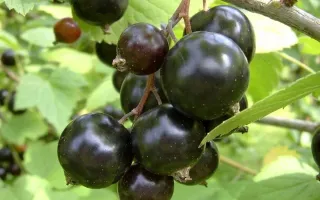
Berries are medium (0.8-1.0 g), round, black with waxy coating, smooth, thin-skinned with dry detachment, with medium number (34) of medium-sized seeds. Receptacle is very small, falling off. Taste is sour-sweet (3.9 points), refreshing, pleasant. Berries are versatile. Chemical composition: dry matter — 16.4%, total sugars — 6.6%, titratable acidity — 2.9%, ascorbic acid — 169.6 mg/100 g, P-active substances — 429.6 mg/100 g, pectic substances (on fresh weight) — 1.0%.
Highly winter-hardy (in winters with sharp temperature fluctuations, flower buds in mixed buds may freeze), early-bearing, self-fertile (52.4%), resistant to powdery mildew and leaf spot diseases, affected by bud mites at medium level, average yield 3.0-4.0 kg/plant.
Advantages of variety: high productivity, high resistance to fungal diseases.
Disadvantages of variety: small berries, slightly sour taste, insufficient resistance to bud mites.
Crop & resistance
Crop
Disease resistance
Specifications
| Type of Variety | |
|---|---|
| Catalog | Catalog → Currant |
No reviews yet. Be the first to share your experience.
Alternatives
Currant saplings · similar varieties


See also
Often considered together with this variety



Recently viewed
Products you’ve viewed on this site
Reviews