


SKU #4367
·
239 views
Bolero
Currant
User rating
0 votes0% positive reviews
No ratings yet — be the first.
Type of Sort
Blackcurrant
Store offers · 3 from 3 stores
Prices are updated on loadLoading offers…
Available at: РамПитомник · Сады Семирамиды · Царь Сад · Yaskrava Klumba
Aggregator catalog: prices are collected automatically from store websites, normalized by AI and converted at the current exchange rate. Before ordering, confirm the price and availability on the store's website. This block is not indexed by search engines — the data is loaded after the page opens.
About product

Medium-ripening variety, obtained at Pavlovsk Experimental Station of the VNI Россельхоз, N.I. Vavilov Institute, from crossing of varieties Ojebyn and Minay Shmyrev. Breeders: E.V. Volodina, S.P. Khotimskaia, O.A. Tikhnova. Under state variety testing since 2008.
Medium-height, moderately spreading, dense bush. Growing shoots are slightly hairy, green and pinkish. Anthocyanin coloration is we…
Type of Sort
Blackcurrant
Description
Medium-ripening variety, obtained at Pavlovsk Experimental Station of the VNI Россельхоз, N.I. Vavilov Institute, from crossing of varieties Ojebyn and Minay Shmyrev. Breeders: E.V. Volodina, S.P. Khotimskaia, O.A. Tikhnova. Under state variety testing since 2008.
Medium-height, moderately spreading, dense bush. Growing shoots are slightly hairy, green and pinkish. Anthocyanin coloration is weak and unevenly distributed along the shoot. Woody shoots are thick, straight or slightly curved, gray-brown or beige with brown tips, slightly hairy, with weak tapering towards the tip. Buds are solitary, large, egg-shaped with pointed tips, pink, distant, hairy, apical bud is non-free, cylindrical or egg-shaped with blunt tip, leaf scar shape is rounded or rounded-triangular.
Leaf is five-lobed, large, dark green with bluish tinge, shiny, dense, wrinkled, with small folds at the junction of central and lateral lobes, rarely hairy along veins on upper and lower surfaces, with denser hairs in the leaf stalk notch area on the upper side. Leaf blade is nearly straight or broadly concave, positioned at an acute (45°) angle to the shoot. Central lobe is large, broadly egg-shaped, with a pointed and forward-projecting tip and weakly expressed, often asymmetric additional projections. By autumn, the tip of the central lobe bends downward. At the junction of the central lobe with lateral lobes, there is a slight rounding — 'waist'. Lateral lobes are large, directed toward the leaf tip, broad, egg-shaped, with pointed and slightly curled tips, veins directed at right angles or rarely obtuse angles. Basal lobes are distinct, large, with raised edges, veins spread out or directed toward the leaf stalk. Base of leaf blade is open, medium depth, rounded to triangular, often with a wide cleft notch. Teeth are sharp, serrated, and doubly serrated, wide with curled 'claw'. Leaf stalk is colored on growing shoots, predominantly green on mature leaves, with anthocyanin spots at the base of the stalk and leaf base. By autumn, some shoots develop bright anthocyanin coloration along the entire length of the stalk.
Flowers are large, cup-shaped with widened base, slightly pinkish. Sepals are egg-shaped with rounded tips, weakly unevenly anthocyanin-colored, curled or twisted, hairy. Petals are spatulate, separate, greenish or greenish-white with barely noticeable pink stripes. Ovary is hairy, uncolored. Inflorescences are medium length (6.0 cm) and long (10.1 cm), medium density, contain 6-11 (up to 14) berries. Inflorescence axis is medium and thick, with distinct tapering toward the tip, green, hairy in upper part. Inflorescence pedicel is short. Berry stalks are long, thick, slightly hairy, green or with 'tan' color.
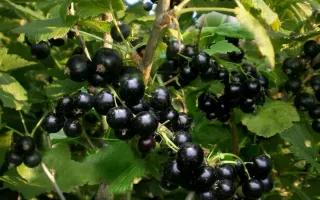
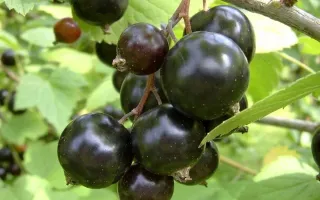
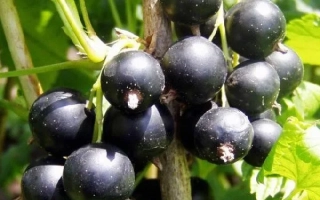
Berries are very large (1.6-2.4 g), round and oval, black, smooth, with weak gloss, medium number of fairly large seeds, thin skin, dry detachment. Receptacle is small, closed, semi-deciduous but dense, fused with flesh. Taste is sour-sweet (4.4 points), pleasant. Berries are versatile. Chemical composition: dry solids — 19.1%, titratable acidity — 3.1%, ascorbic acid — 115.4 mg/100 g, P-active substances — 236.4 mg/100 g, pectin substances (on fresh weight) — 1.0%.
Winter-hardy variety, self-fertile (56.8%), resistant to powdery mildew and anthracnose, slightly damaged by bud mite, productive (2.0 kg/plant).
Advantages of the variety: high self-fertility, large berry size, resistance to fungal diseases.
Disadvantages of the variety: berry skin may rupture upon overripening.
Crop & resistance
Crop
Disease resistance
Pest resistance
Specifications
| Type of Sort | |
|---|---|
| Catalog | Catalog → Currant |
Not yet комментариев. Be the first!
Alternatives
Currant saplings · similar varieties





See also
Often considered together with this variety




Recently viewed
Products you’ve viewed on this site
Reviews · 0