
How can a farm diversify its income and avoid depending on selling a single type of product?
How an agricultural enterprise can reduce its dependence on raw material sales through in-house feed production and primary nut processing.
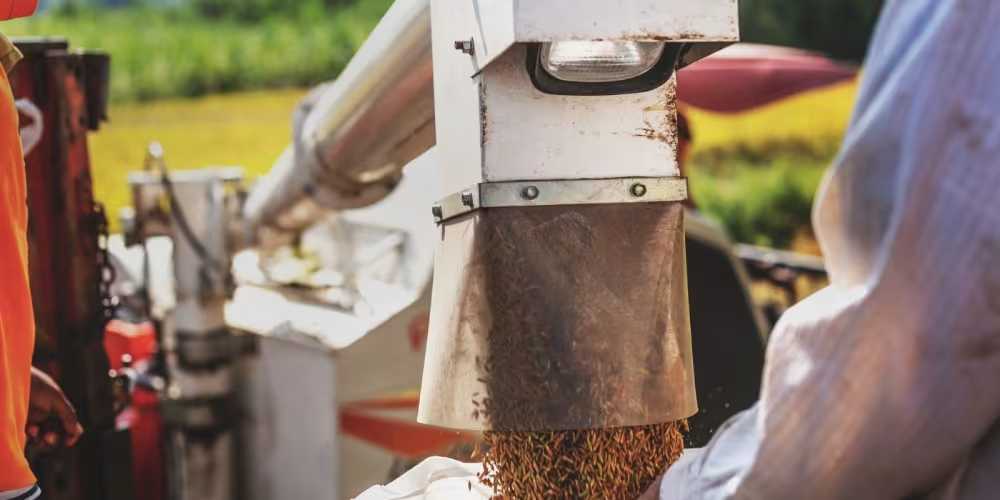
In August 2026, Ukrainian grain exports slowed down noticeably. Over 21 days of the month, 539 thousand tons of grain and leguminous crops were exported, compared to 1.733 million tons over almost the same period last year. For an agricultural enterprise, this is another reminder that harvest income depends not only on how much was harvested. Under such conditions, farms have more reasons to evaluate not just the sale of raw materials, but also options for using them within the farm itself.
Grain can be used for more than just sales
If part of the harvest remains on the farm, a feed granulator makes it possible to include the grain in in-house feed production. But first, you need to determine what volume of raw materials will actually go into processing.
There are three basic scenarios for grain:
sell it after harvesting;
keep it for your own needs;
process it into feed products.
In the TMS Agro catalog, the difference in scale is clearly visible in specific models. The 220V GKM-100 has a capacity of up to 40 kg/h, while the 380V KORMOTEX-260 reaches up to 700 kg/h. Between them are models with 150 and 200 mm dies, including the ROTEX-200. Therefore, equipment is selected to match the actual raw material flow, not the other way around.
When in-house feed production becomes a separate line of business
The scale of in-house granulation is determined by the volume of grain, the need for finished feed, and the regularity of production. First, they calculate how much raw material the farm will process monthly and where the finished feed will go.
The calculation can be structured as follows:
grain volume → feed requirement → equipment capacity → operating hours → additional operations.
The last item is easy to overlook. A granulator presses a prepared feed mixture, but it does not replace the entire processing line. Before granulation, grain must be crushed, and components must be dosed and mixed. Therefore, a single machine does not yet mean a ready-made feed workshop.
Diversification begins with what the farm already has
A new direction does not necessarily start with a new crop. First, it is worth evaluating what raw materials the farm already produces and in what form it sells them. Grain can be sold or partially kept for in-house feed production. Nuts can be sold in shells or have a cracking operation added to the process.
Other products can be sorted, cleaned, or prepared for further processing. This approach makes it possible to gain additional value without radically changing the farm's structure. An additional operation makes sense if there is enough raw material for it, the equipment is regularly loaded, and the finished product has a specific use or sales channel.
Nut orchard: selling raw materials or adding primary processing
For a farm with its own nut orchard, mechanization of cracking makes it possible to process part of the harvest for further sorting and kernel sales. If this operation is repeated throughout the season, you can buy a nutcracker with a capacity matching the actual batch volume. For a small farm, the 220V GRK-200 with a capacity of up to 200 kg/h is suitable, while for larger volumes, the GRK-300 with up to 300 kg/h can be considered.
Both models work with walnuts and hazelnuts, and the gap between the shaft and the plate is adjustable to the size of the raw material. Preliminary calibration helps improve cracking quality, but after the equipment operates, sorting and kernel quality control are still necessary.
How to understand which direction to launch
Before buying equipment, it is more useful to calculate the raw material flow than to simply compare machine prices.
What to check | Why it is needed |
Volume of own raw materials | Shows potential loading |
Volume of finished product | Helps select capacity |
Number of operating hours | Shows machine utilization |
Additional operations | Reveals the need for other equipment |
Channel of use or sale | Shows where the products will go |
For a granulator, what matters is not the entire harvest, but the portion of grain that will actually go into feed; for a nutcracker, similarly, the calculation is based not on the orchard area, but on the volume of nuts for cracking. After this calculation, you can already compare models by capacity, power supply, and configuration: TMS Agro offers 220V and 380V models for granulators, and the manufacturer provides a 12-month warranty for proven granulator and nutcracker models.
"A typical mistake occurs when the machine's capacity is chosen first, and only afterwards do they think about what to load it with. The calculation must proceed from the actual volume of raw materials and the number of operating hours," notes a TMS Agro expert.
When a single harvest works in multiple directions
For a farm, the difference between one and multiple sources of income begins even before the harvest is sold. If all grain leaves the farm as raw material, the season's result is tied to a single market and a single price. When part of it remains for feed and part undergoes primary processing, other options appear. Not every one of them will necessarily bring in more money. But the farm can now decide what to sell, what to process, and what to use in its own production, instead of having to find a buyer for the entire harvest at once.
Editorial team agronom.info
Materials are prepared by the portal's agronomists and editors. We use only trusted sources: Ukrainian agricultural universities, variety registries, open scientific publications.
Related articles
Why a good walnut harvest does not yet mean good earnings
A New Era of Agricultural Packaging: How the PPWR Regulation Gives the Green Light to Paper Bags from "Paper Pak"
How automatic dosing helps reduce overfill and speed up the packaging line
Not yet comments. Be the first!
Comments · 0