
Why a good walnut harvest does not yet mean good earnings
We break down why the volume of harvested walnuts does not equal profit: preparation, cracking, and kernel yield affect the farm's final income.
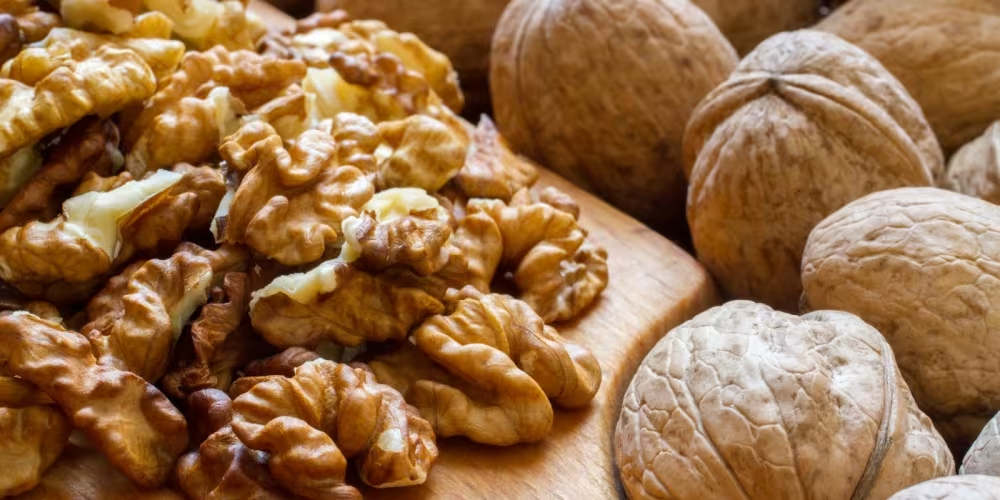
For a small walnut farm, a successful season doesn't end after harvesting. The crop still needs to be dried, prepared, and a decision must be made on how to sell it. One option requires minimal processing, while another adds new operations and costs. Therefore, the same amount of harvested walnuts can bring completely different incomes. If the farm plans to sell kernels, nut crackers become just one part of this calculation.
Sell in the shell or go further
Selling in the shell makes sense if the farm is not ready to spend money on further processing or has a stable buyer for whole nuts. This option reduces the number of post-harvest operations. There is no need to organize cracking and kernel selection. At the same time, the farm sells a product with a minimal degree of preparation.
Processing becomes more interesting when there is a sufficient volume of nuts and a sales channel for the kernels. But a higher price per kilogram does not yet mean greater earnings. Part of the difference is eaten up by cracking, sorting, and labor. Therefore, both options must be compared based on the income from the entire batch.
Cracking can eat up profit through manual labor
With a few bags, the duration of manual cracking doesn't seem critical. With a batch of several hundred kilograms, the situation is different. Every extra hour increases the costs of preparing the kernel for sale. Therefore, one must calculate not only the product yield, but also the time required to process the entire volume.
For comparison, the GRK-50 has a declared productivity of up to 50 kg/h, and the GRK-300 up to 300 kg/h. They can process a 300 kg batch in approximately six and one hour, respectively. The difference is five hours on a single batch. If there are ten such batches per season, the difference already grows to 50 hours of equipment operation.
"Productivity needs to be correlated with the volume of nuts and the timeframe within which the farm plans to process them. The larger the seasonal batch, the more important it is to select equipment that will allow it to be processed within the required deadline," explains a TMS Agro expert.
Cracking quickly is not enough: earnings depend on the result
A batch can be quickly run through equipment, but that doesn't mean the processing will be successful. After cracking, part of the kernel remains whole, and part is broken into smaller fractions. For sales, this difference matters. Therefore, along with productivity, you need to look at what kind of kernel you get in the end.
For the GRK-50 and GRK-300, the manufacturer claims a "butterfly" yield of up to 60%. After proper nut calibration, this figure can reach 90%. This is not a guaranteed result for any given batch. Nuts of different sizes crack differently, so the uniformity of the raw material directly affects the number of whole halves.
When processing truly adds value to the harvest
Processing makes economic sense when the additional value of the finished product covers the costs between harvesting and selling. For this, it is better to compare two scenarios for the same batch.
Parameter | Sale in the shell | Sale after cracking |
Preparation | Minimal | Processing required |
Labor | Fewer operations | Cracking and sorting |
Equipment | Not needed for cracking | Depends on volume |
Product yield | Nut weight | Actual kernel yield |
Sales | Price per kg of nuts | Price of the respective fraction |
Result | Income from the batch | Income minus processing costs |
The working calculation here is simple: additional income from the processed batch minus the costs of its processing. If the difference is small or negative, a more expensive kernel does not yet mean a better financial result.
For different crops, costs arise at different stages
Harvesting the crop does not yet mean getting a ready-to-sell product. Walnuts after harvesting must be cracked and sorted if the farm plans to sell kernels. For pumpkin seeds, the main work is arranged differently. The seeds need to be separated from the pulp right during harvesting.
For this, the Triumf - 2000 pumpkin harvester crushes the fruits and separates the seeds from the pulp directly during harvesting. The productivity declared by the manufacturer is up to 2 hectares per day. That is, the costs between the grown harvest and the finished product do not disappear anywhere. It's just that for different crops, they fall on different stages of work.
Crop kilograms do not yet show earnings
A large harvest gives the farm kilograms of production, but does not guarantee the same increase in income. For walnuts, the result is decided even after harvest: in what form to sell the batch, how much its preparation will cost, and how much time manual labor will take. Therefore, one must calculate not only the yield, but also the cost of bringing the harvest to a marketable product.
Editorial team agronom.info
Materials are prepared by the portal's agronomists and editors. We use only trusted sources: Ukrainian agricultural universities, variety registries, open scientific publications.
Related articles
How can a farm diversify its income and avoid depending on selling a single type of product?
A New Era of Agricultural Packaging: How the PPWR Regulation Gives the Green Light to Paper Bags from "Paper Pak"
How automatic dosing helps reduce overfill and speed up the packaging line
Not yet comments. Be the first!
Comments · 0