
Plant Rhabdovirus
Rhabdovirus
The causative agents are viruses of the Rhabdoviridae family, recognized by their distinct bacilliform or bullet-shaped morphology. These pathogens contain a single-stranded negative-sense RNA genome enclosed in a lipid envelope.
What the section contains
Plant Rhabdovirus
These viruses replicate within the cytoplasm or nucleus of the host plant cell, utilizing the plant's metabolic machinery to synthesize viral proteins and assemble new virions.
Transmission occurs primarily through specific insect vectors, most notably leafhoppers, aphids, and planthoppers, which acquire the virus while feeding on infected plant tissues.
Rhabdoviruses exhibit a persistent type of transmission, meaning they circulate within the vector's body and can be transmitted throughout the insect's lifespan after an incubation period.
These viruses are known to infect a wide range of economically important crops, including cereals, vegetables, and ornamental plants, causing systemic infections that affect the entire plant physiology.
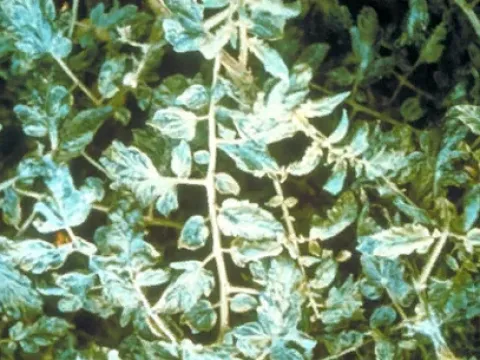
Symptoms of rhabdovirus infection often manifest as chlorotic mosaic patterns, leaf yellowing, and significant stunting. Plants may exhibit reduced growth rates compared to healthy specimens.
Morphological changes are common, such as leaf curling, wrinkling, or the development of abnormal, deformed structures. Shortening of internodes can lead to a bushy or rosette-like appearance in infected plants.
Cereal crops often show tip necrosis and reddening of the leaves. Infected plants may fail to produce grain, or the grains produced are shriveled and have poor germination potential.
- Chlorosis and mosaic leaf discoloration.
- Severe growth retardation and stunting.
- Leaf deformation, curling, and abnormal shape.
- Reduced vigor and physiological stress.
- Deformed fruits or lack of reproductive yield.
The root system of infected plants is often poorly developed, which impairs the plant's ability to uptake water and nutrients, making the infection visible even in the early stages of development.
The prevalence of rhabdoviruses is heavily dependent on the population dynamics of their insect vectors. Warm and dry weather conditions generally favor the reproduction and spread of leafhoppers and aphids.
The presence of perennial weeds around field margins acts as a reservoir for the virus, allowing it to survive between growing seasons and infect new crops as insect vectors migrate.
High planting density combined with inadequate weed control creates an environment where vectors can easily move between plants, facilitating rapid spread of the disease throughout the field.
Plant stress, often caused by drought, nutrient imbalance, or soil salinity, makes crops more susceptible to vector infestation and reduces their natural defense responses against viral pathogens.
Temperatures optimal for plant growth are also ideal for viral replication, meaning the infection can progress rapidly during the peak of the growing season.
Rhabdoviruses cause significant yield losses, often ranging from 30% to 70% in susceptible cultivars, directly impacting the profitability of agricultural enterprises.
Beyond quantity, the quality of the harvested produce is severely degraded, with fruits and seeds becoming unmarketable due to discoloration, deformity, or reduced size.
Infected crops are highly vulnerable to secondary infections from fungi and bacteria because the viral attack weakens the plant's structural integrity and overall immunity.
Degeneration of planting material is a major issue in vegetatively propagated crops, where viruses accumulate over time, leading to a progressive decline in yields season after season.
The cost of implementing intensive control measures to manage vector populations adds significant overhead to production, and in severe cases, entire field sections may be lost.
The primary control strategy involves systematic management of insect vector populations using selective insecticides applied during the critical migration periods.
Maintaining weed-free fields and buffer zones is essential to eliminate reservoirs where both the virus and its vectors can survive and reproduce during the off-season.
Adhering to spatial isolation protocols, where susceptible crops are grown at a distance from known infection sources, helps reduce the risk of vector-mediated transmission.
The use of certified virus-free seed or propagation material is the most reliable way to prevent the introduction of rhabdoviruses into a clean growing environment.
Developing and deploying resistant or tolerant cultivars through modern breeding programs remains the most sustainable approach for managing rhabdovirus threats in large-scale agriculture.